
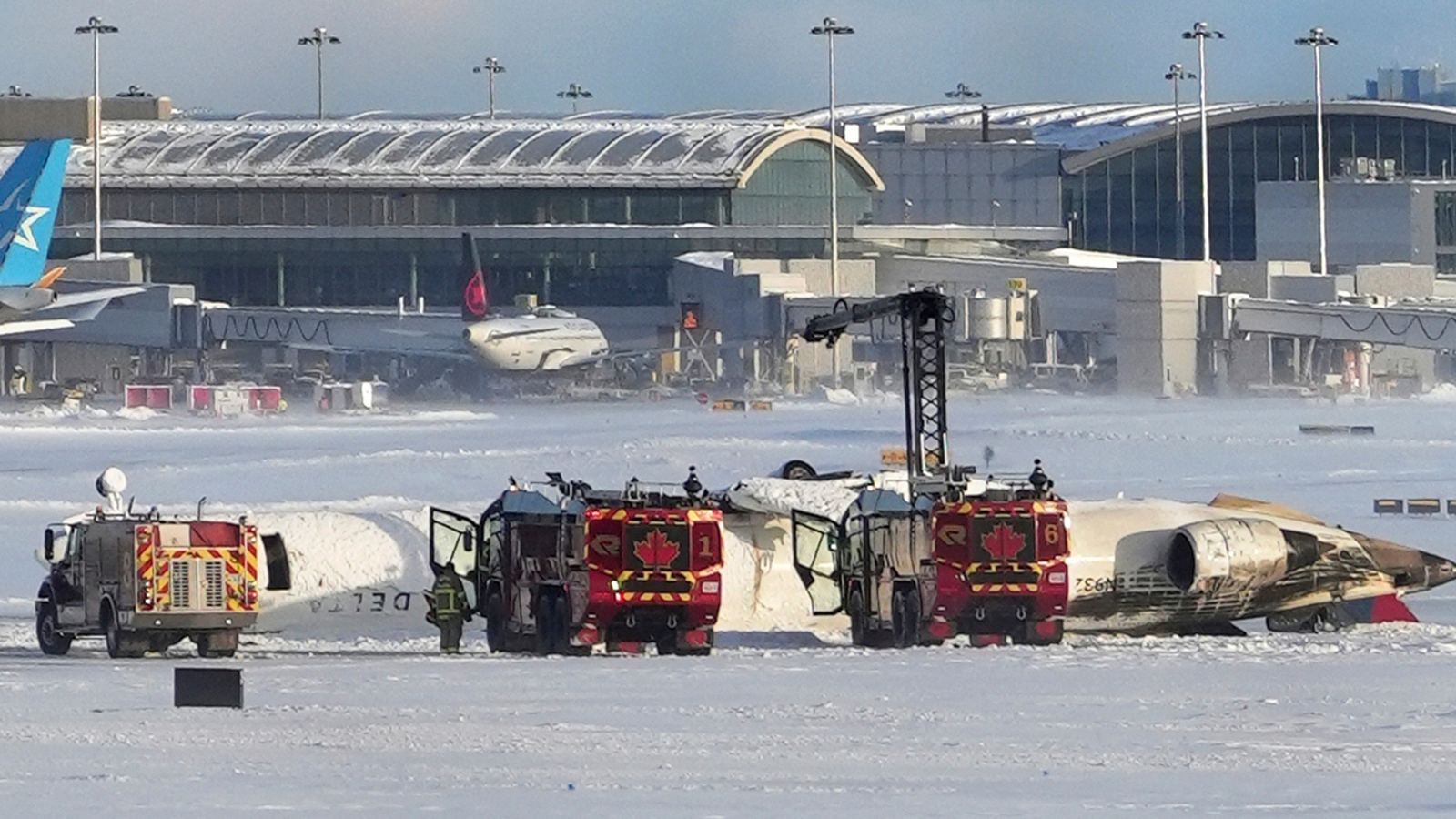
The Toronto plane crash involving Delta Flight 4819 at Toronto Pearson International Airport has captured international attention, raising urgent questions about aviation safety, weather impacts on flight operations, and the remarkable resilience of both passengers and crew. As investigators work tirelessly to piece together what caused this dramatic incident, new details have emerged about the extreme weather conditions that gripped the airport in the days leading up to the crash.
On Monday, a Delta Air Lines regional jet operated by Endeavor Air touched down at Toronto Pearson after departing from Minneapolis. What should have been a routine landing quickly turned into a terrifying ordeal, as the aircraft crashed, caught fire, flipped over, and came to rest upside down on the runway. Miraculously, all 76 passengers and four crew members aboard were evacuated safely, though not without injuries.
Extreme Weather Conditions Plagued Pearson Airport Before the Crash
In the days leading up to the Toronto plane crash, Pearson Airport experienced what its president and CEO described as “extreme conditions.” Deborah Flint, who heads Toronto Pearson, addressed the media on Tuesday, highlighting the unusual weather patterns that had battered the region.
Between Thursday and Sunday, two powerful storms dumped more than 20 inches (50 centimeters) of snow on the airport , an extraordinary amount that exceeded the total snowfall the entire previous winter. Flint noted that this was far from typical weather for the area and caused widespread disruption across Canada and the northeastern United States.
- Thursday storm: First major snow event impacting the region
- Sunday storm: Second significant snowfall adding to the accumulation
- Total accumulation: Over 20 inches in just four days
- Comparative impact: More snow than the entire previous winter season
The severe weather resulted in numerous flight delays and cancellations throughout the region, creating cascading operational challenges. However, Flint was quick to point out that Monday itself was a clear day designated as an operational recovery day for Toronto Pearson.
What Happened During Delta Flight 4819’s Landing
Despite the relatively clear conditions on Monday afternoon, the crash occurred during a period of falling snow and powerful wind gusts. According to reports, winds reached 40 mph at ground level and were even stronger at higher altitudes, creating potentially hazardous landing conditions.
The aircraft involved was a CRJ 900 regional jet, operated by Endeavor Air on behalf of Delta Air Lines. After departing from Minneapolis, the plane attempted to land at Toronto Pearson when the incident occurred. The sequence of events was dramatic:
- The aircraft touched down on the runway
- A crash occurred upon landing
- The plane caught fire
- The aircraft flipped and rolled
- It came to a stop upside down
When asked directly whether the weather conditions may have contributed to the crash, Deborah Flint was cautious, stating that “this is not the time for theories or speculation.” She emphasized that the investigation would determine the precise cause.
Conflicting Reports About Runway Conditions
One notable point of contention involves the actual condition of the runway at the time of the Toronto plane crash. On Monday, Toronto Pearson’s fire chief Todd Aitken stated that the runway was dry with no crosswind present. However, when questioned again on Tuesday about whether the runway had light snow or sleet, Aitken deferred to the investigators.
This discrepancy has added complexity to the ongoing investigation and highlights how rapidly conditions can change at a busy international airport. The investigation will likely scrutinize these varying accounts carefully to establish an accurate timeline.
Investigation Underway by Multiple Agencies
The Toronto plane crash investigation is being led by the Transportation Safety Board of Canada (TSB), with critical collaboration from international partners. Investigators from the U.S. Federal Aviation Administration (FAA) and the National Transportation Safety Board (NTSB) are working alongside Canadian authorities to determine what caused this frightening incident.
According to officials who spoke on Tuesday, investigators plan to examine the aircraft in its current position on the runway over the next two days. This methodical approach will help them gather crucial evidence about the plane’s condition, mechanical systems, and any potential contributing factors.
Heroic Crew and Emergency Response
Perhaps the most inspiring aspect of this harrowing incident is the response from the flight crew and emergency personnel. Deborah Flint was effusive in her praise for everyone involved in the rescue and evacuation efforts.
“Heroically, they got the passengers to safety,” Flint said of the flight crew during Tuesday’s press conference. “I cannot praise the crew, the flight attendants, the pilots, and our emergency teams enough for their swift and effective response. It’s truly amazing, and when you see that aircraft, I feel very grateful.”
The crew’s quick thinking and professionalism undoubtedly saved lives, ensuring that what could have been a catastrophic tragedy resulted in no fatalities. Their actions have been recognized as nothing short of heroic by airport officials and passengers alike.
Passenger Injuries and Medical Response
While all 80 people aboard survived the crash, the injuries sustained ranged from minor to critical. According to Delta, 21 passengers were transported to hospitals, and as of Tuesday, 19 of them had already been discharged , a testament to the resilience of those involved.
Cory Tkatch, commander of operations for Peel Regional Paramedic Services, provided details about the nature of the injuries sustained. These included:
- Back sprains from the violent impact and evacuation
- Head injuries of varying severity
- Anxiety related to the traumatic experience
- Nausea and vomiting caused by exposure to fuel during the incident
Three individuals sustained critical injuries: a child, a man in his 60s, and a woman in her 40s. Medical transport organization Ornge confirmed these details. Despite the critical classification, Flint emphasized that none of the injuries were considered life-threatening , a remarkable outcome given the violent nature of the crash.
Passenger Demographics and International Response
Among those aboard Delta Flight 4819 were 22 Canadian citizens, according to Flint. The international makeup of the passengers highlights the global nature of modern air travel and the diverse communities affected by such incidents.
Airport Operations and Recovery
Following the Toronto plane crash, Toronto Pearson temporarily suspended all flight operations as emergency responders worked at the scene. However, departures and arrivals resumed by 5 p.m. Eastern Time on Monday, demonstrating the airport’s commitment to minimizing further disruption.
Two runways remained closed as of Tuesday, which Flint noted could affect ongoing operations. The airport’s ability to recover quickly while maintaining safety standards speaks to the expertise of its operational teams and emergency planners.
Delta’s Commitment to Affected Passengers
Delta Air Lines CEO Ed Bastian released a statement addressing the incident and the airline’s response. “Our most urgent priority remains taking care of all customers and Endeavor crew members involved,” Bastian said. “We will do everything we can to support them and their families in the coming days, and I know that the hearts, thoughts, and prayers of the entire Delta community are with them. We are grateful to all the first responders and medical teams who have cared for them.”
This compassionate response reflects the airline industry’s recognition that recovery from such incidents extends far beyond the physical rescue , it requires sustained support for everyone affected.
What Comes Next in the Investigation
As the Toronto plane crash investigation progresses, several key questions remain unanswered. Investigators will examine:
- Weather data and conditions at the time of landing
- Aircraft mechanical systems and maintenance records
- Crew training and experience
- Runway conditions and airport procedures
- Communication between the flight crew and air traffic control
The collaborative nature of the investigation, involving Canadian and American agencies, ensures that multiple perspectives and regulatory frameworks will inform the final conclusions. This comprehensive approach is designed to not only determine what caused this specific incident but also to identify any broader safety improvements that could prevent similar occurrences.
Conclusion
The Toronto plane crash involving Delta Flight 4819 serves as a powerful reminder of both the inherent risks of aviation and the remarkable safety systems that protect passengers every day. The combination of extreme weather conditions in the days before the incident, the violent nature of the crash itself, and the miraculous outcome with no fatalities represents a complex story that will take time to fully understand.
As investigators continue their meticulous work examining the wreckage and gathering testimony, the aviation community watches closely for lessons that can be learned. Meanwhile, the heroic actions of the flight crew, the swift response of emergency personnel, and the resilience of the passengers stand as testaments to human courage in the face of crisis. The coming days and weeks will bring more clarity about what caused this dramatic incident, but already, the story of Delta Flight 4819 has become one of survival, professionalism, and gratitude in the face of unimaginable circumstances.