
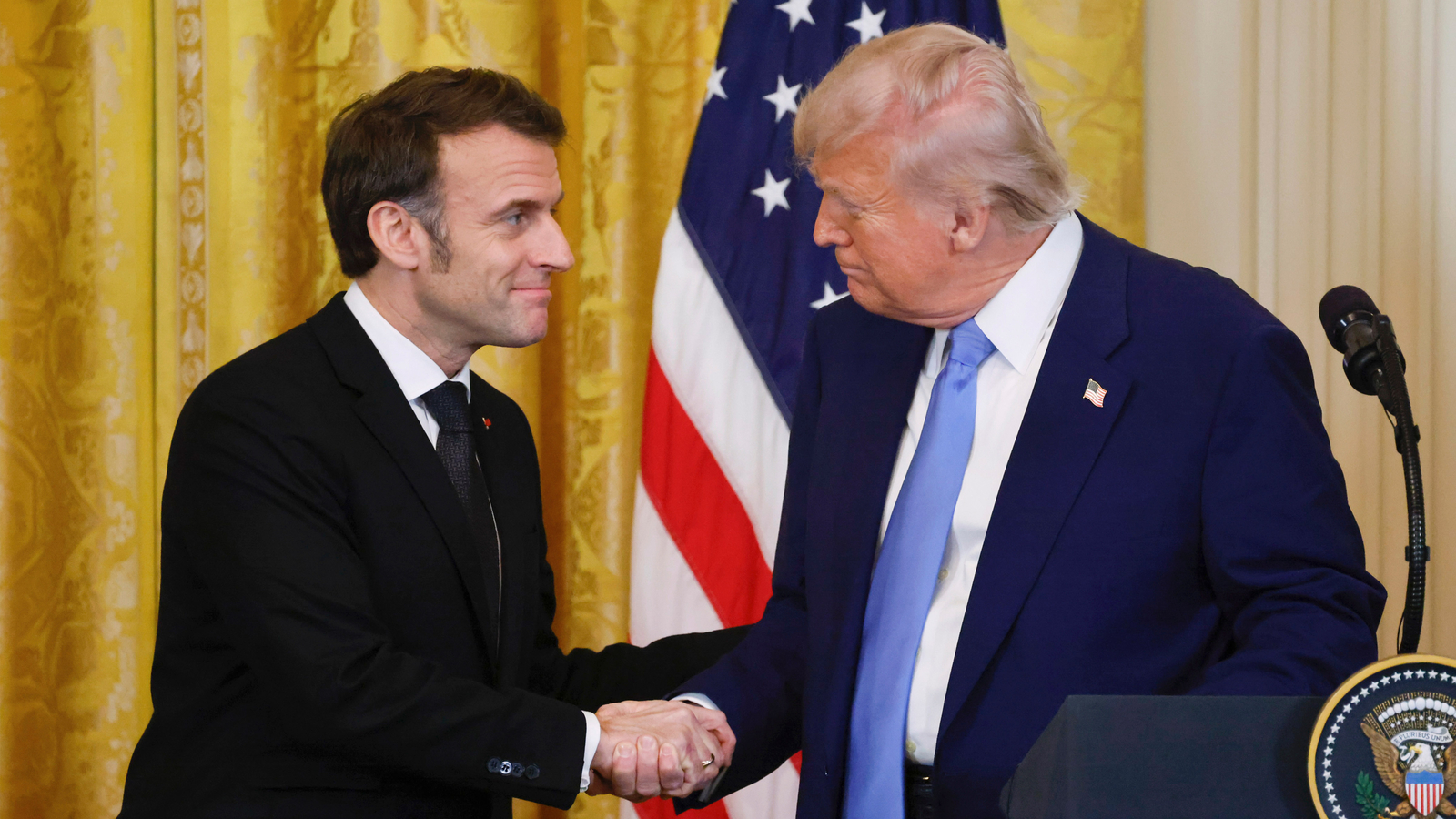
During a high-profile meeting at the White House, French President Emmanuel Macron directly confronted President Donald Trump over his repeated claims about Macron Trump Ukraine aid rhetoric, fact-checking the American leader in real time and cautioning him against rushing into negotiations with Moscow. The tense exchange, which unfolded before the cameras in the Oval Office, underscored growing transatlantic friction over how the war in Ukraine is being managed , and who should be at the table when peace is negotiated.
A Diplomatic Visit That Turned Into a Public Correction
Macron’s visit to Washington was intended to strengthen the Franco-American alliance and discuss a range of global priorities. Instead, much of the headlines came from a single, charged moment in the Oval Office. As Trump repeated his well-worn talking point that Europe was being “paid back” 60% of its contribution to Ukraine’s defense, Macron gently but firmly placed his hand on Trump’s arm and interjected.
“In fact, to be frank, we paid 60% of the total effort,” the French president said. He emphasized that European support came through loans, guarantees, and grants , the same financial instruments used by the United States. “We provided real money, to be clear,” Macron added, signaling his frustration with the narrative that European taxpayers had been subsidized by American generosity.
Trump’s response was characteristically breezy. “If you believe that, it’s okay with me,” he said with a smile. But the moment revealed a deeper truth: the two leaders hold fundamentally different views on who has carried the financial burden of supporting Kyiv since Russia’s full-scale invasion in February 2022.
The Stakes Behind the Spat
Beyond the optics, this disagreement carries real geopolitical weight. Trump has repeatedly demanded that Ukraine repay U.S. military assistance, framing American support as a loan rather than a grant. This position has strained Washington’s relationship with Kyiv and unnored European allies who fear being sidelined in any future settlement. Macron’s public correction was as much about defending the European record as it was about preserving Europe’s role in the diplomatic process.
Macron’s Warning: “Be Careful” With Russia
In a separate interview with Fox News that aired the same day, Macron offered a more candid assessment of the emerging U.S.-Russia dialogue. While he praised Trump as a potential “game-changer” capable of leveraging American deterrence to force Moscow to the table, he also delivered a pointed warning.
“My message was to say be careful because we need something substantial for Ukraine,” Macron explained. He acknowledged that the arrival of Trump in the diplomatic arena had shifted the dynamics of the conflict, but he cautioned against any settlement that fails to provide Ukraine with robust, enforceable security guarantees.
Macron’s careful balance , praising Trump’s initiative while warning of its risks , reflects a broader European anxiety. The U.S.-Russia talks, which have proceeded largely without direct Ukrainian or European involvement, have alarmed capitals from Paris to Warsaw. European leaders fear that a premature deal could leave Ukraine exposed to future Russian aggression and effectively reward Moscow’s three-year campaign of territorial conquest.
The Looming Ukraine Mineral Deal
One of the most tangible outcomes of the renewed U.S.-Ukraine engagement is the proposed agreement giving Washington access to hundreds of billions of dollars in Ukrainian mineral resources. The White House has framed this deal as a way to recoup American wartime investment, and Ukrainian officials indicated on Monday that the agreement is close to being finalized.
Trump announced that he would soon meet with Ukrainian President Volodymyr Zelenskyy, suggesting the two leaders were on the verge of signing the deal. “I will be meeting with President Zelenskyy. In fact, he may come this week or next week to sign the agreement,” Trump said during his joint appearance with Macron.
The mineral deal represents a striking shift in how the U.S. is approaching its support for Ukraine. Rather than framing aid as a straightforward expression of solidarity with a democracy under attack, the Trump administration has recast it as an investment that should generate returns. This reframing has practical implications: it could reshape how future military and economic assistance is structured, and it raises questions about long-term U.S. economic interests in Ukrainian territory.
What the Deal Could Mean for Both Sides
For Ukraine, the agreement could provide a critical lifeline at a moment when its conventional military resources are stretched thin and its economy is under severe strain. Access to American capital and infrastructure investment could help rebuild war-torn regions and strengthen Ukraine’s position in any future negotiations. For the U.S., the deal would establish a direct financial stake in Ukraine’s post-war reconstruction, potentially giving Washington leverage in shaping the country’s political and economic trajectory for decades to come.
The Real Numbers Behind the Aid Debate
Perhaps the most consequential aspect of the Macron-Trump exchange was the question of who has actually paid for Ukraine’s defense. Trump has repeatedly claimed that the U.S. has provided Ukraine with $350 billion in aid since the war began. That figure has been publicly disputed by Zelenskyy and contradicted by independent analysis.
According to the Kiel Institute for the World Economy, a leading tracker of international military and financial support to Ukraine, the United States has committed approximately $119 billion in total assistance. The majority of that figure , roughly $67 billion , has been delivered in the form of military equipment, with the remainder split between financial aid and humanitarian support.
European nations, defined by the Kiel Institute as the European Union plus the United Kingdom, Iceland, Norway, and Switzerland, have collectively contributed around $138 billion. Of that sum, approximately $65 billion has been military equipment, with the rest distributed across financial, humanitarian, and reconstruction assistance. In other words, European financial contributions have actually outpaced American spending when measured by total commitment.
Why the Numbers Matter
The dispute over these figures is not merely an exercise in accounting. It shapes political narratives on both sides of the Atlantic and influences public opinion about who bears responsibility for supporting Ukraine. In the United States, the inflated $350 billion figure has fueled domestic opposition to continued aid and reinforced the Trump administration’s argument that American taxpayers are bearing an unfair share of the burden. In Europe, the more accurate picture has strengthened the case that the continent is doing its part , and more.
Macron’s decision to challenge Trump’s numbers in person was a deliberate effort to correct the record before it calcified into conventional wisdom. By making the correction in front of the cameras, he ensured that the European perspective would be part of the public record, not just a private diplomatic note.
The Bigger Picture: Alliances Under Pressure
The Macron-Trump confrontation is symptomatic of a broader realignment in Western strategy toward Ukraine. For the first three years of the war, the United States and its European allies presented a largely united front, coordinating sanctions, military aid, and diplomatic pressure on Moscow. That consensus is now fracturing under the weight of competing priorities, divergent threat assessments, and the political dynamics of the Trump era.
European leaders like Macron find themselves in an uncomfortable position. They want to preserve the transatlantic alliance, support Ukraine, and avoid antagonizing the White House , often at the same time. Macron’s approach of public disagreement paired with private engagement represents one model for navigating this tension, but it is not without risks. A French president publicly correcting an American president in the Oval Office is a gesture that carries diplomatic weight, and it remains to be seen whether it will produce results or simply deepen the friction.
What Comes Next
In the days ahead, all eyes will be on Washington as Zelenskyy reportedly prepares to travel to sign the mineral resources agreement. That deal, if finalized, will mark a significant milestone in the evolving U.S.-Ukraine relationship. But the underlying disagreements about aid figures, negotiation formats, and security guarantees are far from resolved. Macron’s warning to “be careful” in talks with Putin is likely to echo through European chancelleries as the diplomatic process moves forward.
Conclusion
The Macron-Trump exchange at the White House was more than a moment of awkward diplomacy , it was a window into the fault lines shaping Western policy on Ukraine. As European leaders push back against what they see as misleading claims about aid contributions, and as the Trump administration pursues an unconventional path toward negotiations with Moscow, the future of the transatlantic alliance and the security of Ukraine hang in the balance. Whether the mineral deal, the diplomatic talks, and the contested aid figures ultimately produce a just and lasting peace will depend on the willingness of all parties to move beyond rhetoric and engage with the harder truths about who has paid, who has sacrificed, and what is still at stake.