
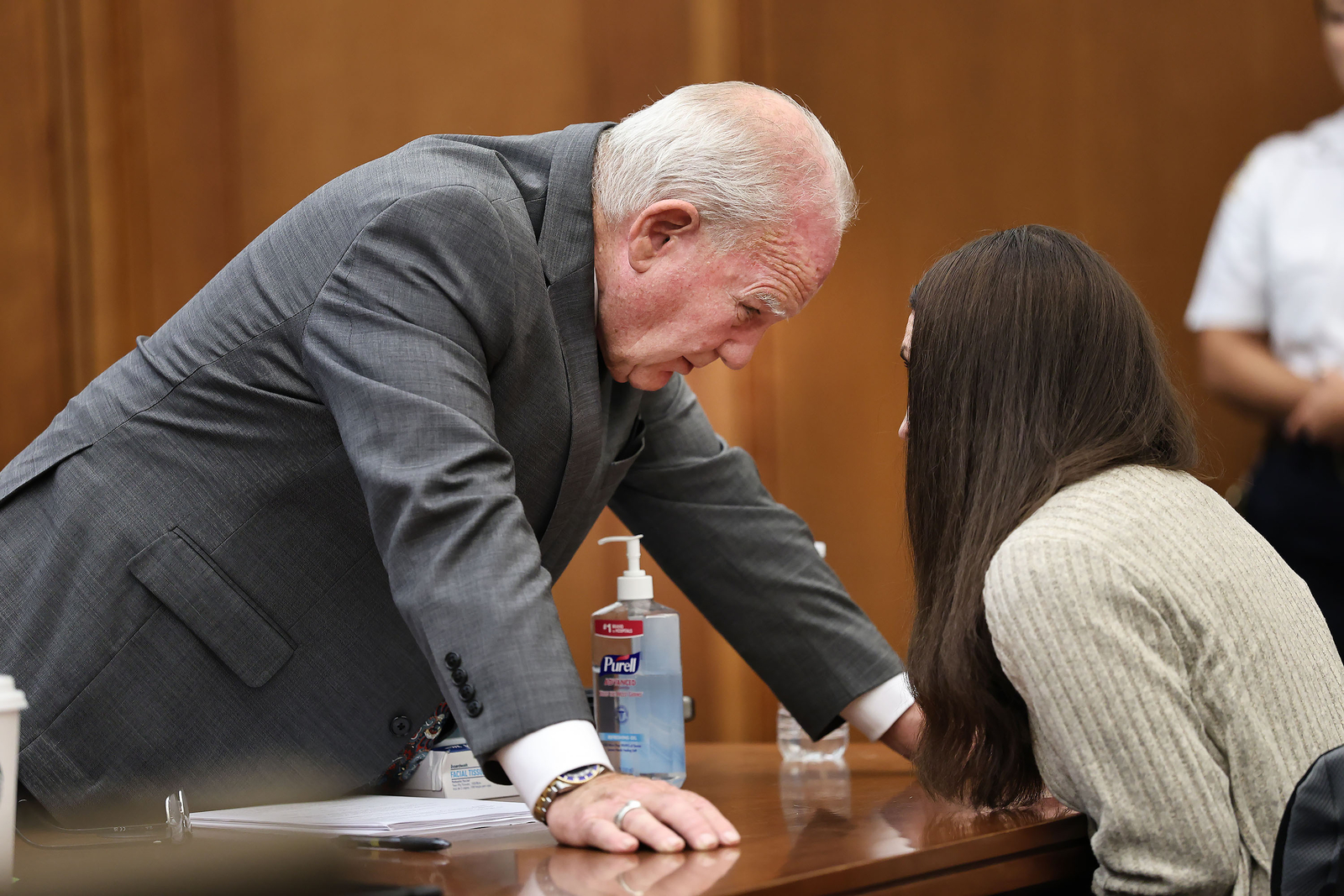
The lindsay clancy trial has reached a critical impasse as a single holdout juror threatens to derail deliberations in one of Massachusetts’ most closely watched criminal cases in recent memory. After six days of failed attempts to reach a unanimous verdict, the jury returned to the Plymouth courtroom Friday morning to continue deliberating whether the former labor and delivery nurse is criminally responsible for the deaths of her three young children in 2023.
The extraordinary situation unfolded Thursday when the jury’s foreperson delivered a note to Judge William Sullivan revealing that one juror was refusing to follow the court’s instructions regarding reasonable doubt. The disclosure provided the most transparent window yet into the deadlock that has paralyzed the jury since deliberations began.
The Holdout Juror and the Judge’s Response
Judge Sullivan took the unprecedented step of bringing each of the twelve jurors into the courtroom individually for private questioning. After hearing from every member of the panel, the judge reread his instructions on the legal standard of reasonable doubt before sending the jurors back to continue their work.
Defense attorney Kevin Reddington seized on the moment, formally requesting that the holdout juror be dismissed from the case. Reddington argued that the juror’s refusal to follow the judge’s instructions disqualified them from continuing to serve. Prosecutors pushed back, opposing the removal, and ultimately Sullivan declined to take the dramatic step.
“I don’t feel it is proper for me to side with one side or the other of the deliberations,” Sullivan explained from the bench. “I don’t feel it’s appropriate for me to say, ‘I agree with one juror or the eleven.’ I have asked if they are able to follow my instructions. They swore earlier that they could.”
Clancy Present for Critical Moment
In a courtroom first, Lindsay Clancy herself was brought to participate in a sidebar conversation with the judge. Paralyzed from the waist down following her suicide attempt after the killings, Clancy uses a wheelchair, which her attorney pushed to the front of the courtroom so she could be present for the discussion about her own fate.
Speaking to reporters afterward, Reddington explained the decision: “She has a right to know what’s going on.” The brief presence of the defendant added another emotional layer to an already charged proceeding that has captivated observers throughout Massachusetts and beyond.
Background of the Case
Lindsay Clancy, now 36, does not deny strangling her three children in the basement of their Plymouth home in 2023 before attempting to take her own life. The children, identified as Cora (age 5), Dawson (age 3), and Callan (age 8 months), became the center of a case that has sparked fierce national debate about maternal mental health, criminal culpability, and the limits of postpartum psychiatric conditions as a legal defense.
Her defense team has built their case around the argument that postpartum psychosis drove her actions,a rare but severe mental health condition that can affect women shortly after childbirth. The prosecution, however, has countered that Clancy knew exactly what she was doing, pointing to evidence that she deliberately sent her then-husband on errands to clear him from the house before the killings.
The Suicide Attempt Question
Prosecutors have also aggressively questioned the seriousness of Clancy’s suicide attempt, suggesting that it was calculated rather than a genuine cry for help. This line of argument has become central to their push to convince the jury that she acted with intent and full awareness of her actions.
The Mental Health Defense
Throughout the trial, the defense has worked to establish that Clancy was in the grip of an acute psychiatric crisis in the days and weeks leading up to the killings. Family members, including Clancy’s mother and sister, have testified about her declining mental state, while her former mother-in-law emotionally recounted how Clancy “was begging for help” before the tragedy.
A defense psychiatrist testified that Clancy suffers from bipolar disorder, while another expert witness argued she was not criminally responsible due to her mental state at the time of the killings. Her diary entries, entered into evidence, chronicled a descent into desperation and “brain fog” in the period before the deaths.
On the other side, a prosecution psychologist took the stand and testified that Clancy was, in fact, criminally responsible for killing her three children. The dueling psychiatric testimony has emerged as a focal point of the jury’s apparent disagreement.
What Happens Next?
The jury has now twice informed Judge Sullivan that it cannot reach a unanimous verdict. As deliberations resume for a seventh day, several possible outcomes loom over the case:
- Continued deliberations: The jury may ultimately break through the impasse and reach a verdict, either convicting or acquitting Clancy.
- Mistrial declaration: If the jury remains hopelessly deadlocked, Sullivan could declare a mistrial.
- Plea negotiations: In the event of a mistrial, prosecutors might choose to negotiate a plea deal with the defense.
- Retrial: Prosecutors could decide to bring the case before a new jury.
- Charges dropped: The Commonwealth could opt to drop the charges entirely.
Potential Verdict Outcomes
Should the jury reach a verdict of guilty, Clancy could face conviction on either murder or manslaughter charges. An acquittal, however, would not necessarily mean her release. A judge could still order her confined to a mental health facility if an evaluation determines that she poses a danger to herself or the public.
Public Reaction and Media Attention
The trial has been livestreamed, drawing intense interest from reporters, legal analysts, and members of the public who have packed the courtroom throughout the proceedings. The case has carved deep divisions among observers, with some viewing Clancy as a victim of devastating postpartum mental illness and others seeing her as a calculating killer who orchestrated the deaths of her own children.
Previous testimony has painted a complex portrait of the defendant. A nanny who worked with the family described Clancy as appearing to be a loving mother before the killings. A chaplain testified that Clancy expressed relief after the deaths, saying she was “so glad” her children were “safe.” An investigator revealed that Clancy had searched online for information about treating a sociopath, while a toxicology expert testified that drug levels in her system were relatively low at the time of the incident.
The courtroom reached an emotional peak during the playback of the 911 call from Clancy’s husband, Patrick Clancy, in which he could be heard screaming, “She killed the kids!” Jurors also visited the actual home where the killings occurred, a rare procedural step that underscores the gravity of the case.
Broader Implications for Postpartum Mental Health
Beyond the immediate legal questions, the trial has reignited critical conversations about how society identifies and treats postpartum psychiatric conditions. Postpartum psychosis, the condition cited by the defense, is recognized as a medical emergency that can cause hallucinations, delusions, and impaired judgment. Yet the criminal justice system often struggles with where to draw the line between mental illness and criminal intent in cases where mothers harm their children.
Mental health advocates have followed the proceedings closely, hoping the case might generate greater awareness and resources for new mothers experiencing severe psychiatric symptoms. Critics of the defense, meanwhile, argue that using postpartum psychosis as a legal strategy risks minimizing the severity of deliberate criminal acts.
A Nation Watching and Waiting
As the jury reconvenes for another day of deliberations, the eyes of Massachusetts,and increasingly, the nation,remain fixed on the Plymouth courtroom. The holdout juror’s stance has raised fundamental questions about jury dynamics, judicial discretion, and the difficulty of applying complex legal standards to a case that blurs the boundaries between madness and malice.
Whatever the ultimate outcome, the lindsay clancy trial will leave an indelible mark on the families affected, the legal community, and the broader public discourse surrounding maternal mental health and criminal justice. The three children at the center of this tragedy,Cora, Dawson, and Callan,remain the most important figures in a story that has divided a community and sparked difficult but necessary conversations.
If you or someone you know is struggling with thoughts of suicide or mental health crisis, please contact the 988 Suicide and Crisis Lifeline by calling or texting 988 in the United States. Help is available, and no one has to face these challenges alone.