
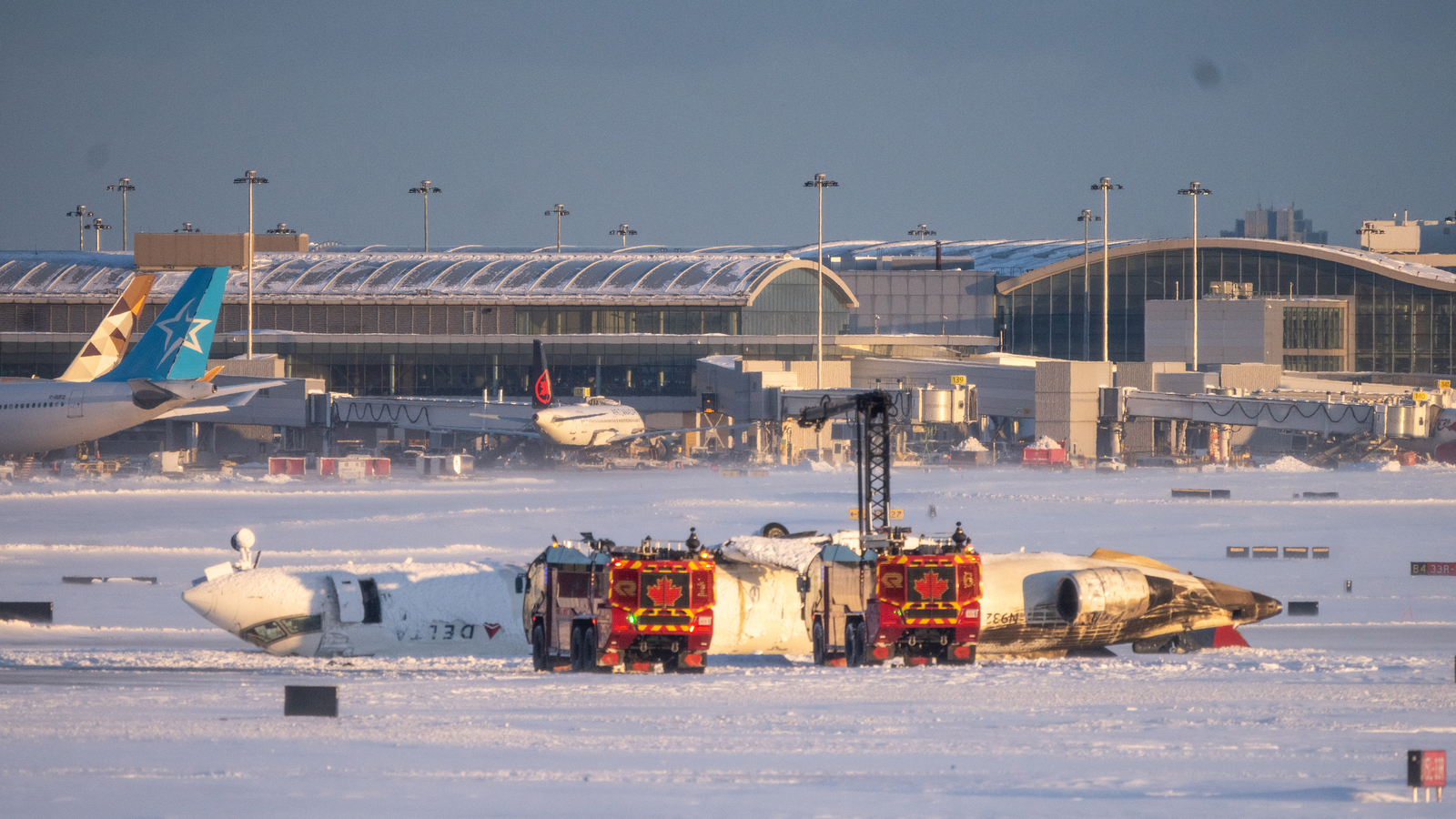
The Delta Flight 4819 crash at Toronto Pearson International Airport on Monday has become one of the most talked-about aviation incidents in recent Canadian history. The dramatic scene unfolded when a regional jet arriving from Minneapolis touched down, caught fire, flipped upside-down, and came to rest inverted on the runway. Miraculously, all 80 people aboard survived , and now investigators are working to understand exactly what went wrong.
As details continue to emerge, Toronto Pearson’s President and CEO Deborah Flint has shed light on the challenging weather conditions that gripped the airport in the days leading up to the disaster. Her revelations are helping paint a fuller picture of the operational environment surrounding the incident.
The ‘Extreme Conditions’ Leading Up to the Delta Flight 4819 Crash
During a Tuesday news conference, Flint provided striking context about the weather that battered Toronto Pearson International Airport in the days before the Delta Flight 4819 crash. She described a four-day stretch from Thursday through Sunday as defined by what she called “extreme conditions” brought on by two separate storms.
“On Thursday and Sunday, we got more than 20 inches, 50 centimeters of accumulated snow,” Flint told reporters. “That is actually not typical. In fact, it is more snow within that time window than we received in all of last winter.”
The sheer volume of snowfall created widespread disruption across the region, Flint noted. There were numerous flight delays and cancellations affecting not only Canada but also the U.S. Northeast, producing backlogs that the airport was still working to manage when the crash occurred.
Monday itself, however, presented a different picture. Flint described the day of the crash as “clear” and characterized it as an “operational recovery day” for Toronto Pearson , a day when the airport was attempting to catch up after days of weather-induced chaos.
The Moment of Impact
Despite Monday’s clear conditions on the ground, the Delta Flight 4819 crash happened amid blowing snow and powerful wind gusts in the broader Toronto area. Winds on the ground reached 40 mph, and even higher velocities were recorded several hundred feet in the air , conditions that immediately raised questions about the role weather may have played in the accident.
When pressed by reporters on whether weather could have contributed to the crash, Flint was measured in her response. “This would not be a time for us to have theory or to speculate,” she said, emphasizing that the investigation should lead the inquiry rather than speculation.
Toronto Airport Fire Chief Todd Aitken added another layer of complexity. On Monday, he stated that the runway was dry at the time of the crash and that there were no crosswind conditions present. The following day, however, when asked whether the runway may have had light snow or slush, he deferred that question entirely to investigators.
Inside the Aircraft: What We Know About the Plane and Its Occupants
The aircraft involved in the Delta Flight 4819 crash was a CRJ 900 regional jet operated by Endeavor Air, a wholly-owned subsidiary of Delta Air Lines. The plane had departed from Minneapolis-St. Paul International Airport and was making its approach to Toronto Pearson when the disaster occurred.
Passenger and Crew Manifest
- Total aboard: 80 people , 76 passengers and 4 crew members
- Canadian citizens: 22 passengers were Canadian nationals
- Crew composition: Pilots, flight attendants, and Endeavor Air operations staff
Perhaps the most remarkable aspect of this story is that all 80 people evacuated the aircraft. Flint was visibly emotional as she praised the flight crew for their actions during the catastrophe, saying they “heroically led passengers to safety.”
The Investigation: Multiple Agencies Now Involved
The investigation into the Delta Flight 4819 crash is being led by the Transportation Safety Board of Canada (TSB), with critical assistance from U.S. authorities. Investigators from both the Federal Aviation Administration (FAA) and the National Transportation Safety Board (NTSB) have been dispatched to Toronto to participate in the inquiry.
Officials confirmed on Tuesday that investigators plan to examine the aircraft in its current inverted position on the runway for at least the next two days. This careful on-site examination is a standard but crucial part of any major aviation incident investigation, allowing experts to document physical evidence before the wreckage is moved.
Injury Report: A Mix of Severity Levels
While the outcome could have been far worse, injuries from the Delta Flight 4819 crash were nonetheless significant. According to Cory Tkatch, commander of operations at Peel Regional Paramedic Services, the injuries ranged across multiple categories:
- Back sprains
- Head injuries
- Anxiety-related symptoms
- Headaches
- Nausea and vomiting from fuel exposure
Twenty-one passengers were transported to hospitals. As of Tuesday, 19 of those individuals had been released. Flint confirmed that while injuries ranged from minor to critical, none were classified as life-threatening. Three people suffered critical injuries , including one child, a man in his 60s, and a woman in her 40s, according to medical transport organization Ornge.
Airport Operations and Recovery Efforts
In the immediate aftermath of the Delta Flight 4819 crash, Toronto Pearson International Airport temporarily halted all flight operations. Departures and arrivals resumed at 5 p.m. ET on Monday, but the recovery was not complete. Two runways remained closed as of Tuesday, a situation Flint warned could continue to affect airport operations.
Delta’s Response
Delta Air Lines CEO Ed Bastian issued a statement that focused squarely on those affected by the disaster. “Our most pressing priority remains taking care of all customers and Endeavor crew members who were involved,” Bastian said. “We’ll do everything we can to support them and their families in the days ahead, and I know the hearts, thoughts, and prayers of the entire Delta community are with them.”
He also expressed gratitude to the first responders and medical teams who provided care in the chaotic moments following the crash.
Survivor Accounts Bring the Crisis into Focus
Beyond the official statements and statistics, the human element of the Delta Flight 4819 crash has emerged through survivor testimonies. One passenger described passengers “hanging like bats” inside the inverted cabin , a vivid illustration of just how disorienting and terrifying the moments after the crash must have been.
These firsthand accounts serve as a powerful reminder that, while investigators work to determine the cause, real human beings lived through an experience that few could imagine. Their stories also underscore the importance of crew training, emergency response protocols, and the role that calm, decisive leadership plays during an aviation crisis.
Key Questions Investigators Are Likely to Explore
As the formal investigation into the Delta Flight 4819 crash progresses, several critical questions are likely to take center stage:
- Weather factors: Despite Flint’s hesitancy to speculate, the strong wind gusts during landing will almost certainly be examined in detail.
- Runway conditions: The discrepancy between Aitken’s Monday and Tuesday statements about runway state will need clarification.
- Aircraft systems: Investigators will look closely at landing gear, braking systems, and any potential mechanical failures.
- Crew actions and decisions: Pilot training and decision-making in the final moments before touchdown will be thoroughly reviewed.
- Air traffic control communications: Standard procedure includes a full review of all communications between the cockpit and ground control.
Conclusion: A Sobering Reminder of Aviation Risks
The Delta Flight 4819 crash at Toronto Pearson International Airport stands as a sobering reminder that aviation, despite being one of the safest forms of transportation, can produce terrifying moments in an instant. The fact that all 80 souls on board survived is a testament to the skill of the flight crew, the design integrity of the CRJ 900, and the rapid response of Toronto’s emergency services. Yet, with three people critically injured and dozens more hurt, the incident is far from a no-harm event.
As the Transportation Safety Board of Canada continues its work , supported by the FAA and NTSB , the traveling public will be watching closely for answers. Whether the cause is ultimately attributed to weather, mechanical failure, human factors, or a combination of all three, the lessons learned from this investigation could shape aviation safety protocols for years to come.
For now, the people of Toronto, the Delta community, and the broader aviation industry are united in something Flint captured perfectly in her closing remarks: gratitude. “It’s really, really incredible,” she said of the emergency response, “and when you see that aircraft, it just makes me really thankful.”