
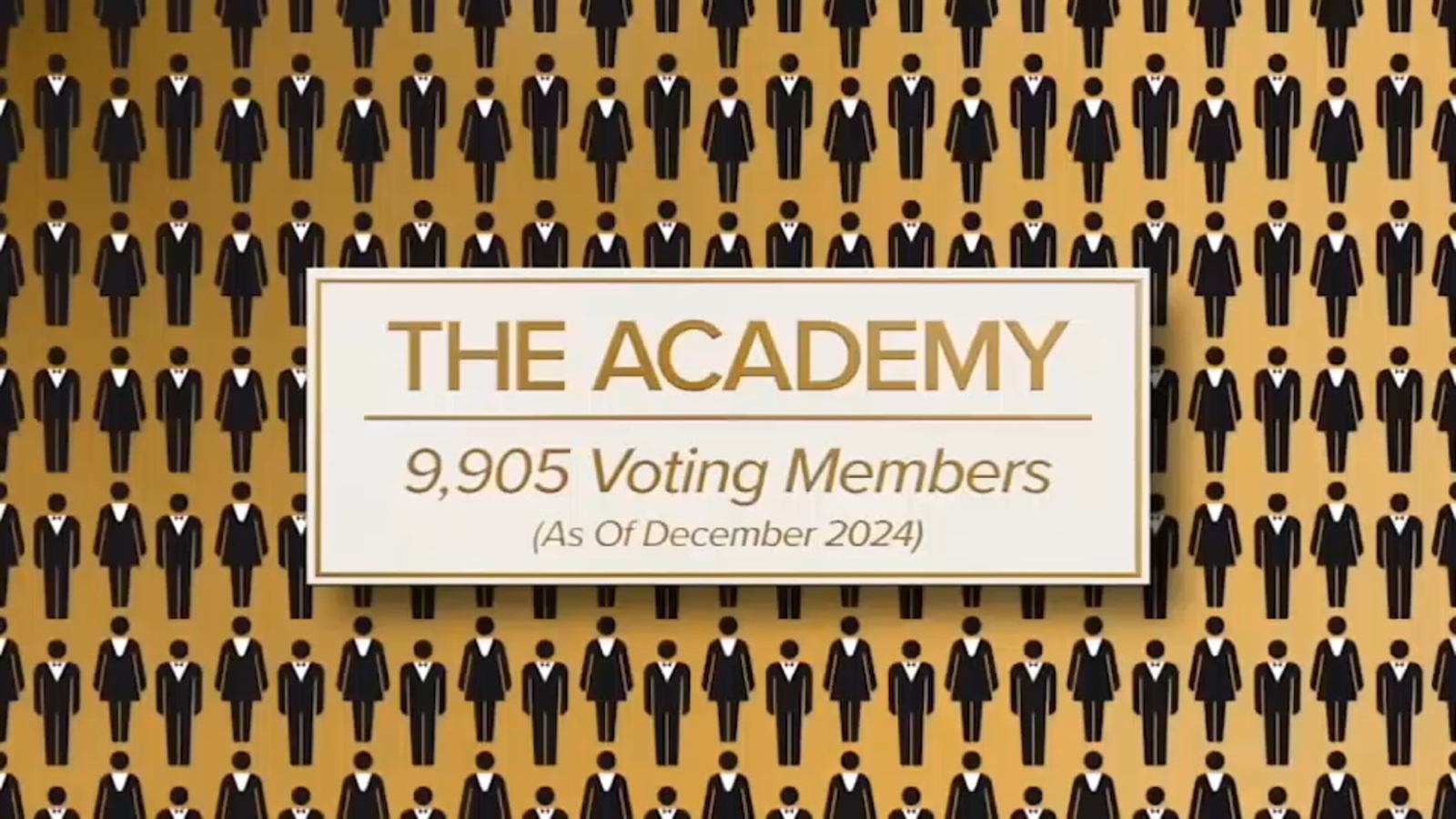
The 2025 Oscars voting process is far more complex than most viewers realize. While audiences tune in to the glitz and glamour of Hollywood’s biggest night, behind the scenes, nearly 10,000 industry professionals are making decisions that can launch careers, cement legacies, and shape cinema history. With the 97th Academy Awards approaching and a stacked field of contenders including “Wicked,” “A Complete Unknown,” and “The Brutalist,” understanding how Oscar winners are actually chosen has never been more fascinating. Let’s pull back the curtain on one of the entertainment industry’s most secretive and sophisticated voting systems.
The Academy: Who Exactly Gets to Vote?
The Academy of Motion Picture Arts and Sciences is the exclusive organization responsible for selecting Oscar winners, and membership is a career milestone in itself. The Academy currently boasts approximately 10,000 voting members, each representing different disciplines within the film industry.
These members are organized into distinct branches based on their professional expertise:
- Actors Branch , for performers who have achieved significant credits
- Writers Branch , for screenwriters and storytellers
- Directors Branch , for filmmakers behind the camera
- Producers Branch , for those who shepherd films into existence
- Technical branches , covering cinematography, editing, sound, costume design, and more
This branch-based structure reflects the Academy’s recognition that filmmaking is a collaborative art form requiring many specialized skills. However, it also creates one of the most interesting quirks in how Oscar voting works.
Branch-Specific Voting for Nominations
When it comes to determining the Oscar nominations, the process is deliberately compartmentalized. Members can only vote within their own branch. So an actor in the Actors Branch will help select nominees for Best Actor and Best Actress, but won’t have direct input on, say, the Best Cinematography shortlist.
However, there’s one important exception. All Academy members, regardless of branch, are eligible to participate in the Best Picture nomination process, because selecting the year’s most outstanding film is considered a universal concern.
How the Final Voting Works
Once nominations are locked in, the voting rules shift dramatically for the final selection of winners.
Everyone Votes on Everything
In the final round, every single Academy member can vote on every single category. This marks a significant departure from the nomination phase. A costume designer can weigh in on Best Sound. A sound mixer can have a say in Best Original Screenplay.
According to film journalist and author of “50 Oscar Nights” Dave Karger, this creates fascinating challenges. “Someone who’s in the costume design branch doesn’t really understand what it takes to be a great sound technician, so how can they really be voting on those very different categories?” he noted.
Despite these concerns, the Academy has maintained this system because it ensures every winner represents a broad consensus across the entire industry, not just one specialty.
The All-Online, Secret Ballot System
The era of paper ballots is long gone. Today’s Oscar voting process is conducted entirely online, with members receiving secure credentials to access the voting platform. Each member casts votes in complete secrecy, with no way for the Academy to track individual choices. This anonymity protects voters from external pressure and ensures that selections reflect genuine preferences rather than strategic alliances or studio lobbying.
The Unique Voting System for Best Picture
Here’s where the 2025 Oscars voting process gets truly distinctive. While every other category uses a simple plurality system, Best Picture employs a sophisticated ranked-choice method that’s mathematically designed to find the most broadly beloved film of the year.
Understanding the Ranked Choice System
Rather than picking a single favorite, Academy members rank all 10 Best Picture nominees from one to ten. The counting then proceeds in rounds:
- First-choice votes are tallied. If any film receives more than 50% of first-place votes, it’s declared the winner.
- If no winner emerges, the film with the fewest first-place votes is eliminated.
- Voters who ranked the eliminated film first have their second-choice votes redistributed to their next preference.
- This process continues through subsequent rounds until one film crosses the 50% threshold.
This preferential voting system means that films don’t necessarily need to be anyone’s top pick to win. They just need to be widely respected and considered a strong contender by a broad cross-section of voters.
Why This Matters for Predictions
The ranked-choice system has profound implications for predicting Oscar winners, particularly in close races. Films that are divisive but passionately loved may struggle because they fail to appear on enough voters’ second or third ballots. Conversely, films with broad but not fervent support can accumulate enough redistributed votes to triumph.
This dynamic could play out dramatically in the 2025 race. While “Emilia Pérez” entered the ceremony with the most nominations, its chances of winning Best Picture may be diminished if it polarized audiences. Meanwhile, “The Brutalist,” with its sweeping ambition and critical acclaim, might benefit from being a common second or third choice even among voters who favored other films first.
The Count: Price Waterhouse Coopers and the Secret Tally
Once voting closes, all ballots flow to Price Waterhouse Coopers (PwC), the legendary accounting firm that has tabulated Oscar results for decades. The secrecy surrounding this process has become legendary in its own right.
According to the Academy, only two partners at PwC know the full results before they’re announced on stage. These partners are responsible for transporting the winning envelopes to the ceremony, memorizing the results in case anything goes wrong with the physical cards. It’s a responsibility that has occasionally produced memorable moments of confusion on live television.
Do Academy Members Have to Watch Every Movie?
One common misconception is that Oscar voters must watch every nominated film before casting their ballots. The Academy explicitly states that this is not required. However, members are strongly encouraged to watch as many nominees as possible, and the organization provides screeners and hosts special screenings to facilitate this.
The reality is that with thousands of films competing for attention each year, and many Academy members working on their own productions, comprehensive viewing is practically impossible. This is partly why the ranked-choice system for Best Picture exists , it accommodates the reality that voters bring varying levels of familiarity with each contender.
What to Expect on Oscar Night
The 97th Academy Awards ceremony, hosted by comedian Conan O’Brien, airs live on Sunday, March 2. The broadcast begins at 7 p.m. ET / 4 p.m. PT on ABC and streams on Hulu, with red carpet coverage starting at 3:30 p.m. ET / 12:30 p.m. PT on “On The Red Carpet at the Oscars.”
With voting now closed, the results are locked away with PwC, ready to be revealed envelope by envelope on Hollywood’s grandest stage. Every category winner represents months of campaigning, countless hours of viewing, and the collective judgment of thousands of industry professionals.
Conclusion: Why the Process Matters
The 2025 Oscars voting process represents something remarkable in modern entertainment: a system designed not to reward the loudest campaign or the biggest studio, but to identify films and performances with the broadest genuine respect across the entire film community. The combination of branch-specific nomination voting, universal final voting, online secrecy, and ranked-choice tabulation for Best Picture creates a uniquely democratic process within an industry often dominated by commercial pressures.
Whether you’re a casual viewer tuning in for the spectacle or a serious film enthusiast analyzing every category, understanding how the votes are actually counted adds a rich new layer to Oscar night. As the envelopes are opened and the winners step onto that legendary stage, you’ll now know exactly what journey brought them there , from 10,000 voters, through branches and ballots, to the most prestigious prize in cinema.