
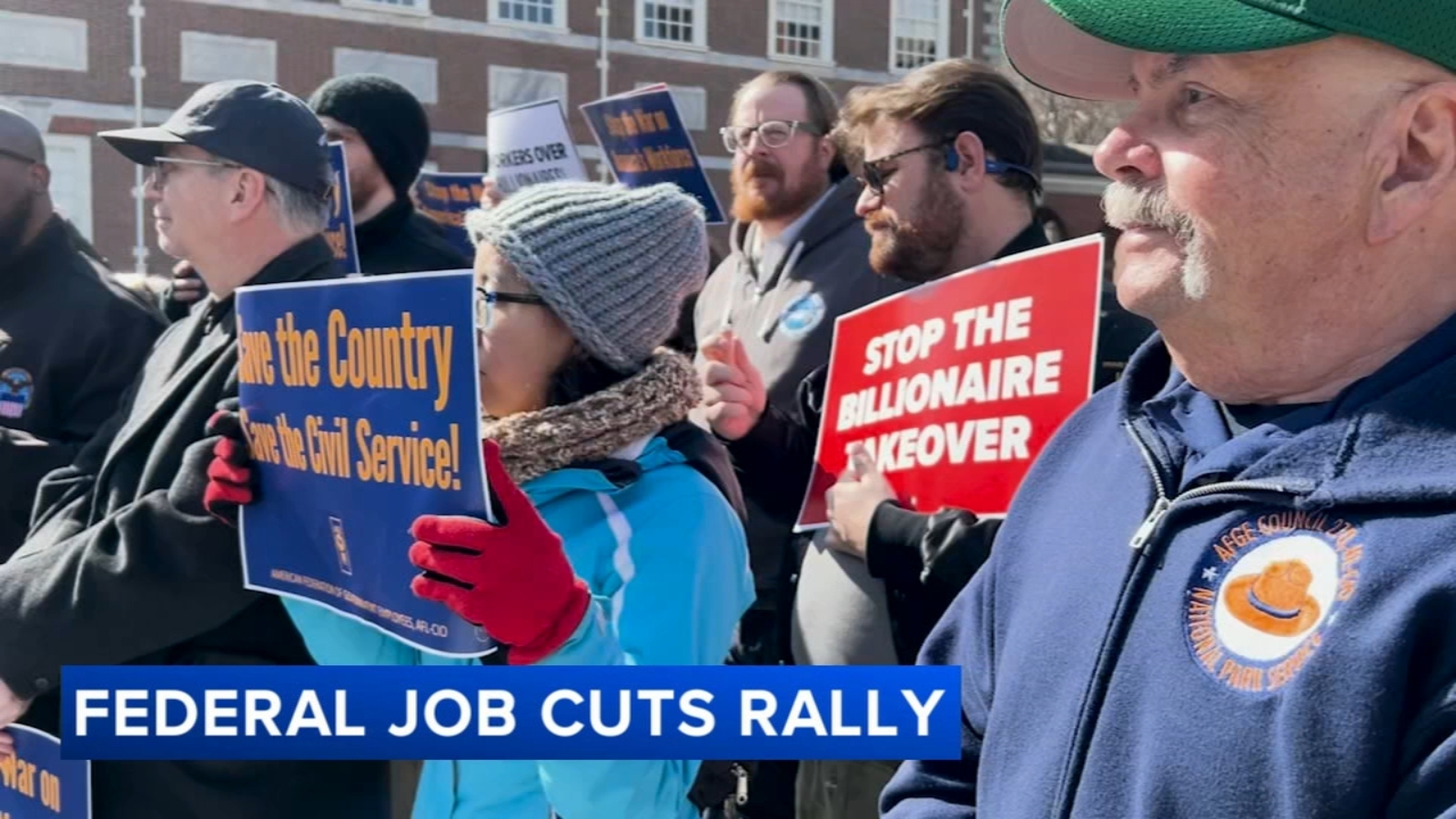
The wave of federal layoffs sweeping through Washington has now crashed into the heart of Philadelphia, igniting fierce opposition from union leaders, lawmakers, and the workers themselves. What began as a coordinated effort by President Trump and Elon Musk to slash the federal workforce has transformed into a defining political battleground in the City of Brotherly Love, where history, civic pride, and economic survival all hang in the balance.
On a chilly Monday outside Independence Hall, a powerful coalition gathered to denounce what they characterize as an unprecedented assault on public servants. Congressman Brendan Boyle (D-Pa.) stood shoulder to shoulder with local union members and national labor leaders, including the president of the American Federation of Government Employees (AFGE), to deliver a unified message: these federal layoffs will not go unchallenged.
A Historic Setting for a Modern Protest
There is no more symbolically charged location in America for a protest against government overreach than Independence Hall. The very site where the Founding Fathers declared independence from a monarch has now lost two of its own park rangers to the recent wave of government job cuts. For David Fitzpatrick of AFGE Council 270, the parallel was unmistakable.
“Some 250 years ago, a grievance was filed right here,” Fitzpatrick declared. “That grievance was the Declaration of Independence, and it was filed against kings. We will no longer answer to a king.” His remarks captured the fierce sense of betrayal felt by federal workers who once considered their positions a pillar of democratic service.
The Human Cost at Independence Mall
The irony is not lost on Philadelphia’s residents. As the nation prepares to celebrate America’s 250th birthday in 2026, the very workforce responsible for preserving and presenting the historic landmarks along Independence Mall is being systematically dismantled. Congressman Boyle minced no words when he pointed out the absurdity of the timing.
“So you’re telling me that at the same time we are celebrating 250 years of American democracy, we are slashing the workforce that takes care of the places where that history lives?” Boyle asked incredulously. “That is nuts.”
The Mechanics Behind the Mass Firings
The Trump Administration, working in concert with Elon Musk’s controversial Department of Government Efficiency (DOGE), has executed thousands of federal layoffs in recent months. The stated goal is to eliminate government waste. The execution, however, has raised serious legal and ethical questions that labor organizations are now preparing to challenge in court.
According to Everett Kelley, the National President of AFGE, the terminations may not survive judicial scrutiny. “We are looking at probably several lawsuits,” Kelley announced at the Philadelphia rally. The union argues that the administration is bypassing the established procedures that protect civil servants from arbitrary dismissal.
The Performance Review Controversy
One of the most troubling aspects of the recent federal layoffs involves the official justification provided to terminated employees. Many of those who received pink slips were told they had failed to meet performance standards, a claim that rings hollow for many affected workers.
“Many of them had never even had a performance review,” Congressman Boyle noted, exposing what labor advocates call a paper trail of pretextual firings. Federal employees who spent years, and in some cases decades, serving the public found themselves dismissed without warning, without cause, and without due process.
Musk’s “Five Bullet Points” Ultimatum
Adding fuel to the fire, Elon Musk has issued a sweeping new demand to the remaining federal workforce: submit a list of accomplishments from the previous week, or risk termination. President Trump has publicly endorsed this directive, framing it as a long-overdue accountability measure.
“I thought it was great because we have people who don’t show up for work, and no one knows if they work for the government,” Trump told reporters when asked about the policy.
Federal workers, however, have reacted with a mixture of disbelief and frustration. Ed Welch, a federal parks worker and president of AFGE Local 2058, offered a pointed rebuttal that highlights the absurdity of reducing complex public service to a simple checklist.
“Now we are being told to tell somebody what we did last week,” Welch said. “I did so much last week I cannot put it into five bullet points. I spoke to 1,500 people.”
The Skepticism Among Career Civil Servants
The distrust runs deep. Many federal employees view the accomplishment-reporting demand as the next phase in a broader campaign to manufacture justifications for additional firings. For workers who have dedicated their careers to public service, the requirement feels less like an accountability tool and more like a loyalty test with potentially devastating consequences.
The Economic Earthquake in Pennsylvania
Beyond the emotional and political dimensions, the federal layoffs are delivering a tangible economic shock to the Philadelphia region. Congressman Boyle highlighted one of the most alarming figures to emerge from the recent cuts: approximately 400 positions eliminated at the Pennsylvania office of the Internal Revenue Service.
“These are not 400 federal jobs in some distant bureaucracy,” Boyle emphasized. “These are 400 Philadelphia jobs.” The distinction matters because it reframes the national debate over government downsizing as a deeply local concern with real consequences for families, neighborhoods, and the regional economy.
What the IRS Cuts Mean for Taxpayers
The loss of hundreds of IRS employees in Pennsylvania raises practical concerns about the agency’s ability to process returns, respond to taxpayer inquiries, and conduct audits. Critics warn that service delays could cascade across the state, affecting millions of residents who depend on a functioning tax system. Supporters of the cuts counter that the agency was bloated and inefficient. The truth likely lies somewhere in between, but the immediate pain falls on the workers and the communities they support.
The Fight Ahead: Lawmakers Vow to Push Back
As Philadelphia’s federal workers brace for what many expect to be another wave of terminations, the response from elected officials and organized labor is hardening into a sustained campaign of resistance. AFGE has signaled its intent to pursue multiple legal avenues, while members of Congress like Boyle are using their platforms to keep the issue in the national spotlight.
Key Battlegrounds to Watch
- The Courts: AFGE’s anticipated lawsuits could test the legal limits of executive authority over the federal workforce, potentially reaching the Supreme Court.
- Congress: Lawmakers may attempt to pass legislation restoring funding or positions, though such efforts face steep odds in a divided government.
- The 2026 Celebration: With America’s semiquincentennial on the horizon, the staffing of Independence Mall has become a symbolic flashpoint that could shape public opinion.
- Local Elections: Down-ballot races in Pennsylvania may increasingly turn on voter attitudes toward the federal cuts and their economic impact.
Voices from the Front Lines
What makes this moment in Philadelphia particularly poignant is the human element. The federal workers affected by the federal layoffs are not abstract budget lines. They are park rangers who guide tourists through the birthplace of American democracy, IRS employees who help citizens navigate complex tax codes, and countless others whose daily work keeps the machinery of government running.
Their stories, like Ed Welch’s account of speaking to 1,500 people in a single week, reveal a workforce that defies the lazy caricature of bureaucratic inefficiency. These are professionals who chose public service often at the expense of higher private-sector salaries, and they are now watching their careers evaporate under the weight of a political ideology that frames their work as expendable.
Conclusion: A Defining Moment for American Democracy
The federal layoffs unfolding in Philadelphia represent far more than a personnel decision. They are a referendum on the role of government, the value of public service, and the meaning of democratic accountability. When union leaders invoke the language of the Declaration of Independence, when lawmakers point out the absurdity of cutting historic preservation staff before a national anniversary, and when career civil servants question the legitimacy of their dismissals, they are collectively raising a fundamental question: who does the government serve, and at what cost?
As lawsuits are filed, as more terminations loom, and as Philadelphia prepares to host the nation’s 250th birthday celebration, the answer to that question will shape not only the future of thousands of families but also the soul of American public life for generations to come. The fight has only just begun, and Philadelphia has made clear that it intends to be at the center of it.