
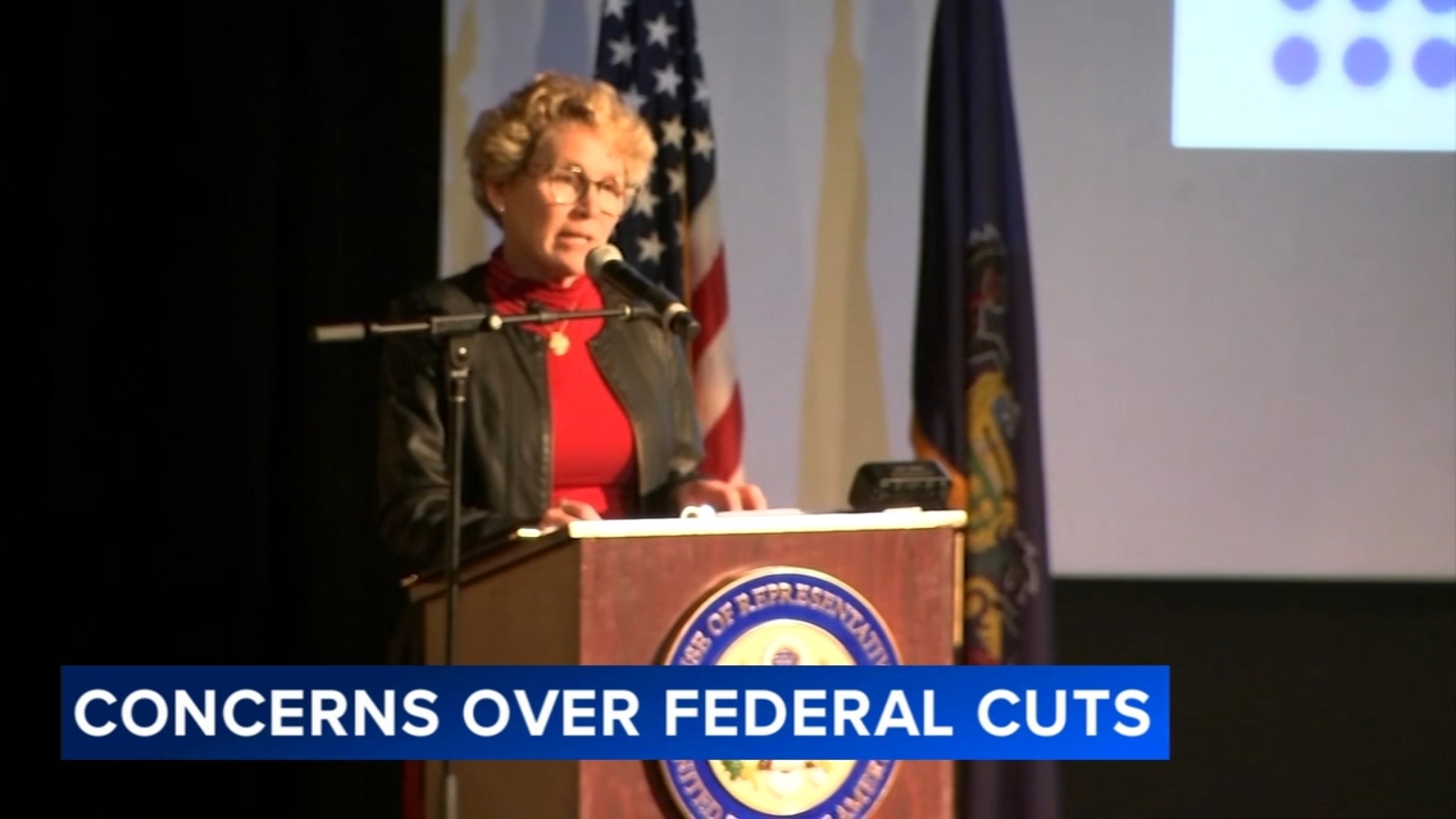
Federal job cuts dominated a packed town hall in Phoenixville, Pennsylvania, where hundreds of residents gathered to question the scale, legality, and human cost of workforce reductions ordered under the Trump administration and promoted by Elon Musk’s Department of Government Efficiency, commonly known as DOGE.
The event at the Colonial Theatre was held by Democratic U.S. Rep. Chrissy Houlahan, who represents Pennsylvania’s 6th Congressional District. Although she supports efforts to identify waste, fraud, and abuse in government, Houlahan expressed serious concerns about the administration’s methods and its impact on federal employees, public services, and communities that depend on them.
Residents also criticized the abrupt dismissals and demanded greater transparency from federal officials. Their concerns extended beyond Washington: workers in Pennsylvania, including hundreds employed at an Internal Revenue Service office, are already facing the consequences.
Phoenixville Residents Voice Fear and Frustration
The theatre reached capacity as residents from across the region came to discuss the administration’s aggressive federal workforce reductions. Several attendees described feeling anxious about the country’s direction and disappointed by what they viewed as insufficient oversight of the layoffs.
Kelly Walker of Sanatoga said the pace of the changes had left her frightened about the future. Carol Hanson of Chester Springs encouraged residents to remain engaged, speak publicly, and participate in peaceful protests when they believe government actions are harmful.
Their comments reflected a broader frustration among attendees who agree that government should operate efficiently but do not believe efficiency should come at the expense of legal protections, institutional expertise, or essential services.
Efficiency Is the Goal, but the Process Matters
During the town hall, Houlahan said she supports eliminating genuine waste and abuse in federal agencies. However, she questioned whether mass dismissals were being conducted with adequate evidence, consistency, and respect for established procedures.
Her message to affected workers was one of reassurance, although she acknowledged that many details remained unsettled. The uncertainty surrounding the cuts has left federal employees and their families unsure whether more reductions are coming or whether previously dismissed workers may be reinstated.
This uncertainty is particularly disruptive because federal workers often hold specialized positions that require extensive training. Positions involving tax collection, criminal investigations, diplomacy, park protection, and national security cannot always be filled quickly or easily. Even short-term staffing losses can create backlogs, delay services, and weaken emergency response capabilities.
The Controversial Email Demand
During the town hall, Musk again defended a directive requiring federal employees to submit an email describing five accomplishments from the previous week. According to the source, Musk warned that employees who failed to respond to a follow-up request could be fired.
The demand generated confusion across the federal government, especially when employees received inconsistent instructions from different agencies. Several major organizations, including the FBI and the State Department, advised their employees not to answer the message directly.
President Donald Trump defended the request, arguing that poorly performing government employees should be identified and held accountable. Supporters of the effort say productivity requirements can reveal employees who are not contributing sufficiently. Critics counter that a generic weekly report does not accurately measure performance and fails to account for the complexity of many government assignments.
They also argue that meaningful performance management requires clear expectations, documented evaluations, supervisors trained to assess results, and due process. Terminating employees without an individualized review risks punishing dedicated public servants while overlooking genuine failures elsewhere in the system.
Concerns Over Alleged Illegal Terminations
Outside Independence Hall, members of the American Federation of Government Employees gathered for a rally and argued that the terminations violated federal rules. Labor representatives and Democratic lawmakers have continued to press the administration to explain its legal authority for dismissing employees.
One of the central questions is whether the administration followed required procedures, including probationary status rules, reduction-in-force procedures, and applicable appeal rights. Federal employees are not automatically protected from being dismissed, but they are entitled to specific legal and procedural safeguards. The scope of those protections can vary by agency, position, and employment status.
Democratic U.S. Rep. Brendan Boyle argued that the dismissals could have a devastating effect on Pennsylvania and the Philadelphia region. He highlighted approximately 400 layoffs connected to a Pennsylvania IRS office, stressing that federal employment is also local employment.
Pennsylvania Families Bear the Economic Cost
Although the staffing decisions are made in Washington, their effects are felt in local economies. Federal employees purchase homes, pay taxes, support small businesses, and contribute to community organizations. When hundreds of positions are eliminated in one area, the resulting financial shock spreads well beyond the workers who receive termination notices.
Tax preparation and enforcement may also suffer when experienced IRS employees leave. Reduced staffing can lead to longer waits for taxpayer assistance, slower processing of returns, and diminished enforcement capacity. Boyle’s point was simple: positions funded by the federal government are often Pennsylvania jobs held by people who live and work in the same communities as their congressional representatives.
The impact becomes more severe when employees are abruptly removed from specialized roles. Years of institutional knowledge can disappear in a matter of days, making it difficult for remaining workers to maintain normal operations.
Public Lands and Cultural Sites Lose Experienced Staff
The cuts are not limited to administrative offices. Independence Mall, part of the national park system, reportedly lost rangers as a result of the layoffs. Those employees perform duties that visitors may not always see, including protecting historic resources, answering questions, monitoring conditions, and coordinating public safety.
Reducing park staff can diminish the quality of visitor experiences and make it harder to preserve nationally significant sites. It can also leave remaining employees with larger areas to patrol and more responsibilities to manage.
Supporters of the cuts may argue that every federal program should be evaluated for value. Yet efficiency reviews should distinguish between duplicative spending and services that provide a clear public benefit. Historic landmarks, law enforcement agencies, diplomatic offices, and tax-collection operations each serve distinct purposes and should not be treated as interchangeable.
Performance Letters Raise Questions About Fairness
Many dismissed workers received notices alleging that they had failed to meet performance standards. According to Boyle, however, some of those employees had never received a formal performance review during their time with the government.
If accurate, that discrepancy raises significant questions about the basis for the dismissals. A claim of poor performance normally requires supporting evidence. Without prior evaluations, warnings, improvement plans, or documented failures, employees may be left with little opportunity to understand the accusation or challenge it effectively.
Fairness also requires agencies to apply the same standard consistently. Managers should be able to address legitimate underperformance, but vague or unsupported notices can undermine confidence in the process and increase the likelihood of legal disputes.
What Workers and Communities Can Do
Residents affected by federal job cuts can take several practical steps:
- Preserve all employment records. Workers should save termination letters, contracts, performance reviews, emails, pay information, and any agency instructions related to the dismissal.
- Do not ignore deadlines. Federal employees may have a limited period to appeal a termination or request reconsideration, depending on their status and agency.
- Seek qualified assistance. A federal employment lawyer, union representative, or employee advocacy organization can help explain available options.
- Contact congressional representatives. Lawmakers can request information from agencies, raise individual cases, and question officials during hearings.
- Document effects on public services. Communities can track longer wait times, reduced access, canceled programs, and other consequences to present a clear record of the cuts.
- Participate peacefully and constructively. Public meetings, rallies, letter-writing campaigns, and elections provide lawful ways to influence future decisions.
Accountability Will Shape the Debate
The controversy over federal job cuts is ultimately about more than staffing numbers. It is about whether the government can pursue savings without abandoning legal safeguards, weakening public services, or treating employees unfairly. Rooting out fraud and waste is a legitimate goal, but the methods used to reach that goal must be transparent, evidence-based, and consistent with the law.
The packed Phoenixville town hall showed that the issue has generated strong emotions across party lines. Many residents appear willing to support responsible reform, but they want assurance that reductions are based on verified needs rather than arbitrary directives.
Conclusion: As federal workforce reductions continue to affect Pennsylvania employees and institutions, oversight will remain essential. The coming debate should focus not only on how much money the administration hopes to save, but also on what those savings cost the public. A credible efficiency campaign must protect essential services, respect employee rights, and provide evidence for every termination. Until those standards are met, the federal job cuts are likely to remain a source of outrage, uncertainty, and intense public scrutiny.