
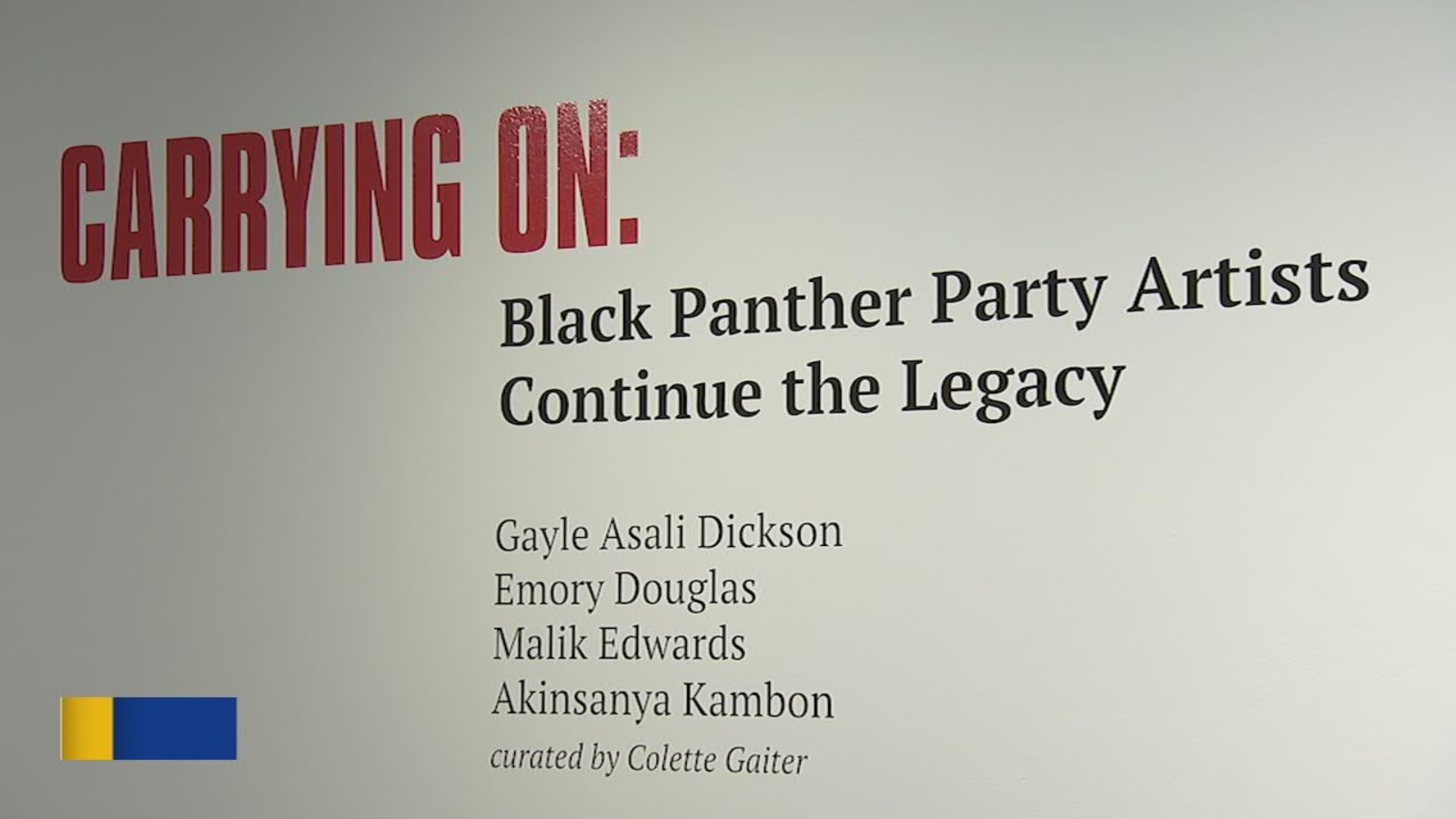
Four visionary black panther party artists are being celebrated in a powerful new exhibition at Rowan University Art Gallery & Museum in Glassboro, New Jersey. Titled “Carrying On: Black Panther Party Artists Continue the Legacy,” the show brings together four artists who once contributed to the legendary Black Panther newspaper, alongside their contemporary work that continues the party’s revolutionary artistic tradition. Running through March 15, the exhibition offers a rare opportunity to witness how revolutionary art evolves across generations while maintaining its commitment to social justice and community empowerment.
The Exhibition: A Cultural Bridge Between Decades
Curated by Colette Gaiter, Carrying On represents more than just an art display , it’s a living dialogue between past and present activism. The exhibition features work from artists connected to the original Black Panther newspaper, which served as one of the most influential publications in American social justice history. According to Mary Salvante, Director and Chief Curator for Rowan University Art Gallery & Museum, the institution aims to be “a cultural destination for the region” by “representing as many different voices as we can.”
This commitment to diverse representation is precisely what makes the exhibition so compelling. By gathering artists from different eras of the Black Panther movement, the show illustrates how visual activism has continuously adapted to address the pressing issues of each generation, from police brutality in the 1960s to the modern Black Lives Matter Movement.
Featured Black Panther Party Artists and Their Work
Four remarkable artists anchor the exhibition, each bringing their unique perspective and artistic evolution to the gallery walls.
Emory Douglas: The Revolutionary Minister of Culture
Perhaps the most iconic name among the featured black panther party artists, Emory Douglas served as the Revolutionary People’s Communication Network’s Minister of Culture from 1967 until the newspaper’s final issues in 1980. His bold, graphic illustrations became synonymous with the party’s visual identity, transforming art into a weapon of resistance.
Douglas’s approach to art was deeply rooted in storytelling from a perspective that mainstream media refused to provide. His work tackled quality-of-life issues in Black communities, presenting narratives of struggle, resistance, and hope through striking imagery. The phrase “All power to the people” remains one of his most enduring visual messages, capturing the essence of panther ideology in a single powerful declaration.
Douglas has always understood art’s transformative potential, noting that “the art is a powerful tool to language that can be used to enlighten, to inform, and perhaps a guide to action.” His presence in the exhibition honors the foundational role he played in establishing revolutionary art as a legitimate and necessary cultural force.
Gayle Asali Dickson: Honoring Black Women’s Legacies
Gayle Asali Dickson’s contribution to the exhibition represents a crucial bridge between generations of resistance art. Working for the Black Panther newspaper during a pivotal transition period when the organization’s focus shifted from self-defense to community survival programs, Dickson brought a distinctly feminist perspective to revolutionary imagery.
One of her most powerful series in the exhibition celebrates important Black women in history, including a striking tribute to Ida B. Wells, the pioneering journalist and anti-lynching crusader. This series reinforces how Black women’s contributions have often been marginalized even within movements for racial justice.
Dickson’s contemporary work demonstrates her continued responsiveness to current events. Among her pieces on display is a work created “in response to the George Floyd murder,” showing how her artistic practice remains engaged with ongoing struggles against racial violence and systemic injustice.
Malik Edwards: Pointillism Meets Artificial Intelligence
Malik Edwards represents the fascinating evolution of revolutionary art across technological paradigms. His work from the 1970s featured innovative pointillism pieces that proved remarkably prescient in anticipating digital culture. His piece titled “Videophilia” depicted people holding what could be described as early mobile devices , small screens on sticks , decades before smartphones became ubiquitous.
Today, Edwards continues pushing artistic boundaries by embracing cutting-edge technology. His current practice involves creating digital prints and experimenting with artificial intelligence programs, demonstrating that revolutionary art must continually evolve its tools to remain relevant. This trajectory from analog pointillism to AI-generated imagery shows how the spirit of innovation that defined the Black Panther era continues to thrive in unexpected ways.
Professor Akinsanya Kambon: Liberation Through Experience
Professor Akinsanya Kambon brings a deeply personal dimension to the exhibition through work that reflects his service in the Vietnam War. His art emerges from lived experience with both military conflict and the liberation struggles of Black communities, creating powerful visual narratives about freedom, sacrifice, and resistance.
According to Gaiter, “liberation is the biggest theme” running through Kambon’s work , a theme that resonates profoundly with both the historical mission of the Black Panther Party and contemporary movements for social transformation. His contribution reminds viewers that the fight for liberation spans multiple fronts, both domestic and international.
Historical Context: The Birth of Revolutionary Art
To fully appreciate the exhibition, understanding the origins of the Black Panther Party is essential. Founded in 1966 in Oakland, California, by Huey P. Newton and Bobby Seale, the Black Panther Party for Self-Defense emerged as a direct response to systemic police brutality in Black neighborhoods. What began as a local patrol organization quickly evolved into a national movement addressing broader issues of inequality, education, healthcare, and political representation.
Central to the party’s strategy was the recognition that cultural work was inseparable from political organizing. The Black Panther newspaper, launched in 1967, served as both an information platform and an artistic canvas, featuring Emory Douglas’s iconic illustrations alongside articles covering community programs, political analysis, and revolutionary theory.
The party’s reach extended far beyond Oakland, establishing chapters in cities across the country and building coalitions with other progressive movements of the era. This national scope helps explain why contemporary artists across different generations and regions continue to identify with and extend the Black Panther legacy.
Why This Exhibition Matters Today
The timing of Carrying On is far from coincidental. As Gaiter notes, the resonance between historical Black Panther activism and the Black Lives Matter Movement has brought renewed attention to the party’s visual culture. When millions took to the streets following the murder of George Floyd, many carried signs featuring imagery and slogans directly inspired by Black Panther artwork from the 1960s and 1970s.
This cultural continuity demonstrates that revolutionary art is not merely a historical artifact but a living practice that adapts to new circumstances while maintaining its core commitment to justice. The artists featured in the Rowan exhibition don’t simply preserve the past , they extend it, applying lessons learned from earlier struggles to contemporary challenges.
The exhibition also serves an educational function, introducing younger audiences to an artistic tradition they may have encountered only through social media reposts. By presenting original works alongside contemporary pieces, viewers can trace the evolution of revolutionary aesthetics and understand how today’s movements draw upon yesterday’s visual vocabulary.
Planning Your Visit
The Carrying On: Black Panther Party Artists Continue the Legacy exhibition offers an accessible entry point into revolutionary art history. Admission is free, removing economic barriers to experiencing this important cultural work.
Exhibition Details:
- Venue: Rowan University Art Gallery & Museum
- Address: 301 High Street W., Glassboro, NJ 08028
- Gallery: 301 High Street Gallery
- Dates: Through March 15
- Admission: Free
Glassboro is conveniently located in southern New Jersey, making the exhibition accessible to visitors from Philadelphia, the Jersey Shore, and the broader Delaware Valley region. The university’s commitment to being a cultural destination for the region ensures that visitors will find a welcoming environment designed to facilitate meaningful engagement with the artwork.
Conclusion: The Ongoing Revolution of Black Panther Party Artists
The legacy of black panther party artists refuses to remain confined to history books or museum archives. Through exhibitions like Carrying On at Rowan University, the revolutionary spirit embodied by Emory Douglas, Gayle Asali Dickson, Malik Edwards, and Professor Akinsanya Kambon continues to challenge, inspire, and transform new audiences. Their work reminds us that art has always been essential to movements for social change , a tool for education, mobilization, and cultural preservation that transcends any single generation.
As long as systemic injustice persists, the visual language developed by Black Panther Party artists will continue evolving, finding new forms and new practitioners committed to its radical potential. The artists featured at Rowan University prove that the work begun in 1966 is far from finished. Instead, it lives on through every contemporary artist who picks up a pen, brush, or digital tablet with the intention of speaking truth to power. This exhibition doesn’t just commemorate a legacy , it actively continues it, ensuring that the revolutionary imagination remains alive and well in the 21st century.