
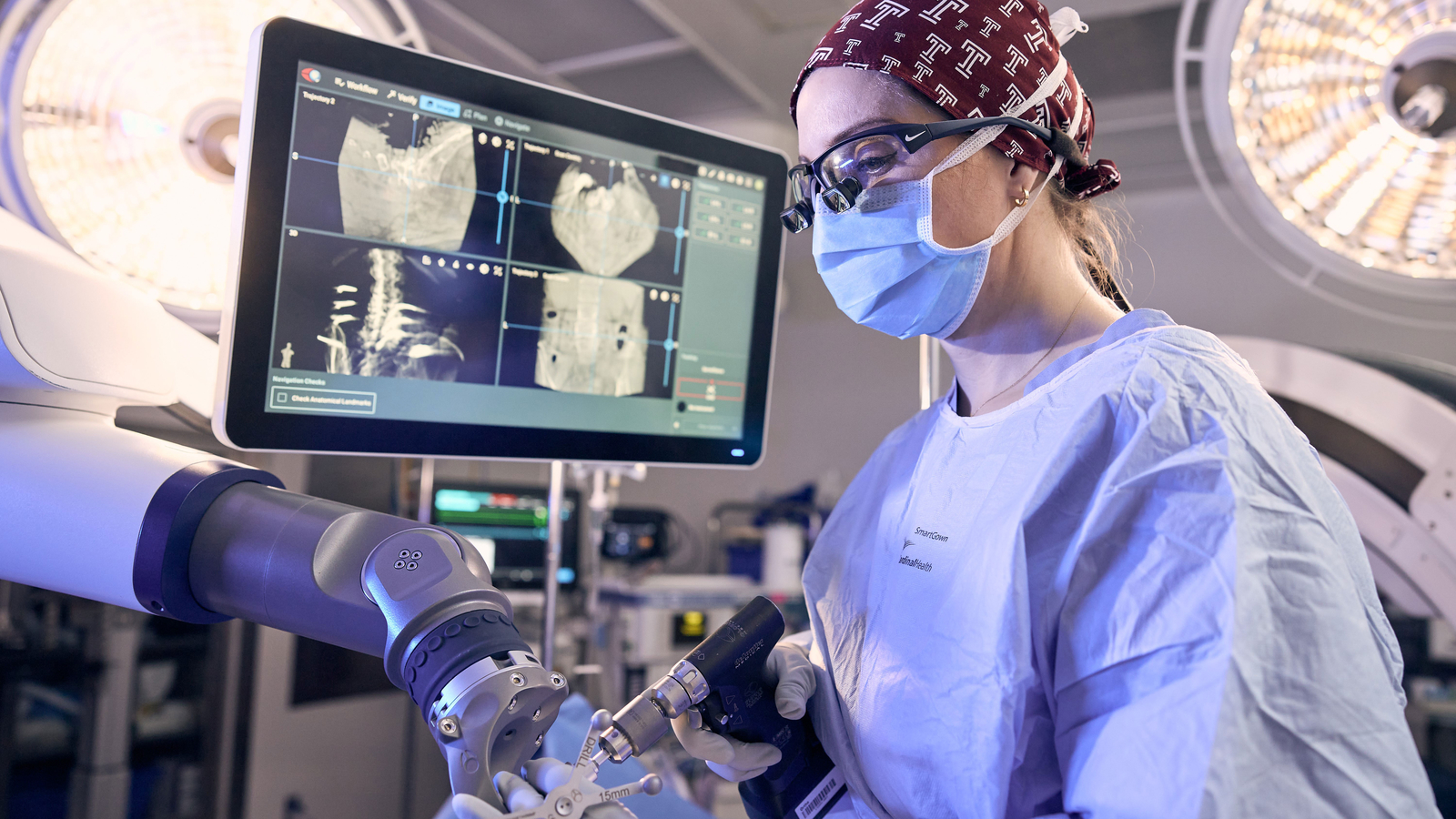
For people living with persistent back pain, limited mobility, or spinal instability, the prospect of surgery can feel daunting. Concerns about effectiveness, recovery, and surgical risk are understandable. Fortunately, robotic-assisted spinal surgery is helping spine specialists plan and perform complex procedures with greater precision while supporting less invasive approaches and more personalized care.
At Temple University Hospital, board-certified and fellowship-trained spine surgeon Dr. Theresa Pazionis is combining robotic navigation, patient-specific planning, and 3D-printed implants to improve the way certain spinal conditions are treated. These tools do not replace surgical expertise. Instead, they give surgeons a more detailed map of each patient’s anatomy, helping them make carefully informed decisions before and during an operation.
What Is Robotic-Assisted Spinal Surgery?
Robotic-assisted spinal surgery uses three-dimensional imaging, computerized planning, and a robotic guidance system to help a surgeon carry out a planned procedure. The system does not operate independently, and it cannot make clinical judgments on its own. The surgeon remains in control, using the technology to translate a detailed preoperative plan into precise surgical placement.
This technology is especially valuable when accuracy matters most, such as positioning pedicle screws, rods, and other spinal implants. Small deviations can affect the stability of the construct or place nearby nerves and blood vessels at unnecessary risk. Robotic assistance helps the surgeon follow the planned trajectory while adapting to the patient’s actual anatomy.
How the Process Works
Robotic spinal surgery generally follows a carefully coordinated workflow:
- Imaging and planning: Detailed CT or other three-dimensional images are used to create a map of the patient’s spine. The surgeon reviews this information to determine the safest approach and ideal implant positions.
- Plan refinement: The surgical plan is adjusted to account for the patient’s condition, anatomy, bone quality, alignment, and treatment goals.
- Surgical registration: During the procedure, the robotic platform aligns the digital plan with the patient’s anatomy.
- Guided placement: The robotic arm or navigation system directs instruments along the planned path, while the surgeon monitors the procedure and makes any necessary clinical decisions.
- Verification and completion: The construct is checked to confirm appropriate placement before the operation is completed.
Think of the technology as a highly sophisticated GPS system. A GPS can identify an efficient route and help a driver avoid errors, but a skilled driver is still responsible for navigating traffic, interpreting conditions, and responding to unexpected events. Robotics serves the same complementary role in the operating room.
Key Benefits of Robotics in Spine Care
Greater Surgical Precision
Complex spinal anatomy varies considerably from one person to another. Vertebrae may differ in size and shape, and abnormal curvature, prior surgery, tumors, infections, or deformities can make placement more difficult. A robotic platform allows the surgeon to account for these differences before making an incision.
By guiding instruments according to the individualized plan, robotics can improve the accuracy of hardware placement. More precise placement may reduce the likelihood of misplaced implants, revision procedures, and complications associated with injury to nearby structures.
Support for Minimally Invasive Techniques
Some robotic procedures can be performed through smaller incisions than traditional open surgery. Because the system provides a detailed view of the deeper anatomy, the surgeon may need less direct exposure to reach the target area.
Minimally invasive approaches may lead to less disruption of surrounding muscles and soft tissues. For appropriate candidates, this can translate into less postoperative pain, a shorter hospital stay, and a faster return to walking and everyday activities. Outcomes vary by patient and procedure, however, so a smaller incision alone does not determine the quality of a result.
Potentially Shorter Operating Time
Preoperative planning and real-time navigation can help the surgical team move through complex cases more efficiently. The robotic system can reduce uncertainty about instrument angles and implant positioning, allowing the team to focus on the technical steps of the operation.
Although not every case will be faster, improved workflow may reduce time spent repositioning instruments or repeatedly checking trajectories.
Reduced Radiation Exposure
Traditional spine procedures may require repeated X-rays or fluoroscopic images to confirm the position of instruments and implants. Robotic navigation can reduce the need for some of these repeated images because the platform continuously aligns the surgical plan with the patient’s anatomy.
Reducing unnecessary imaging is particularly valuable for patients and operating-room staff. The surgical team continues to follow appropriate radiation-safety practices, especially in cases that require additional imaging.
Personalized Spinal Implants and Surgical Planning
Robotics is only one part of the shift toward individualized spine care. Advances in additive manufacturing have also made patient-specific spinal implants possible. Using 3D-printing technology, implants can be designed to fit a person’s unique anatomy more closely than many standard, off-the-shelf devices.
A customized implant may improve contact with the available bone, support load distribution, and help surgeons correct alignment with greater accuracy. In selected complex cases, these characteristics may contribute to better fixation and a reduced need for revision surgery.
Not every patient requires a custom implant. Standard implants remain effective for many operations, and their design continues to improve. The decision depends on factors such as the condition being treated, spinal anatomy, the location of the problem, bone quality, and the surgeon’s assessment.
The Growing Role of Predictive Analytics
Another promising development is the use of predictive analytics and digital simulations. Sometimes described as a digital twin, a virtual model can help a surgeon compare possible approaches and anticipate how different implant positions or correction strategies may affect the final result.
Before surgery, the clinical team can use these models to study alignment, pressure distribution, range of motion, and other important variables. This makes it possible to refine the operation around the patient rather than applying the same technique to everyone.
Digital twins are not crystal balls. They are planning tools based on available medical data, and their usefulness depends on accurate imaging, sound clinical judgment, and careful execution. The final decisions must always consider the patient’s overall health and findings observed during surgery.
Technology Still Depends on Surgical Expertise
The most important message about robotic-assisted spine surgery is that the robot is an assistant, not the surgeon. It cannot evaluate nerve function, identify unexpected anatomy, manage bleeding, modify a plan when conditions change, or determine whether a patient is medically ready for surgery.
Excellent surgical technique remains essential. A well-designed plan is useful only when it is applied correctly, and technology cannot compensate for poor judgment or inadequate training. Experienced spine surgeons also evaluate broader health concerns that may affect healing and long-term stability.
Why Bone and Muscle Health Matter
Before any spinal operation, the care team should assess factors that influence recovery. Bone health is especially important because weakened bones may not hold implants securely. When appropriate, osteoporosis or other metabolic bone conditions should be identified and treated before surgery.
Sarcopenia, a loss of muscle mass and strength associated with aging or illness, can also affect mobility and recovery. Nutritional status, physical fitness, smoking, diabetes, medications, and chronic medical conditions may influence the risk of complications.
For this reason, medical optimization is a critical part of personalized care. Depending on the patient’s needs, the team may recommend strength exercises, nutritional support, bone-density evaluation, smoking cessation, or management of other health conditions before proceeding.
Who May Benefit from Robotic-Assisted Surgery?
Robotic systems can assist with several types of spinal procedures, including operations that require precise placement of screws and other hardware. They may be considered for adults with spinal deformity, degenerative disease, instability, tumors, infections, or other complex conditions.
Candidacy depends on more than a diagnosis. A qualified spine specialist will consider:
- The specific spinal condition and severity of symptoms
- The patient’s anatomy and any previous spinal operations
- Bone quality and overall nutritional health
- Age, activity level, and treatment goals
- Underlying medical conditions and surgical risk
- Whether a robotic or minimally invasive approach offers a meaningful advantage
Robotic assistance is not automatically the best choice for every case. For some straightforward operations, conventional navigation or other established techniques may produce an excellent result. The value of robotics lies in selecting it when improved planning and precision can address the challenges of a particular procedure.
What Patients Should Ask
When discussing surgery, patients should feel comfortable asking whether robotics is appropriate, which system will be used, and how it will change the planned operation. Other useful questions include:
- How will the technology improve accuracy in my specific case?
- Am I a candidate for a minimally invasive approach?
- Will custom 3D-printed implants be considered?
- How will my bone health and muscle strength be optimized?
- What complications are associated with this procedure?
- What should I expect during recovery and rehabilitation?
- How many procedures of this type has the surgical team performed?
The Future of Personalized Spine Surgery
Robotics, patient-specific implants, predictive analytics, and digital simulation are changing what is possible in spinal care. Together, these innovations can help surgeons plan with greater detail, place hardware more accurately, and choose implants that better match an individual’s anatomy.
For patients whose pain or instability has not improved with conservative treatment, these advances may offer a safer and more predictable path forward. Still, the strongest outcomes come from the right combination of technology, surgical skill, medical preparation, and attentive postoperative care.
To determine whether robotic-assisted spinal surgery is appropriate, patients should consult a fellowship-trained spine specialist who can evaluate their condition and explain the available options. A careful assessment can help ensure that the treatment plan is based not only on advanced technology, but also on the patient’s unique needs and long-term goals.