
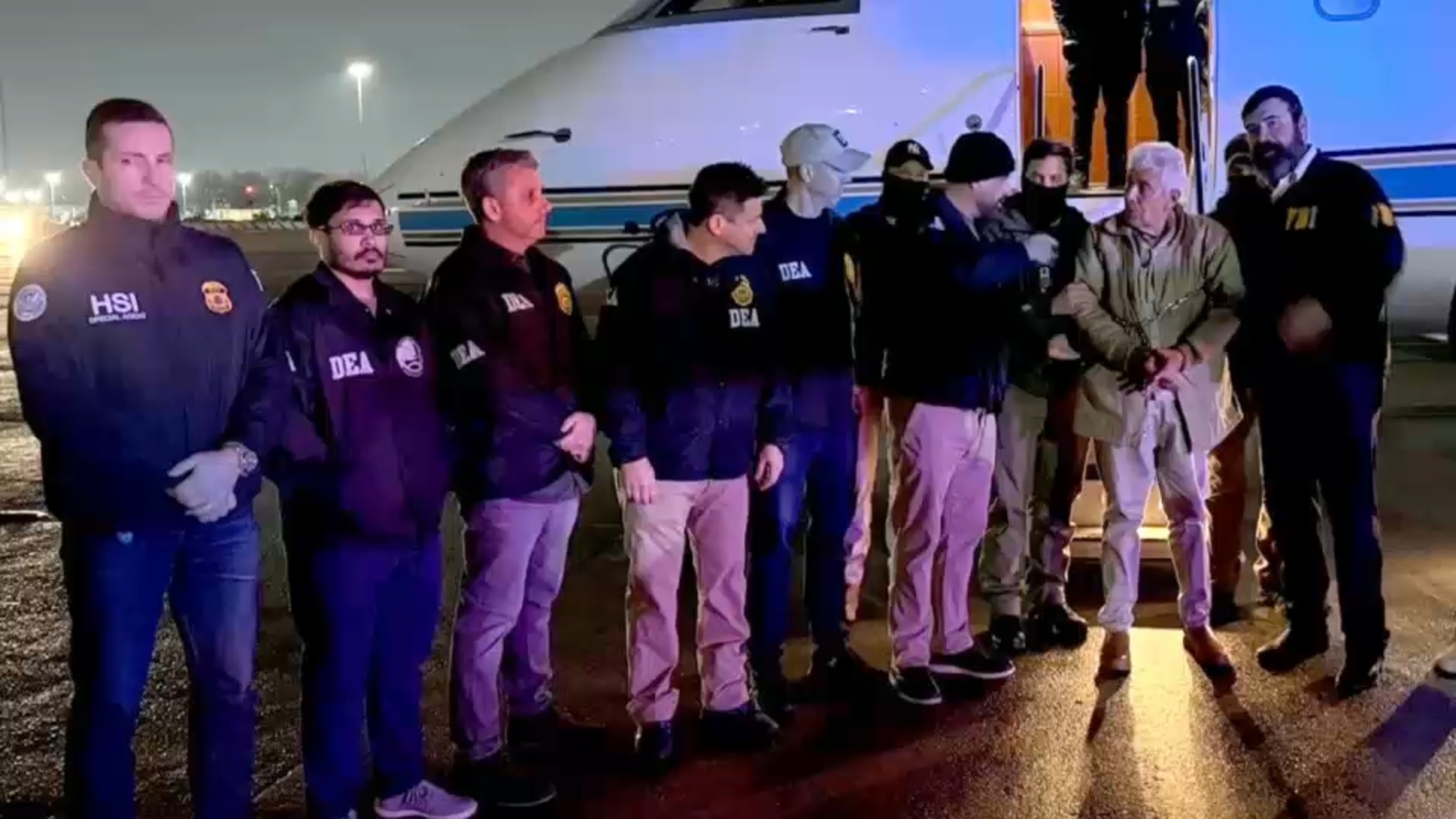
More than four decades after the brutal kidnapping and murder of Drug Enforcement Administration agent Enrique “Kiki” Camarena, Rafael Caro Quintero, the alleged architect behind one of the most infamous killings in the history of Mexican narco wars, has finally been arraigned in a United States federal courtroom. The 72-year-old Mexican drug lord stood before a Brooklyn federal court judge in shackles and an orange jumpsuit, facing multiple drug trafficking and weapons charges that could potentially carry the death penalty.
The arraignment marked a milestone moment in a case that has haunted the DEA for nearly 40 years, drawing more than 100 DEA agents to the New York City courtroom to witness what one official called “a historic event.”
Symbolic Courtroom Scene Draws DEA Agents From Across the Nation
The atmosphere inside the federal courthouse was charged with emotion as the man accused of orchestrating Camarena’s torture and killing in 1985 was finally forced to answer for his alleged crimes on American soil. Caro Quintero appeared in a bright orange tee shirt beneath a navy smock, shackled at the hands as he took his seat before the judge.
In a deeply symbolic gesture, a DEA agent was permitted to join U.S. marshals in escorting Caro Quintero from the courtroom, representing the agency’s long pursuit of justice for one of its fallen brothers. The moment underscored the significance of an investigation that has spanned multiple continents and generations of law enforcement personnel.
- Over 100 DEA agents packed the Brooklyn courtroom for the arraignment
- Caro Quintero faces charges including leading a continuing criminal enterprise
- A DEA agent symbolically joined marshals in escorting the defendant
- The 72-year-old entered a not guilty plea through his court-appointed attorney
From Guadalajara to Brooklyn: The Long Road to American Justice
The path to this American courtroom was extraordinarily long and circuitous. Caro Quintero was originally convicted in Mexico in 1985 for the torture and murder of Camarena, receiving a 40-year prison sentence. He served 28 years of that term before being released in 2013 when a Mexican judge ruled that he had been improperly tried. The decision sparked outrage from U.S. officials, who watched in frustration as the convicted killer vanished into hiding.
Five years later, in 2018, the FBI added Rafael Caro Quintero to its prestigious 10 Most Wanted Fugitives list, offering a staggering $20 million reward for information leading to his arrest or capture. The massive bounty reflected the seriousness with which American authorities viewed his alleged crimes and his continued involvement in the narcotics trade.
His whereabouts remained unknown until 2022, when Mexican authorities finally tracked him down once again. At the time of his recapture, the FBI warned that Caro Quintero should be considered “armed and extremely dangerous” and revealed that he was allegedly involved with both the infamous Sinaloa cartel and the Caro-Quintero drug trafficking organization operating in the Badiraguato region of Sinaloa.
The Camarena Case: A Defining Moment in DEA History
Enrique “Kiki” Camarena’s story remains one of the most significant chapters in the annals of American drug enforcement. He joined the DEA in 1974, just one year after the agency’s founding, and was deployed to Mexico where he spent more than four years investigating the country’s largest marijuana and cocaine trafficking operations.
By early 1985, Camarena was reportedly close to uncovering a multibillion-dollar drug pipeline that would have dealt a devastating blow to Mexican narcotics organizations. On February 7, 1985, while heading to meet his wife for lunch, Camarena was kidnapped in broad daylight in Guadalajara, Mexico. What followed was a brutal ordeal that ended with his torture and murder at the hands of those seeking to protect their lucrative criminal enterprise.
His killing became a watershed moment in the ongoing conflict between drug cartels and law enforcement, inspiring the popular Netflix series “Narcos: Mexico,” which dramatized the events surrounding his capture and the broader Mexican drug war of that era. The case also fundamentally transformed how the United States approached international drug enforcement cooperation.
Prosecutors Outline Decades of Criminal Activity
During the arraignment proceedings, Assistant U.S. Attorney Saritha Komatireddy delivered a powerful statement condemning Caro Quintero’s alleged criminal career. She stated that after 40 years, “the man who murdered Enrique Camarena is finally facing justice in the United States,” emphasizing that “justice never forgets.”
Komatireddy characterized Caro Quintero as someone who “pioneered Mexican drug trafficking” and established the violent enforcement methods that became hallmarks of cartel territorial control. The federal indictment charges him with multiple drug and weapons offenses in the Eastern District of New York, including the most serious charge of leading a continuing criminal enterprise,a charge that makes him eligible for capital punishment if convicted.
His court-appointed attorney entered a not guilty plea on his behalf and did not contest pretrial detention, ensuring that Caro Quintero will remain in U.S. custody as his case proceeds through the federal court system.
Part of a Larger Extradition Wave Under Trump Administration Pressure
Caro Quintero was not alone in his transfer to American custody. He was among 29 top drug operatives from Mexico who were expelled and transferred to the United States under significant pressure from the Trump administration. This mass extradition represented a dramatic shift in U.S.-Mexico relations regarding drug enforcement cooperation and signaled a new, more aggressive approach to pursuing cartel leaders.
The coordinated effort demonstrated that decades-old fugitives, no matter how long they had evaded capture, could still find themselves facing American justice. For law enforcement families and the DEA community, the extraditions offered a measure of closure that had long seemed impossible.
DEA Leadership Celebrates a Hard-Fought Victory
Following the arraignment, DEA Special Agent in Charge Frank Tarentino of the New York division addressed reporters outside the courthouse, his voice carrying the weight of four decades of pursuit. “Today is a historic event,” Tarentino declared. “We have waited 40 years for this day. This day, when justice would be served.”
Tarentino emphasized that Camarena “remains a symbol of strength, honor, courage, unity and determination” within the DEA and the broader law enforcement community. He pledged that Rafael Caro Quintero, “the man responsible for Kiki’s kidnapping, torture and murder in 1985 in Guadalajara, Mexico, will answer for his crimes.”
The presence of so many DEA agents at the hearing underscored the deeply personal nature of the case for the agency. Camarena was, after all, the first DEA agent killed on Mexican soil, and his memory has been honored through memorials, scholarship programs, and the annual Red Ribbon Campaign, which began in his honor and has become one of the largest drug prevention efforts in the United States.
Looking Ahead: What Comes Next in the Case
With pretrial detention secured and a not guilty plea entered, the case against Caro Quintero now enters the discovery and pre-trial motion phase. Given the complexity of the charges, the international dimensions of the evidence, and the high-profile nature of the defendant, legal observers expect the proceedings to extend over many months, if not years.
The death penalty eligibility attached to the leading a continuing criminal enterprise charge ensures that the stakes could not be higher for the aging defendant. However, regardless of the ultimate verdict, the simple fact that Caro Quintero has been brought to face American justice represents a profound achievement for the DEA and the families who have awaited this moment since 1985.
Conclusion: A Chapter Closed, Justice Pursued
The arraignment of Rafael Caro Quintero in a Brooklyn federal courtroom closes one chapter in a decades-long pursuit while opening another in the American legal system. For the DEA agents who packed the courtroom and the family of Enrique “Kiki” Camarena, the day represented long-awaited accountability for a crime that fundamentally shaped modern drug enforcement policy. While the legal battle ahead will be complex and lengthy, the symbolic weight of Caro Quintero standing before an American judge,shackled and facing the same justice system he allegedly spent decades evading,cannot be overstated. As prosecutors have pledged, “justice never forgets,” and after 40 years, that promise has finally been tested and affirmed on American soil.