
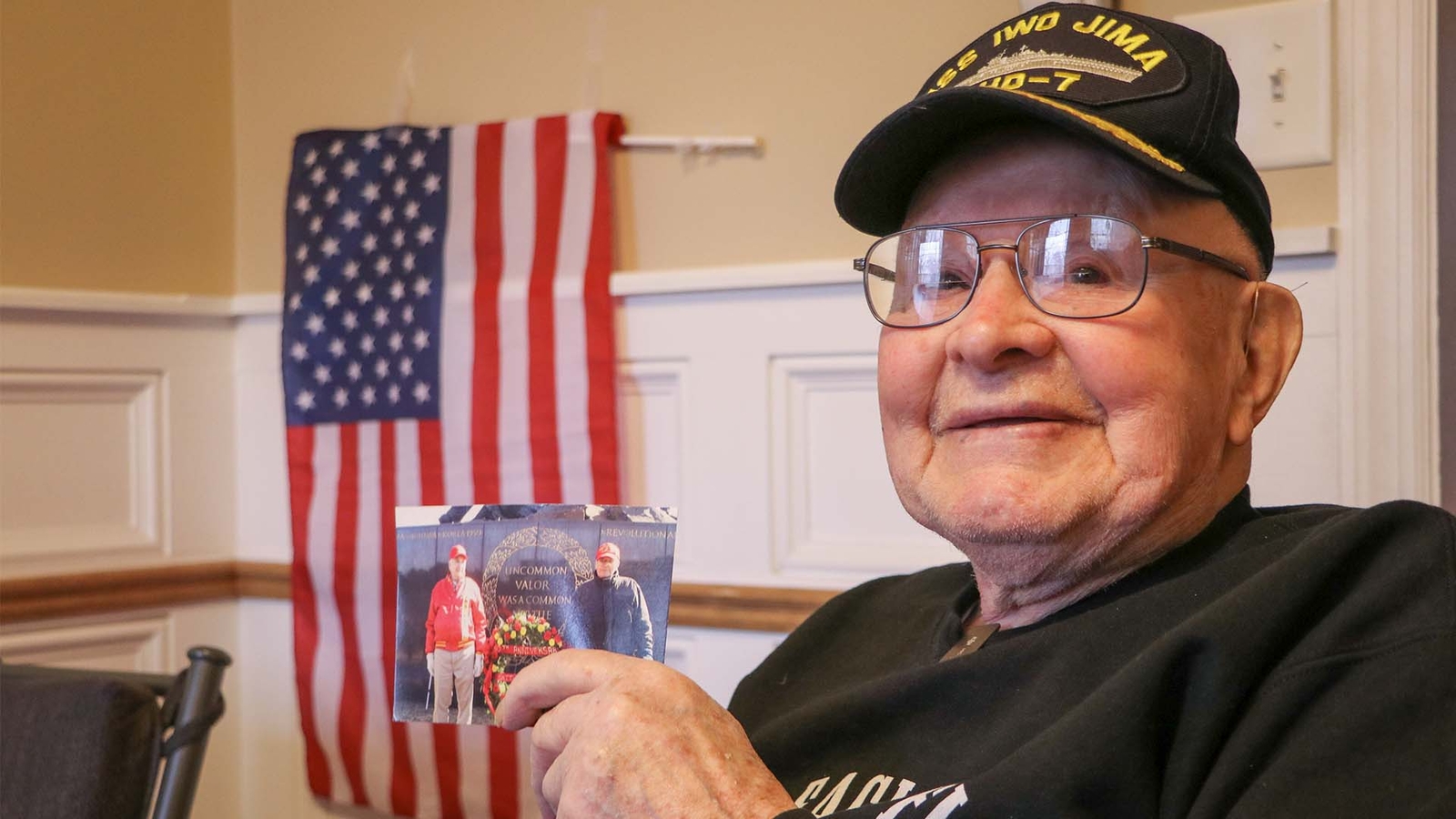
As the world marks the 80th anniversary of the Battle of Iwo Jima, the stories of the men who fought there grow ever more precious. Among the dwindling number of survivors, 99-year-old William “Buck” Myers of South Philadelphia stands as a living testament to one of the most brutal and iconic conflicts of World War II. His memories, still vivid after eight decades, offer a powerful reminder of the sacrifices made by an entire generation of American heroes.
The Battle of Iwo Jima, which raged from February 19 to March 26, 1945, remains one of the most significant engagements in the Pacific Theater. More than 6,800 American service members lost their lives on the small volcanic island, and nearly 20,000 were wounded. The raising of the flag atop Mount Suribachi, immortalized in Joe Rosenthal’s legendary photograph, became a defining image of American resilience and victory. Eighty years later, the battle’s legacy continues to shape how we understand courage under fire and the true cost of freedom.
Buck Myers: A South Philadelphia Son at War
Born and raised in South Philadelphia, William “Buck” Myers came of age during a time when the call to service echoed through every American neighborhood. Like millions of young men of his generation, Myers answered that call, joining the Marines and deploying to the Pacific in the waning years of the global conflict. His journey would take him to the black sands of Iwo Jima, where he would face some of the fiercest fighting of the war.
Recalling the chaos of those early days on the island, Myers describes the overwhelming sensory experience of combat with a clarity that belies his ninety-nine years. “We were undergoing fire at the time,” he explained, the memories still sharp enough to transport him back to 1945. “It has a certain distinct smell to it.” That smell,a mixture of cordite, sand, and something darker,remains etched in his mind, a sensory marker of one of history’s most consequential battles.
The Wounds of Iwo Jima
Myers’ service on Iwo Jima came at a steep personal cost. During the brutal fighting, he was struck in the back by shrapnel, an injury that would earn him the prestigious Purple Heart medal. The Purple Heart, awarded to those wounded or killed in action while serving with the U.S. military, is a tangible symbol of sacrifice,one that nearly every WWII veteran carries with both pride and pain.
For Myers, the physical wound healed, but the psychological scars have endured far longer. “I’ll never forget it, I’ll tell you the truth,” he says quietly. “It wakes me up at times, just the different things that happened, really.” This honest acknowledgment of trauma speaks to a reality that many combat veterans face, regardless of the era in which they served. The Battle of Iwo Jima left invisible wounds alongside the visible ones, and Myers’ willingness to share this truth provides an important lesson for younger generations.
Sixty Years Later: An Unexpected Reunion
In a remarkable twist of fate, Myers’ wartime experience would shape his life in ways he could never have imagined. Six decades after the battle, he was reunited with Arthur Gavlock, a fellow veteran who had fought beside him on Iwo Jima. The reunion came about through the determined efforts of Gavlock’s granddaughter, Holly Fantaskey Jermyn, who helped her grandfather locate his long-lost mates from the war.
Gavlock had spent years searching for the men with whom he had shared the harrowing experience of the Battle of Iwo Jima. When his granddaughter helped facilitate the reunion, it marked the beginning of a meaningful friendship that would last until Gavlock’s death in 2010. The bond forged in combat proved stronger than the six decades that had separated them, and the two men stayed in close contact throughout Gavlock’s remaining years.
A Friendship Written in Ink
The depth of Gavlock’s connection to Myers was evident in the small details. Gavlock kept Myers’ phone number written on his nightstand, a daily reminder of a friendship that transcended the boundaries of ordinary acquaintance. This gesture,the simple act of preserving a number in ink,speaks volumes about what these veterans meant to one another. For men who had survived the crucible of Iwo Jima together, the connections made on that battlefield were irreplaceable.
When Gavlock passed away in 2010, the friendship did not end. Fantaskey Jermyn, Gavlock’s granddaughter, remained connected with Myers and his family, ensuring that the bonds forged in wartime would continue to bridge generations. This continuation of relationship across decades represents something profound about the legacy of WWII veterans,their stories and connections ripple outward through families and communities long after the battles themselves have ended.
Marking the 80th Anniversary Together
This week, as the nation paused to recognize the 80th anniversary of the Battle of Iwo Jima, Myers and Fantaskey Jermyn reunited once again. This time, they came together to share their story, ensuring that the experiences of those who fought on the island would not be forgotten. Their collaboration represents the crucial work of passing memory from one generation to the next.
For Myers, now approaching his centenary year, these moments of reflection carry particular weight. He is among the last of a generation that will soon be gone entirely. When the 90th anniversary arrives, there may be no survivors left to tell their stories in person. This makes each interview, each reunion, and each shared memory an invaluable historical artifact.
More Than a Soldier
Beyond his service in WWII, Buck Myers has built a rich and full life. He is a devoted Philadelphia Eagles fan, following the team through decades of triumphs and heartbreaks with the same loyalty he showed his country in combat. He is also a grandfather and great-grandfather, roles he treasures deeply. His influence on his family extends beyond the personal,his grandsons were inspired by his service to join the military themselves, continuing a family tradition of service to country.
These details paint a picture of a man who did not allow his wartime experiences to define his entire existence. While the memories of Iwo Jima wake him in the night, he has built a life filled with family, community, and the simple pleasures that make up a well-lived life. This balance between honoring the past and embracing the present offers a valuable perspective for all who hear his story.
Preserving the Stories of Local Heroes
The effort to document Myers’ story is part of a larger movement to preserve the experiences of local WWII veterans before their voices are silenced forever. U.S. Navy veteran Shawn Swords and his film crew, working through their organization American Veterans Media, are dedicated to capturing this crucial history through film. Their work represents a vital link between the generation that fought WWII and the generations that follow.
Documentary filmmakers like Swords understand that veteran stories are not just historical records,they are living testimonies that carry lessons applicable to any era. By capturing these narratives on film, they ensure that future generations will have direct access to the voices of those who served. This kind of military reunion storytelling preserves not just facts, but the texture of lived experience.
The Enduring Legacy of Iwo Jima
The Battle of Iwo Jima occupies a unique place in American military history. The iconic photograph of the flag raising on Mount Suribachi has become synonymous with American triumph and sacrifice. Beyond the image, however, lie thousands of individual stories,each one a universe of fear, courage, loss, and survival. Buck Myers’ story is one such narrative, a reminder that history is ultimately composed of individual human experiences.
As we mark this 80th anniversary, the words and memories of veterans like Myers serve as both tribute and warning. They honor those who gave their lives on that small island, and they caution future generations about the true cost of war. The smell of battle that still haunts Myers, the wounds that never fully healed, the friendships that spanned decades,these are the human dimensions of a battle too often reduced to statistics and iconic images.
Carrying the Torch Forward
The work of preserving these stories falls not just to documentary filmmakers but to all of us. Whether through supporting veteran organizations, listening to the elders in our communities, or simply taking the time to learn about events like the Battle of Iwo Jima, each of us has a role to play in honoring this legacy. The connections formed by veterans like Myers and Gavlock,and continued by family members like Fantaskey Jermyn,demonstrate how the bonds of service can ripple across generations.
Conclusion
Ninety-nine years old and still telling his story, Buck Myers embodies the resilience and spirit of the Greatest Generation. His reflections on the Battle of Iwo Jima, shared on the 80th anniversary of that pivotal conflict, remind us that history is not made of dates and statistics alone. It is made of flesh-and-blood men and women who faced impossible circumstances and emerged with stories that continue to teach us about courage, friendship, and sacrifice.
As the years pass and the ranks of WWII veterans continue to thin, stories like Myers’ become increasingly precious. The reunions, the documentaries, the simple act of a granddaughter keeping her grandfather’s friend close,these are the threads that weave the past into the present. They ensure that the legacy of Iwo Jima, and of all who fought there, will not be forgotten. In hearing Myers’ words, we honor not just his service, but the service of all those who stood beside him on those black volcanic sands eight decades ago.