
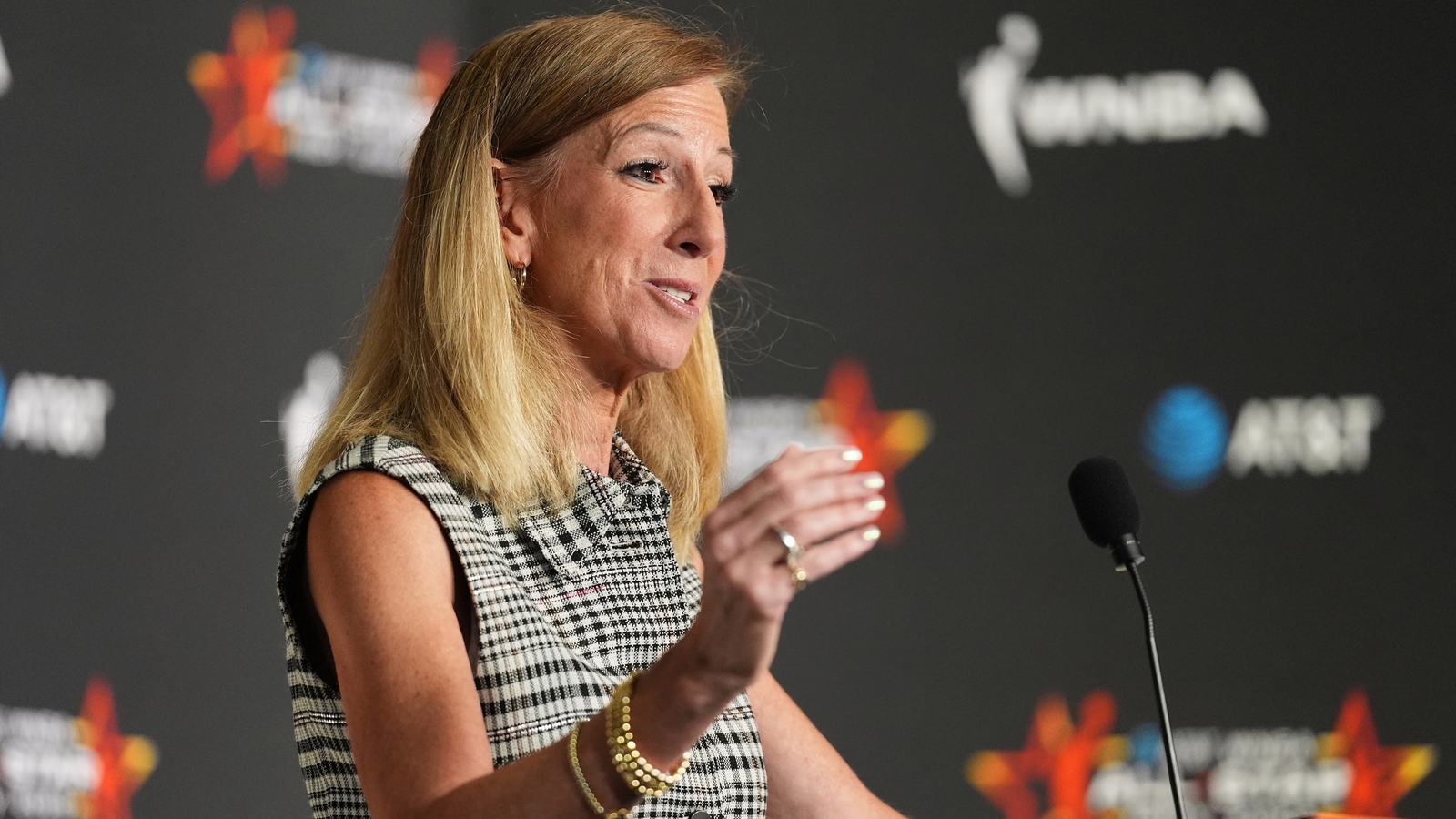
The Cathy Engelbert retirement announcement marks the close of one of the most consequential chapters in women’s professional basketball history. After more than seven years steering the WNBA through unprecedented growth and considerable turbulence, Engelbert confirmed she will step down at the end of the year, leaving behind a transformed league and a complex legacy that will be debated for years to come.
Engelbert, who turns 62 in November, made the announcement in conjunction with NBA Commissioner Adam Silver, who praised her stewardship during what he called “the most significant period of growth in the league’s 30-year history.” As the second-longest tenured leader the WNBA has ever had, Engelbert’s departure signals not just a changing of the guard, but the end of an era defined by ambitious expansion, record-breaking financials, and persistent cultural friction.
A Business Leader’s Bold Vision
When Cathy Engelbert took over as WNBA commissioner in 2019 after a distinguished career as president of Deloitte, the league faced existential questions about its long-term viability. Sagging attendance, limited media coverage, and franchise instability had cast doubt on whether women’s professional basketball could sustain itself as a major American sports property. Engelbert was brought in specifically as a turnaround specialist, and she approached the role with the analytical mindset of a Fortune 500 executive.
“I was brought in as a business leader to transform the business,” Engelbert explained in a phone interview with The Associated Press. She pointed to measurable improvements across revenue, merchandise sales, viewership, and attendance as evidence that her strategic approach paid dividends. Perhaps the most striking metric: the average value of a WNBA franchise skyrocketed from roughly $10 million in 2019 to approximately $460 million by 2026, a nearly 46-fold increase that reflects the broader explosion of interest in women’s sports.
Landmark Achievements That Reshaped the League
Engelbert’s tenure produced several watershed moments that fundamentally altered the WNBA’s economic landscape and competitive stature.
The Transformative Collective Bargaining Agreement
The most celebrated achievement of her tenure came this past spring with the negotiation of a new collective bargaining agreement that introduced the WNBA’s first ever million-dollar player salaries. The CBA represented a hard-fought compromise after contentious negotiations that left some hard feelings on both sides of the table. Beyond headline-grabbing salaries, the agreement addressed long-standing player concerns about compensation, working conditions, and revenue sharing.
Charter Flights and Player Welfare
One of the most tangible quality-of-life improvements for players came through the implementation of charter travel for teams. For years, WNBA players endured the physical toll of commercial flights on the day of games, a logistical burden that compounded the inherent challenges of professional athletics. Engelbert prioritized charter travel as both a competitive necessity and a recognition of players’ professional status.
Media Rights and Expansion
Engelbert presided over negotiations for a historic long-term media rights deal that substantially increased the league’s broadcast footprint and revenue streams. Coupled with a planned expansion to 18 teams by the end of the decade, these developments positioned the WNBA for sustained growth at a moment when women’s sports were capturing unprecedented cultural attention.
Record television ratings across multiple networks, surging merchandise sales, and consistently strong attendance figures further validated the strategic direction Engelbert championed.
The Tumultuous Side of Transformation
Growth, however, came with growing pains. The Cathy Engelbert retirement conversation cannot be divorced from the controversies and tensions that marked her time in office. As the league’s profile rose, so too did the volume of criticism directed at its leadership and players alike.
Player Safety and Online Vitriol
Players have publicly expressed concerns about the surge in social media harassment directed at them over the past several seasons. Many felt the league office did not move aggressively enough to address safety concerns, both online and at venues. Engelbert consistently condemned the abuse, calling such attacks “unacceptable,” but critics within the player ranks argued that rhetoric needed to be matched with more robust protective measures.
Navigating the Transgender Athlete Conversation
The league also found itself at the center of broader cultural debates regarding transgender athletes participating in women’s professional sports. Engelbert attempted to navigate this sensitive terrain by stating clearly, “We have no current eligibility issues in the WNBA,” while emphasizing that any future policy discussion would involve the players’ association and the athletes themselves. Nevertheless, the topic remained a persistent source of public controversy throughout her tenure.
Strained Relationships with Players
Perhaps most telling was the candid assessment offered by New York Liberty star Breanna Stewart, vice president of the WNBA players’ union executive committee. Speaking before the All-Star Game, Stewart noted that while players respect Engelbert, “there is not much of a relationship” between the commissioner and the athlete community. The friction became particularly visible during the recent CBA negotiations, when public disagreements over terms exposed deep rifts in trust and communication.
Engelbert has consistently maintained that her relationships with players remain productive, even as she acknowledged the complexity of representing both ownership interests and athlete welfare.
Why Now? The Personal Side of Departure
For Engelbert, the timing of the retirement announcement reflects both strategic calculation and deeply personal motivations. She revealed that she had originally planned to serve only three and a half years when she accepted the role, meaning her seven-and-a-half-year tenure already exceeded her initial commitment.
“This is a really good time given the financial transformation journey we’ve been on,” Engelbert explained. “Getting the collective bargaining agreement done, getting a long-term media rights deal done, getting expansion done.” With these foundational pieces in place, she believes the league is positioned for its next chapter under fresh leadership.
Family considerations also played a significant role. Engelbert spoke emotionally about the online hate she has endured personally, noting that the vitriol has spilled over and affected her family. With her mother approaching her 90th birthday and two children, one of whom she says she barely sees, the prospect of retirement carries profound personal meaning.
“My mom is turning 90 this year, and she said that ‘it would be good if you were retired to spend more time with me,'” Engelbert shared with a laugh. “I’m one of eight kids, and I have five brothers. They always say, ‘Can you retire so you can spend more time with us?'”
What Comes Next for the WNBA
The WNBA commissioner succession process is already underway, though Engelbert has been tight-lipped about specific candidates. She confirmed that the league is evaluating both internal and external potential successors, suggesting that the next commissioner could come from within the existing league office structure or from outside the organization entirely.
Whoever assumes the role will inherit a league in dramatically better financial shape than the one Engelbert inherited in 2019, but they will also face a more complex cultural and political environment. The challenges of player safety, social media governance, transgender policy, and maintaining the delicate balance between growth and athlete welfare will require careful navigation.
Engelbert has pledged to remain engaged through the end of the year to ensure a smooth transition, and even offered to stay beyond December if the succession search requires more time. “I love women’s basketball and am not going anywhere yet,” she affirmed. “We’ll run a real succession process in the remaining four months. If we don’t find someone, I’ll stay on.”
She also expressed a desire to support her successor in ways she herself was never supported. “I had no transition. I walked in the door, and I was by myself, as no one transitioned me into this role,” she reflected. “Hopefully I can help this next leader transition in, especially considering the elevation of this league.”
A Complicated Legacy in Women’s Basketball
Evaluating Engelbert’s tenure requires holding two truths simultaneously: the WNBA she leaves behind is immeasurably stronger than the one she found, yet the human cost of that transformation, on players and on Engelbert herself, is real and significant. The financial metrics tell a story of staggering success. The lived experiences of those within the league paint a more nuanced picture.
The Cathy Engelbert retirement announcement invites reflection on what the WNBA has become and what it might yet become. Her strategic mind, business acumen, and relentless focus on financial sustainability delivered tangible results that will benefit the league for decades. The question facing her successor is whether that growth can continue without sacrificing the trust and goodwill of the athletes who make the product possible.
As the WNBA prepares to welcome its next leader, the basketball world watches with anticipation. The foundation Engelbert built is solid, the momentum is undeniable, and the potential remains enormous. The next commissioner will inherit both a thriving enterprise and the unfinished work of building a league where transformation and trust move forward together.