
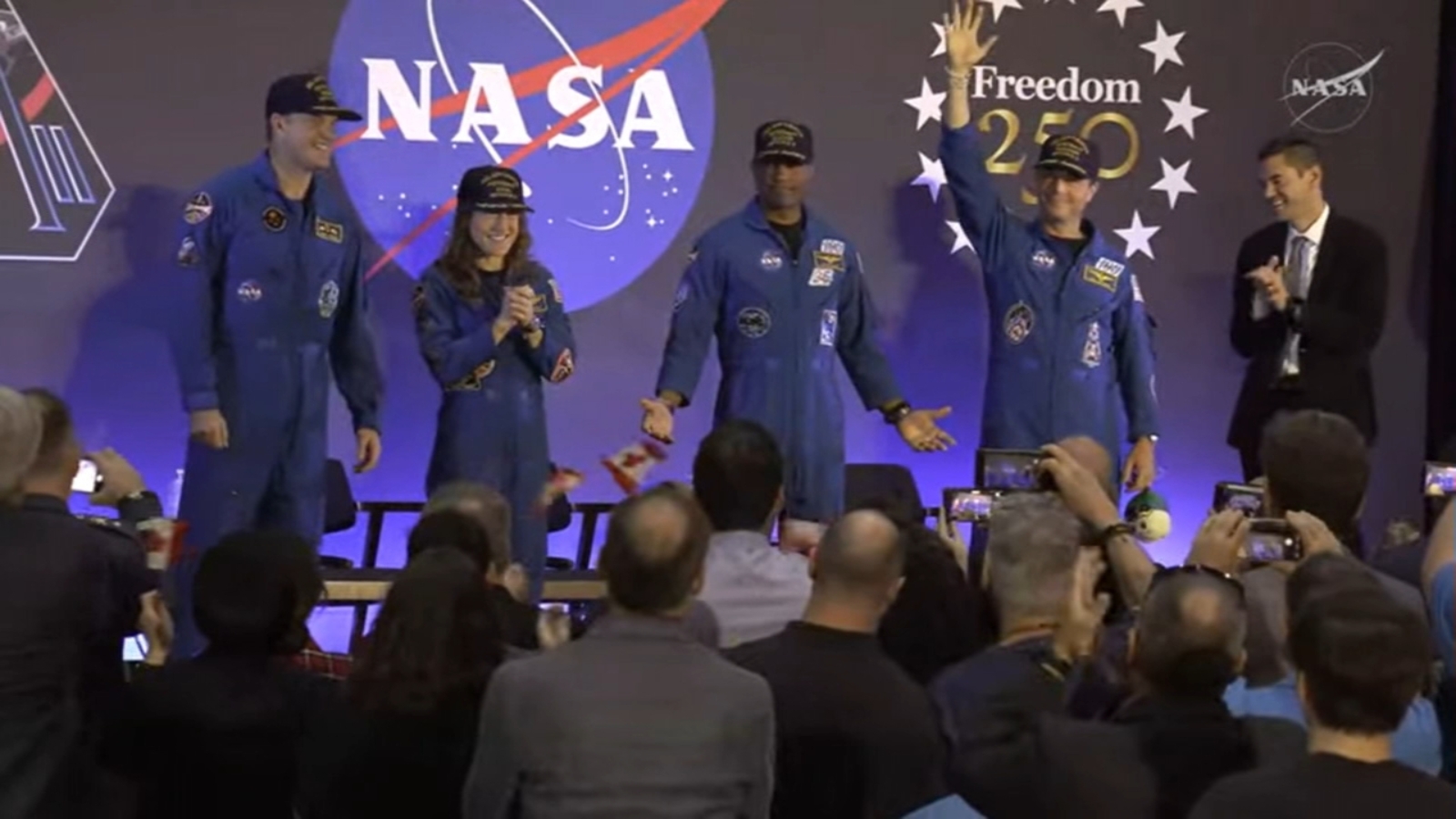
The Artemis II mission has returned its astronauts to Earth, but the crew is still adapting to gravity, daily routines, and the unexpected public attention surrounding their historic journey around the Moon. During a recent appearance at NASA’s Johnson Space Center in Houston, Reid Wiseman, Victor Glover, Christina Koch, and Jeremy Hansen reflected on the mission, its challenges, and what their flight means for humanity’s next steps into deep space.
The mission launched successfully, carried the crew on a lunar flyby, and ended with a safe splashdown. It marked the first time astronauts had traveled around the Moon since the Apollo era and served as a critical test of the spacecraft, navigation systems, life-support equipment, communications, and operations needed for future lunar missions.
A Historic Flight With Real-World Imperfections
NASA characterized the mission as a success from liftoff through the lunar flyby and return to Earth. The four astronauts agreed with that assessment, but they also emphasized that the journey was not flawless. Like any complex spaceflight, Artemis II presented problems that required the crew and support teams on the ground to respond, adapt, and keep the mission moving safely.
For Glover, that combination of achievement and imperfection is an important part of the mission’s legacy. He explained that the crew had done exactly what it prepared to do and now needed to confront the scale of what that accomplishment meant.
That sense of significance also became personal for Koch. After speaking with her husband, she became emotional when he told her that her work had made a difference. For an astronaut, the most meaningful measure of a mission may not be publicity or personal recognition, but knowing that years of training and service had inspired or affected people beyond the flight itself.
What Artemis II Actually Accomplished
Unlike the Apollo lunar landings, Artemis II did not place astronauts on the Moon. Instead, the crew traveled around our nearest celestial neighbor before returning home. That distinction is essential: the mission was designed as a proving flight, not a landing expedition.
- Test the crew spacecraft with astronauts aboard during a deep-space mission.
- Fly the spacecraft and its occupants around the Moon.
- Evaluate navigation, communications, life-support, and other critical systems.
- Give flight controllers and engineers experience supporting a human mission beyond low Earth orbit.
- Prepare NASA and its international partners for increasingly complex Artemis missions.
Although the astronauts did not land, their journey crossed a boundary no human crew had reached in more than half a century. It also demonstrated that NASA’s modern lunar exploration program can support people traveling far beyond Earth while relying on a combination of spacecraft, international cooperation, and highly coordinated ground operations.
Coming Home Is Its Own Adjustment
Returning from space does not immediately return the body and mind to ordinary life. Koch described waking during her first days back on Earth and briefly feeling as though she were still floating. She had to remind herself that gravity was once again keeping her firmly on the ground.
That experience illustrates why astronaut rehabilitation begins immediately after landing. Even a relatively short mission can affect balance, coordination, muscle function, sleep, and spatial awareness. Recovery allows the cardiovascular and musculoskeletal systems to readapt gradually while medical teams monitor each crew member’s health.
The psychological transition is just as real. Astronauts must move from a tightly structured environment,where every action can affect mission safety,to a world filled with noise, schedules, family responsibilities, and public expectations. The Artemis II astronauts are also adjusting to a new level of attention. They completed a historic mission and have become visible representatives of a program watched around the world.
Their reflections suggest that the return involved more than physical recovery. It required the crew to process what they had seen and done, reconnect with loved ones, and understand how their achievement would be remembered.
The Bathroom Problem Nobody Can Ignore
One of the most memorable mission anecdotes involved a problem with the spacecraft’s waste-management system. Wiseman explained that a vent used to move substances away from the spacecraft experienced plumbing difficulties during the first two days.
He jokingly recalled watching through the window as the system released what looked like countless tiny flecks of ice into space. The visual was fascinating, but the malfunction was more than a curiosity. In a closed spacecraft, even a small plumbing or ventilation issue can affect crew comfort, sanitation, and the efficient use of limited resources.
The incident provided a useful reminder that human spaceflight depends on ordinary systems working in extraordinary conditions. Rockets, navigation computers, and advanced guidance systems often receive most of the attention, but crews also need reliable toilets, ventilation, water management, and waste disposal. A mission cannot be considered truly successful unless those basic systems function as part of the larger spacecraft.
Problems encountered during Artemis II can also improve later missions. Engineers and flight controllers will review the data, assess the system’s performance, and determine whether procedures or hardware should be changed. This iterative process is one of the primary reasons NASA conducts crewed test flights before attempting more ambitious operations.
Why the Moon Flyby Still Matters
The crew’s close approach to the Moon was not a substitute for landing, but it was a major technological and human milestone. Artemis II tested people and equipment together in the deep-space environment needed for a lunar landing campaign.
That matters because missions become more difficult with every additional stage. A lunar landing requires:
- A reliable trip from Earth to lunar orbit.
- A proven spacecraft capable of supporting astronauts during the journey.
- A crew able to transfer between vehicles safely.
- A lunar lander designed to descend to the surface and return to orbit.
- Surface systems capable of supporting astronauts away from Earth.
- Missions, spacesuits, tools, communications, and navigation prepared for lunar conditions.
By flying astronauts around the Moon and bringing them home safely, the Artemis II mission supplied evidence that the first major elements of that sequence can work with humans aboard. Future crews will still face risks, but they can build on experience rather than beginning entirely from theoretical models.
Wiseman’s Message About the Next Lunar Landing
When asked whether a crew could land on the Moon in the future, Wiseman expressed confidence, tempered by realism. He said that if the Artemis II astronauts had been given a lander and the opportunity, they would have been prepared to descend to the surface. At the same time, he acknowledged that landing would be extremely technically challenging.
His message to the teams preparing future missions was direct: they should approach the work every day believing that success is achievable. That does not mean overlooking risks. Instead, it means combining confidence with discipline, testing, and careful engineering.
NASA currently plans to use Artemis III as a low Earth orbit mission involving the lunar lander before attempting a lunar landing with Artemis IV. According to the information shared during the crew’s Houston remarks, NASA aims for the Artemis IV crew to land on the Moon in 2028. NASA officials also indicated that astronaut selections for the upcoming crews would be announced soon.
Schedules and mission designs can change as hardware is tested and technical challenges arise, but the roadmap reflects NASA’s intention to move step by step. The Artemis III work in low Earth orbit could provide valuable experience with the lunar lander before that vehicle is committed to a deep-space journey.
The International Dimension of Artemis
The Artemis II crew included three NASA astronauts and one Canadian Space Agency astronaut. Hansen’s participation underscored that lunar exploration is not solely a United States effort. Artemis is an international program, and the experience gained by international astronauts and partner agencies will help shape future operations.
International participation can distribute expertise, strengthen diplomatic relationships, and create a broader foundation for exploration. It also means that the success of the lunar campaign depends on communication and coordination across agencies, cultures, engineering organizations, and mission-control teams.
The presence of a Canadian astronaut also highlighted Canada’s contribution to human spaceflight and its role in the Artemis program. As missions become longer and more complicated, cooperation among nations will become increasingly important.
Lessons for the Artemis Generation
The astronauts’ reflections offer several lessons about exploration. First, progress rarely arrives in one dramatic leap. Artemis II was not a lunar landing, but it was a necessary step toward one. Second, impressive technology still depends on practical details, from plumbing to sleep schedules. Third, exploration is a human endeavor shaped by emotion, relationships, and a shared sense of purpose.
For engineers, the mission supplied operational data. For astronauts, it provided experience that cannot be replicated through simulation alone. For young people considering science, engineering, medicine, or mathematics, the crew’s journey demonstrates that ambitious goals are reached through years of study, practice, teamwork, and persistence.
The crew’s return also reinforced how dangerous and demanding space travel remains. No successful mission eliminates risk. Instead, each flight improves knowledge, exposes weaknesses, and allows future explorers to proceed with greater understanding.
Looking Ahead After Artemis II
The success of the Artemis II mission gives NASA a stronger foundation for the next phase of lunar exploration, but it does not guarantee that the entire program will proceed without delays. The lunar lander, spacesuits, orbital mechanics, communications, surface systems, and mission schedules must all mature before astronauts can safely reach the Moon.
Wiseman’s confidence reflects the crew’s experience: the distance between Artemis II’s lunar flyby and a future landing is significant, but no longer appears theoretical. The same systems, people, and partnerships that supported this historic flight will continue developing through Artemis III, Artemis IV, and later missions.
As the astronauts continue adjusting to life on Earth, their mission remains a defining achievement of the modern space age. Artemis II carried humans around the Moon, tested critical deep-space capabilities, revealed issues that engineers can address, and brought the world closer to seeing astronauts walk on the lunar surface again.
The lasting significance of the Artemis II mission is not that it completed every objective of the Artemis program. Its importance lies in proving that astronauts can again travel into deep space, travel around the Moon, and return safely,with the knowledge, courage, and international cooperation needed to take the next step.