
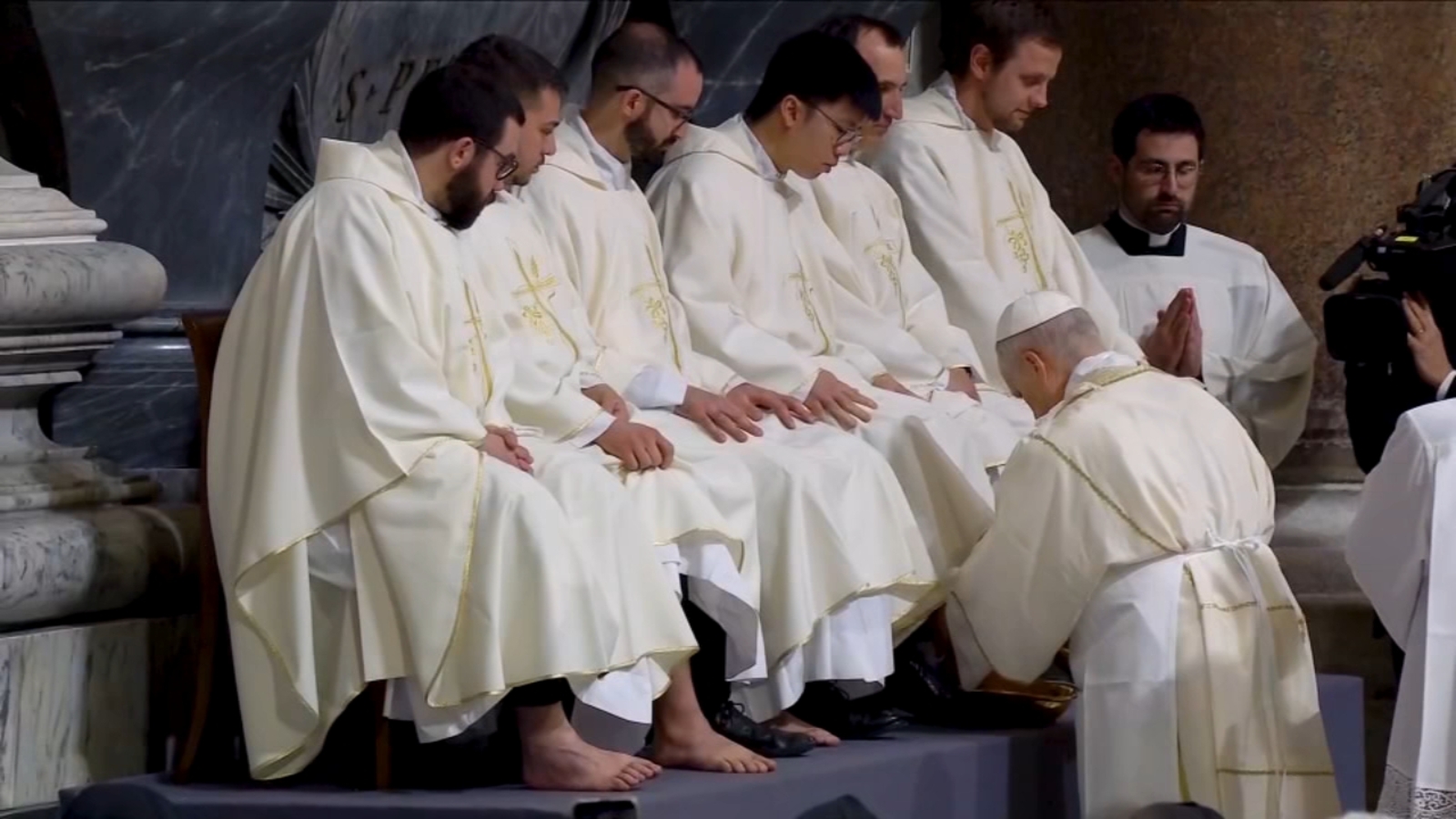
In a deeply symbolic moment for the Catholic Church, Pope Leo XIV Holy Thursday ceremony has made headlines worldwide. The new pontiff revived the centuries-old tradition of washing the feet of 12 priests during the Mass of the Lord’s Supper, restoring a practice that had been transformed by his predecessor, Pope Francis. This decision marks one of the most visible signals yet of Pope Leo XIV’s pastoral vision and his desire to honor the vocation of Catholic clergy.
The ritual took place inside the Archbasilica of Saint John Lateran, the official ecclesiastical seat of the Bishop of Rome, drawing the attention of Catholics and observers across the globe. By choosing to wash the feet of priests rather than laypeople or non-Christians, as Francis often did, the new pope has made a deliberate statement about the role and dignity of the ordained ministry.
The Ceremony: A Return to Form
The Holy Thursday foot-washing ritual, known as the Mandatum, commemorates the moment when Jesus washed the feet of his 12 apostles at the Last Supper before his crucifixion. It is one of the most recognizable traditions of Holy Week and serves as a powerful reminder of Christ’s call to servant leadership.
During the ceremony, Pope Leo XIV poured water from a golden pitcher over the feet of each priest, dried them carefully with a white cloth, and kissed them,a sequence that mirrored the Gospel account with remarkable fidelity. Among the 12 participants were 11 priests ordained by Leo himself the previous year, along with Father Renzo Chiesa, director of the principal seminary of the Diocese of Rome.
Who Participated in the Ritual?
- 11 newly ordained priests from the previous year’s ordination class
- Father Renzo Chiesa, head of the main Roman diocesan seminary
The selection of these particular participants was not incidental. By including both newly ordained priests and an experienced seminary director, the pope symbolically honored both the future and the formation of the priesthood, suggesting a continuity of vocation and care.
The Pontiff’s Homily: Service as True Power
In his homily, Pope Leo XIV described the foot-washing as a “free and humble gesture” that reveals “the true omnipotence of God.” His words struck a deeply theological note, framing the act not merely as a symbolic tradition but as a profound meditation on Christian identity and mission.
“Through this act, Jesus purifies not only our image of God,of the idolatry and blasphemy that have distorted it,but also our image of humanity,” the pontiff declared. His message challenged worldly notions of strength and success, urging Catholics to reconsider what it truly means to be powerful in the eyes of God.
A Contrast with Worldly Values
The pope went on to articulate a vision of Christian leadership that stands in stark contrast to the dominant narratives of contemporary culture. “We tend to consider ourselves powerful when we dominate, victorious when we destroy our equals, great when we are feared,” he preached. “Instead, as true God and true man, Christ offers us the example of self-giving, service, and love.”
Coming from a pontiff who has spoken firmly against war and violence, these words carried particular weight. The homily positioned the foot-washing ritual not just as a historical reenactment but as a prophetic statement about the kind of leadership the Church and the world desperately need.
Breaking with Pope Francis’s Reforms
To understand the significance of Pope Leo XIV’s decision, it is essential to recognize how dramatically Pope Francis changed this ritual. Beginning with his first Holy Thursday as pope in 2013, Francis insisted on including women and people of other religions among the 12 whose feet were washed. Before that, the ritual was performed exclusively on Catholic men inside Roman basilicas.
Francis frequently took the ceremony outside the Vatican walls, performing the foot-washing in prisons, juvenile detention centers, and facilities for asylum seekers. These settings were powerful and pastoral, sending a message of inclusivity, humility, and solidarity with marginalized communities. For many Catholics, these moments became defining images of Francis’s papacy.
By restoring the ritual to its traditional form, Pope Leo XIV has chosen a different path,one that emphasizes the priestly vocation itself as worthy of honor and reflection. This decision reflects what appears to be a broader pastoral priority: encouraging and protecting Catholic clergy.
Championing Priests in Crisis
Pope Leo XIV’s support for priests has not been limited to ceremonial gestures. In April, he dedicated his monthly prayer intentions specifically to priests experiencing crisis,those who have lost hope due to loneliness, exhaustion, or doubt.
In the prayer intentions distributed by the Vatican, the pope expressed a heartfelt plea: “May they feel that they are not mere functionaries or solitary heroes, but beloved children, humble and cherished disciples, and pastors sustained by the prayer of their people.”
He also asked that God teach the faithful to care for their priests, “to listen without judging, to give thanks without demanding perfection,” and to accompany them through prayer. This language represents a notable shift in tone, particularly when compared with Pope Francis, who frequently criticized what he called “clerical culture”,an attitude that places priests on a pedestal above the laity.
A Different Vision of the Priesthood
While Francis saw clericalism as a root cause of the sexual abuse crisis and other abuses of power and authority, Pope Leo XIV seems to take a more affirming stance toward priests themselves, even while acknowledging the serious challenges they face. Rather than emphasizing institutional critique, his approach appears to focus on accompaniment, spiritual care, and mutual support between clergy and laity.
This difference does not necessarily signal a contradiction with Francis’s legacy. Both popes have expressed concern for the wellbeing of priests and the integrity of their ministry. However, the rhetorical emphasis,and the symbolic weight of choosing priests for the foot-washing,suggests that Pope Leo XIV intends to lead the Church in a direction that more openly honors and uplifts the ordained ministry.
Tradition and Renewal: A Balanced Approach
Pope Leo XIV’s revival of the traditional foot-washing ritual should not be interpreted as a wholesale rejection of Pope Francis’s pastoral innovations. Rather, it represents a selective restoration,one that preserves the symbolic richness of the traditional practice while leaving room for the inclusive spirit that Francis championed.
The Catholic tradition has always held that legitimate diversity exists within unity. By choosing to honor priests during this particular ceremony, the new pope is reinforcing a specific theological truth: that the ordained ministry holds a unique and sacred place within the Church’s life. This does not diminish the dignity of laypeople or non-Catholics; rather, it highlights the particular charism and calling of those who serve at the altar.
Looking Ahead: What This Means for the Catholic Church
The Holy Thursday foot-washing ceremony is far more than a quaint liturgical custom. It is a moment each year when the pope has an unparalleled opportunity to communicate his priorities and pastoral vision to the entire Church. Pope Leo XIV’s choices on this occasion,the people he selected, the words he preached, and the tradition he restored,offer an early glimpse into the kind of pontificate he intends to lead.
For Catholics who have been disheartened by the challenges facing the priesthood, whether due to the ongoing fallout from the abuse crisis, declining vocations in certain regions, or the loneliness that often accompanies ministry, this gesture carries genuine encouragement. The pope’s words and actions together paint a picture of a Church that wants to walk alongside its priests, not stand in judgment of them.
Conclusion: A Meaningful Gesture with Lasting Implications
Pope Leo XIV’s decision to revive the traditional foot-washing ritual for priests on Holy Thursday is a powerful and pastoral act that will shape how Catholics understand his papacy. By returning to a practice that emphasizes the sacred nature of the priesthood while also preaching a message of humility and service, the new pope has crafted a moment that speaks to both tradition and renewal. His call for Catholics to support, pray for, and accompany their priests,especially those struggling with loneliness, exhaustion, or doubt,sets a compassionate tone that may well define his leadership in the years to come. In a Church seeking healing and renewal, this gesture points toward a future where the clergy and laity walk together, each recognizing the dignity and calling of the other.