
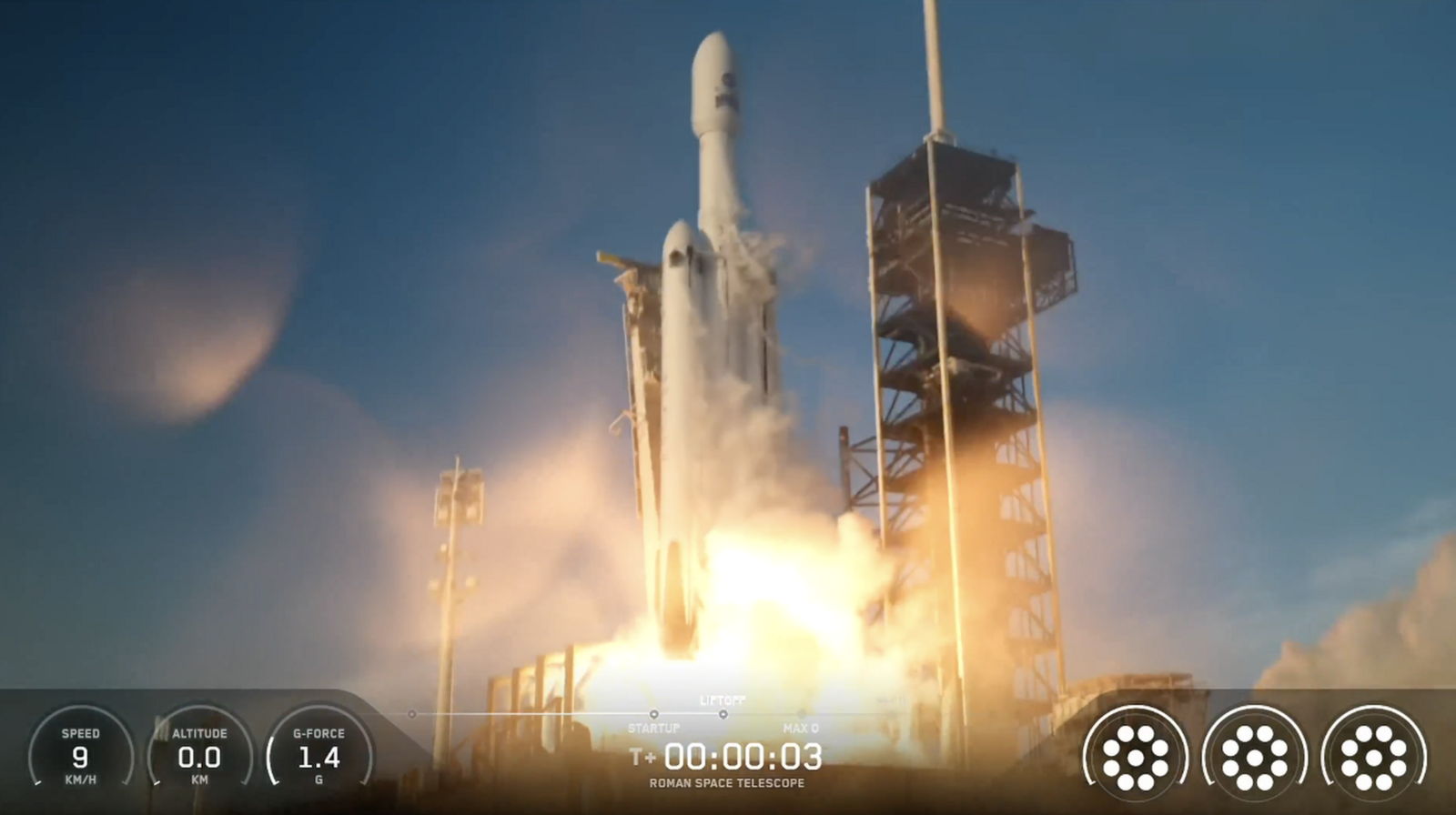
In a thunderous display of engineering and ambition, NASA launched its newest flagship observatory, the Roman Space Telescope, on a quest to peer deeper into the cosmos than ever before. Riding a SpaceX Falcon Heavy rocket skyward from Kennedy Space Center, this $4.3 billion marvel promises to revolutionize our understanding of dark energy, dark matter, and countless exoplanets orbiting distant stars. With a field of view more than 100 times wider than Hubble’s and the ability to scan the sky 1,000 times faster, Roman is poised to become the most productive cosmic surveyor in history.
A Historic Launch and Unexpected Congratulations
The early-morning liftoff captivated spectators along Florida’s Space Coast. As the Falcon Heavy climbed beyond the atmosphere, its two reusable side boosters peeled away and executed precision landings back at Cape Canaveral, their return punctuated by sharp sonic booms that rattled windows miles away. Shortly afterward, ground controllers erupted in applause as the bus-sized Roman Space Telescope separated cleanly from the rocket’s upper stage.
NASA science mission director Nicky Fox was visibly emotional watching the moment unfold. “It’s such a good day!” she exclaimed. Hours later, NASA Administrator Jared Isaacman was interrupted mid-press conference by an unexpected phone call. President Donald Trump was on the line, congratulating the team on the stunning spectacle. “Boy, it looked beautiful on television,” Trump said. “You’re the hottest in space.”
Honoring the Mother of Hubble
The telescope carries a name that resonates through astronomical history. It honors the late Nancy Grace Roman, NASA’s first chief astronomer, who joined the fledgling space agency in 1959 and tirelessly championed the idea that observatories above Earth’s obscuring atmosphere could see farther and better than anything on the ground. She died in 2018 at the age of 93, making her the first woman to receive this prestigious naming honor from NASA.
Retired NASA scientist Ed Weiler, who coined the phrase “Mother of Hubble” for Roman, emphasized how meaningful this tribute is. He recalled how Roman personally hired him back in 1978. “I think Nancy would be very proud that the namesake telescope will tackle some of the biggest, lingering questions about the universe, such as dark energy.”
An Unlikely Origin Story for the Telescope Mirror
Perhaps the most surprising detail is where the telescope’s primary mirror came from. The nearly 8-foot (2.4-meter) mirror is virtually identical in size to Hubble’s, yet it wasn’t built from scratch for astronomy. Instead, this mirror is spy satellite surplus.
More than a decade ago, the National Reconnaissance Office donated two leftover mirrors to NASA for repurposing in scientific missions. The second mirror remains in storage, awaiting its own cosmic adventure. This ingenious recycling not only saved money but also allowed Roman to launch nearly a year ahead of schedule and remarkably within budget.
The Power of an Unmatched Field of View
Joining a Constellation of Great Observatories
Roman will travel 1 million miles into space to join the James Webb Space Telescope at a gravitationally stable observation point. Together with Hubble still orbiting closer to Earth, the European Space Agency’s Euclid spacecraft, and the National Science Foundation’s Vera C. Rubin Observatory in Chile, this new fleet will form the most ambitious astronomical collaboration ever assembled.
“Roman’s vast reach will allow us to find the weird, the rare, and the unusual,” explained senior project scientist Julie McEnery on the eve of launch. “We’ll redefine what it means to find a needle in a haystack.”
Speed as a Superpower
Roman’s true advantage lies in its staggering pace. A month of Milky Way observations by Roman would take Hubble an entire century to complete. With its wide-field infrared camera matching Hubble’s sensitivity but operating 1,000 times faster, Roman will deliver what McEnery calls the “deepest look yet into the heart of our galaxy,” scanning the galactic bulge at dead center with unprecedented efficiency.
Unlocking the Secrets of the Hidden Universe
Mysteries of Dark Matter and Dark Energy
Perhaps nothing excites astronomers more than the prospect of finally understanding the invisible forces shaping our cosmos. Together, dark matter and dark energy account for the vast majority of the universe, yet remain stubbornly hidden from direct observation. Roman’s massive catalog of galaxies will help scientists measure precisely how quickly the universe is expanding, offering crucial clues about these puzzling phenomena.
A Planet Hunter Like No Other
Roman isn’t just about cosmic structure; it’s also a prolific planet hunter. According to Nicky Fox, “It’s going to find thousands of supernovae, tens of thousands of planets, billions of galaxies, and tens of billions of stars.” Once Roman identifies promising new worlds, the more powerful James Webb Space Telescope will zoom in to characterize their atmospheres and conditions.
The Experimental Coronagraph
Among Roman’s instruments is an experimental coronagraph designed to block out starlight, creating a kind of artificial eclipse. This technology will allow Roman to directly image faint planets orbiting masked stars, opening an entirely new window into exoplanet exploration. While Roman itself isn’t built to detect life, Fox explained that it “will pave the way for future observatories to answer what NASA considers the biggest question: Are we alone? Is there another Earth 2.0 looking back at me?”
Designed for a Long and Productive Life
Unlike many previous missions, Roman was designed with longevity in mind. The telescope is engineered to be refueled by future robotic tankers, potentially extending its operational life well beyond its nominal mission. This forward-thinking design philosophy positions Roman as a long-term investment in humanity’s cosmic curiosity.
The telescope’s combination of massive field of view, infrared sensitivity, and revolutionary coronagraph technology means it will conduct cosmic surveys on a scale previously unimaginable. Astronomers around the world are already planning their observing campaigns, eager to mine the rich data Roman will pour back to Earth.
Conclusion: A New Chapter in Cosmic Discovery
The launch of the Roman Space Telescope marks the beginning of an extraordinary new chapter in space exploration. By marrying unprecedented speed with sweeping cosmic perspective, Roman will tackle questions that have puzzled humanity for generations: How did the universe begin? Why is it expanding faster and faster? Are there truly other worlds out there?
From uncovering billions of previously hidden galaxies to shining light on the invisible dark universe, Roman stands ready to deliver answers we can scarcely imagine. As Nicky Fox so eloquently put it, the telescope will do “things that we’ve never been able to do before.” With its successful liftoff now in the history books, the countdown begins to a future filled with discoveries that will rewrite textbooks and inspire generations. The hidden universe is finally within reach, and the Nancy Grace Roman Space Telescope is leading the way.