
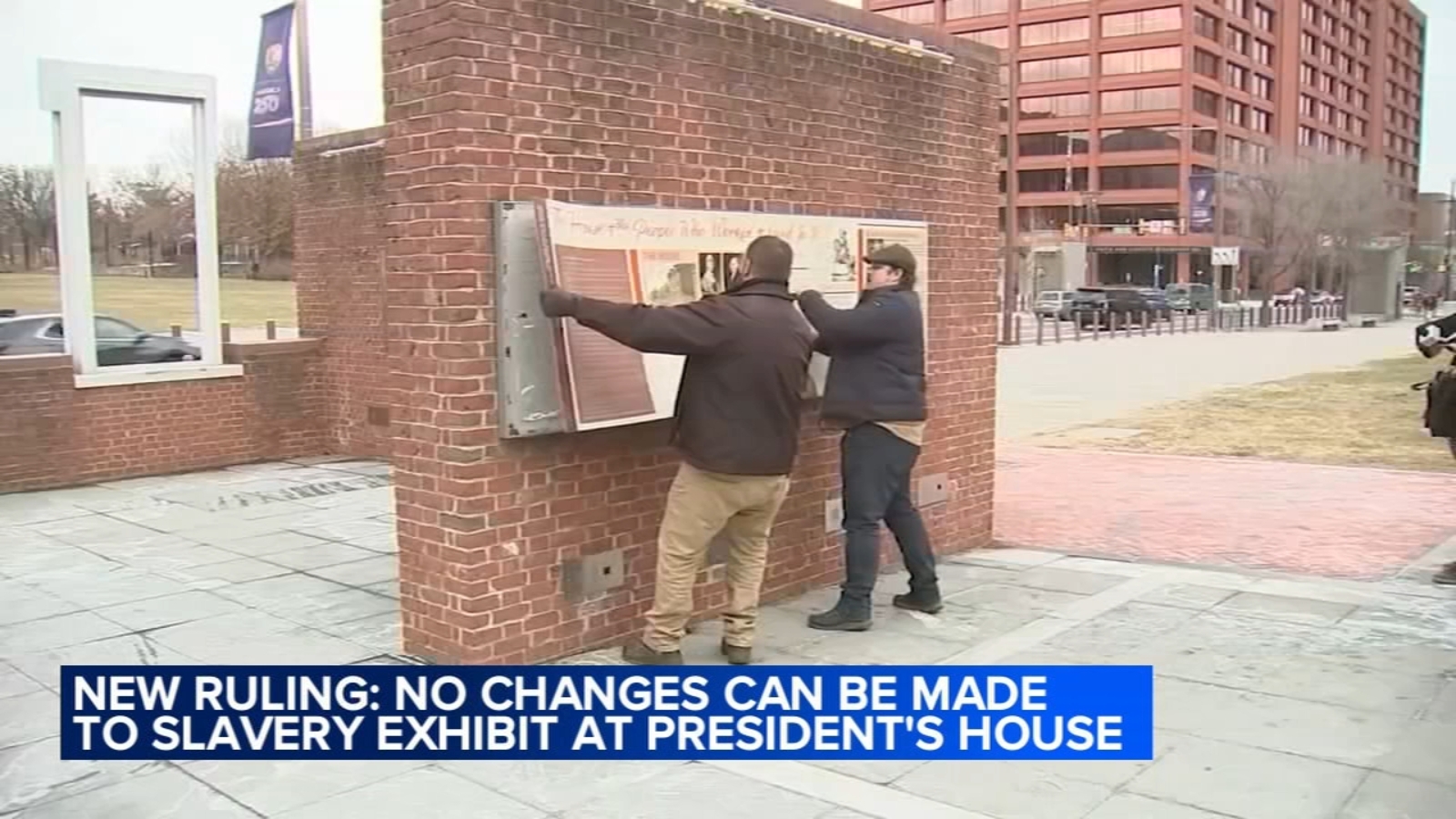
In a significant ruling that reverberates through the historic heart of Philadelphia, a federal appeals court has ordered that the President’s House slavery exhibit at Independence Mall remain exactly as it is , at least for now. The decision represents a meaningful, if preliminary, win for community advocates, historians, and descendants who have fought to preserve an unflinching account of the nine people enslaved by President George Washington during his residence in the city.
The Third Circuit Court of Appeals directed the federal government to maintain the “status quo,” keeping all 16 restored interpretive panels in place while the underlying lawsuit continues to unfold. The ruling does not, however, resolve the broader legal and cultural battle over how America chooses to tell the story of its founding.
Background: A Site Built on Complicated History
The location of the President’s House slavery exhibit sits at the intersection of American promise and American contradiction. Just steps from Independence Hall, where the Declaration of Independence was debated and signed, the open-air exhibit marks the spot where George Washington , the nation’s first president , kept enslaved Africans in bondage while serving as head of state in Philadelphia from 1790 to 1797.
Opened to the public in 2010 after years of advocacy by the Avenging the Ancestors Coalition, the memorial was the result of one of the most successful grassroots campaigns in recent Philadelphia history. When archaeologists unearthed the foundations of the former executive mansion during a construction project in the early 2000s, community leaders pushed to ensure the site’s darker chapters were not erased in favor of a celebratory narrative. The exhibit ultimately earned designation as part of a National Historic Landmark and has since drawn visitors from around the world , including, notably, then-President Barack Obama and his family.
The Nine Enslaved Lives Honored
At the center of the exhibit are the stories of nine individuals Washington enslaved in Philadelphia: Oney Judge, whose daring escape captured national attention; Hercules, the celebrated cook; his daughter Richmond; the butler Austin; her mother Alice; Christopher Sheels, the president’s personal attendant; Giles, the blacksmith; Paris; and Moll.
Through engraved panels, projected images, and carefully curated interpretation, the memorial offers visitors an intimate portrait of enslaved lives lived under the shadow of the nation’s founding ideals. For many African American families, the site represents something rare in public history , recognition at the highest level that freedom’s promises were incomplete without confronting the bondage that coexisted with them.
The Months-Long Dispute That Reached the Courts
The current legal fight began in January, when the National Park Service , which administers the site under a partnership arrangement , removed all 16 of the physical exhibit panels. The agency’s action triggered swift opposition from city officials, historians, and community advocates who viewed the removal as a politically motivated attempt to soften the narrative surrounding Washington’s complicated legacy.
City lawyers responded by filing for a preliminary injunction, asking the court to order the panels restored while the broader case moved through the legal system. Within weeks, the panels were reinstalled at the Independence Mall site, though the underlying disagreement remained unresolved.
The Third Circuit’s latest ruling effectively freezes the situation in place. Federal authorities are now required to leave the exhibit untouched , physically , while judges consider whether the removals violated any legal obligations the government may have to preserve the historical record in its current form.
What the Court Actually Said
In its order, the federal appeals court used explicit language: the government must “preserve the status quo.” That phrasing matters. It means no further alterations to the physical exhibit, no additions, no removals , at least until the Third Circuit hears oral arguments and issues a substantive ruling on the merits of the underlying dispute.
The order, however, is narrowly drawn. It does not address the 18 additional panels that remain off-site , interpretive materials that once supplemented the core story of the enslaved residents. Advocates had hoped to see those returned as well, but the court’s current scope is limited to maintaining what is already in place.
A Quiet Battle on the National Park Service Website
Even as the physical exhibit has been ordered to remain untouched, advocates have raised alarms about a parallel effort , one unfolding online and largely out of public view. According to Michael Coard, a longtime leader of the Avenging the Ancestors Coalition and one of the most visible figures in the campaign to preserve the exhibit, the National Park Service has quietly updated language on its official website.
The revised web text reportedly softens descriptions of Washington’s relationship with slavery, suggesting the president “often expressed discomfort” with the institution and that the people he enslaved in Philadelphia enjoyed greater “autonomy” than enslaved people in other regions. To critics, this is precisely the kind of historical smoothing they feared , language that, while not denying outright, reframes bondage in the most comfortable possible terms.
“If he felt discomfort, what about the 316 that he enslaved at Mount Vernon?” Coard asked pointedly. “What about the nine he enslaved in Philadelphia?”
The coalition argues that if changes are going to occur, they need to happen transparently and consistently across every platform , not quietly on a federal webpage where most visitors will never compare notes.
Reactions From Visitors and Advocates
The dispute has not been an abstract one for those walking through the Independence Mall site. Visitors interviewed during the unrest expressed both surprise and frustration that a memorial of this nature could be subject to removal.
“It was really shocking to me, especially with the 250th anniversary of this country coming up,” said Melissa Carucci, a South Philadelphia resident. Her sentiment echoes a growing national conversation about how the United States chooses to commemorate its origins , and whose stories are deemed appropriate for public memory.
Sarah Moss, who traveled from Emeryville, California, to see the exhibit, framed the issue more broadly. “To take down any part of African American history is just a disservice to this country,” she said. “We need to know history to not repeat it.”
The Coalition’s Cautious Optimism
For the Avenging the Ancestors Coalition, the court order is meaningful but not mission accomplished. Coard has likened the moment to lacing up running shoes , preparation for a longer race, not a celebratory finish.
The group’s ultimate goal remains the return of all 34 panels , the 16 currently in place plus the 18 still in storage , so that visitors can engage with what Coard describes as “the truth, the whole truth, and nothing but the truth about American history.” The coalition is also pushing for independent academic review of any proposed interpretive changes, to ensure that historical accuracy, not political preference, drives the language used at the site.
What Happens Next in Court
From a legal perspective, the case remains in its early stages. The Third Circuit’s order simply preserves the current state of affairs pending further proceedings. Lawyers on both sides will exchange written briefs, after which the court will hear oral arguments. A final ruling on the underlying constitutional and administrative questions could take many months , and possibly years , to arrive.
Coard has predicted that the matter will ultimately reach the Supreme Court of the United States, regardless of how the lower court rules. Given the cultural weight of the dispute and its potential implications for how federal sites interpret complicated historical figures, that forecast is far from unusual.
In the meantime, both sides have publicly affirmed their commitment to historical memory , albeit with sharply different views of what that memory should look like.
The Department of Interior’s Position
In a written statement, the U.S. Department of the Interior defended the broader effort to update interpretive materials at historic sites. “By telling the full story,” the statement read, “we strengthen our shared understanding and ensure that future generations inherit not just the land we love, but the truth of the journey that brought us here.”
The statement did not address specific concerns about the website language or whether further physical changes were planned if the legal landscape shifted. It also did not commit to engaging the academic community or descendant groups in any review process, an omission that has fueled further skepticism among advocates.
Why This Fight Matters Beyond Philadelphia
The battle over the President’s House slavery exhibit is not simply a local zoning argument over glass and metal panels. It sits at the intersection of competing visions for American public history , one that emphasizes context, complexity, and the often-painful truths of the founding era, and another that pulls interpretive material toward a more reassuring, less confrontational narrative.
Historians across the country have watched the dispute closely, aware that similar questions are emerging at other federal sites, from presidential libraries to Civil War battlefields. Decisions made here will inevitably influence how the National Park Service , and every agency that manages public memory , approaches the task of reckoning with slavery in the years ahead.
For descendants of the enslaved, for educators, and for the millions of annual visitors to Independence Mall, the exhibit is more than signage. It is a public acknowledgment that the men who wrote “all men are created equal” coexisted with , and benefited from , a system of human bondage that cannot be sidelined or softened without doing violence to the historical record itself.
Conclusion
The federal court’s order may be temporary, but the principle at stake is anything but. By requiring the President’s House slavery exhibit to remain unchanged while the case proceeds, the Third Circuit has given advocates breathing room , and given the public a chance to keep witnessing the full, complicated story of the nation’s earliest days. As the 250th anniversary of independence approaches, the question of how America tells its own origin story has never felt more urgent. Whether the final ruling expands or contracts the memorial, the fight itself has already accomplished something important: it has put the spotlight on nine enslaved lives and demanded that they remain part of the national conversation.