
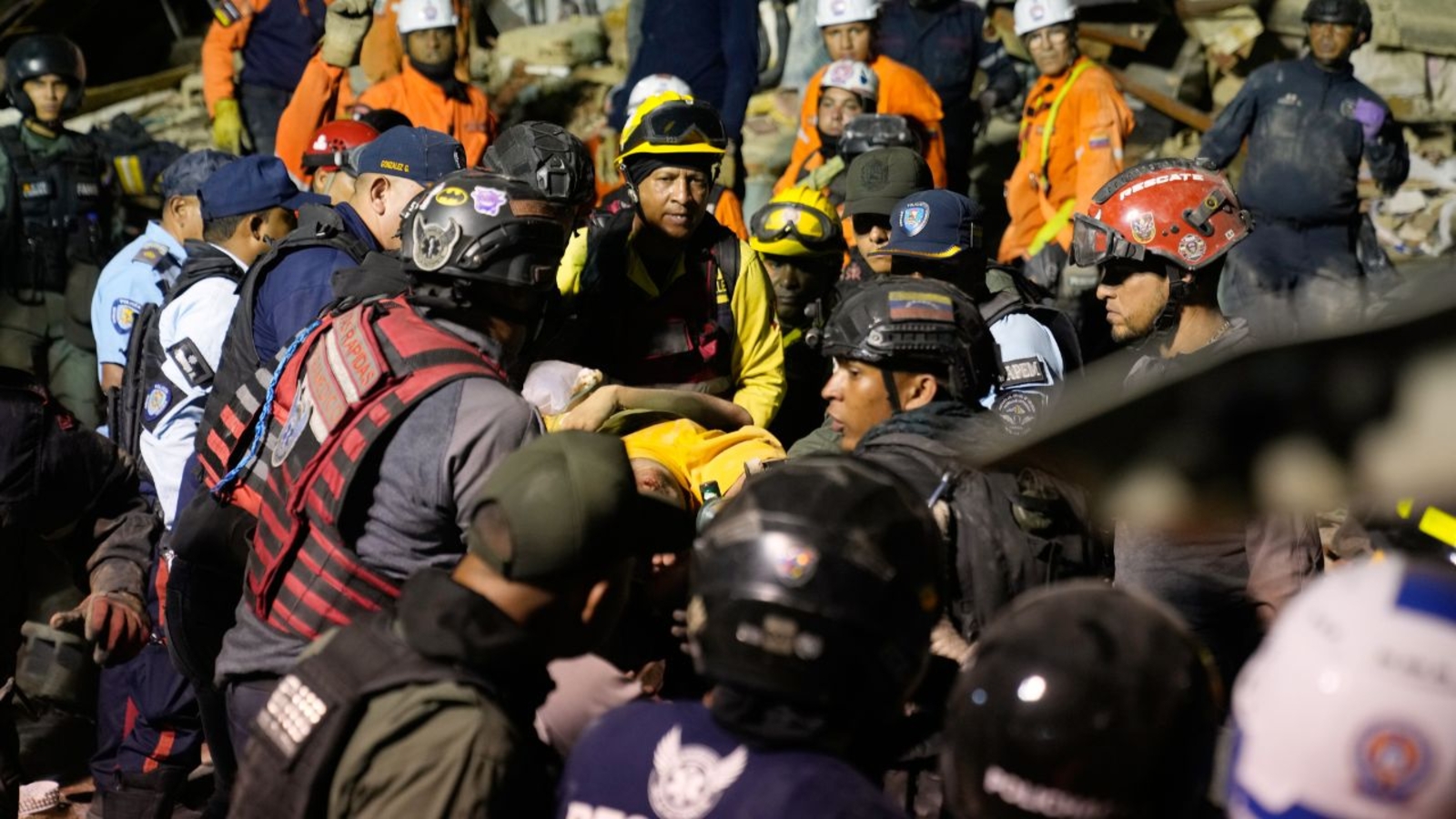
The Venezuela earthquakes that rocked the country on Wednesday evening have left a trail of devastation across the northern coast, claiming at least 235 lives and injuring more than 4,300 people. The twin disasters,measuring 7.2 and 7.5 in magnitude,struck within a minute of each other, sending panicked residents into the streets and reducing buildings to skeletal remains. With thousands still reported missing and rescue operations racing against time, Venezuela faces one of the most catastrophic natural disasters in its modern history.
A Nation Shaken: The Scale of the Venezuela Earthquakes
The powerful tremors struck just west of Morón on Venezuela’s Caribbean coast, approximately 170 kilometers (105 miles) west of the capital, Caracas. According to the U.S. Geological Survey, the first earthquake registered a magnitude of 7.2 at a depth of 22 kilometers, while the second, slightly larger quake measuring 7.5, hit only a minute later at a shallower depth of just 10 kilometers, with its epicenter roughly 16 kilometers southwest of Morón.
While Venezuela sits near multiple fault lines, straddling the boundary between the South American and Caribbean plates makes strong seismic activity relatively uncommon compared to other parts of Latin America. However, the back-to-back nature of these Venezuela earthquakes, combined with their shallow depth, amplified the destruction significantly.
Marcos Ferreira, a geophysicist and researcher at the Geological Survey of Brazil, explained the phenomenon using a vivid analogy: “It is as if I am screaming and then someone starts screaming, too. That amplifies the vibration and adds to the potential hazard.”
La Guaira Bears the Heaviest Burden
The coastal region of La Guaira, located north of Caracas and home to the country’s main international airport, suffered some of the worst damage and highest casualties. The airport itself was forced to close due to structural damage, creating significant logistical challenges for incoming aid shipments.
Acting President Delcy Rodríguez officially designated La Guaira as a “disaster zone” and called on businesses throughout the country to make heavy construction equipment available for rescue operations. Authorities began diverting rescue teams from other regions to focus on the devastated coastal area, which has historical experience with major natural disasters,a catastrophic 1999 mudslide killed thousands and remains one of the country’s worst tragedies.
Rescue Efforts in Venezuela: A Community Response
As rescue efforts in Venezuela intensify, heartbreaking scenes have emerged from the rubble. State television broadcast dramatic footage of survivors being pulled from collapsed structures, including a woman trapped beneath a cement slab whose bare foot was the only visible sign of life before crews successfully extracted her.
However, frustration is mounting among residents who say government response has been inadequate. In Caracas, Dayana Delgado, a mother of three, voiced the desperation shared by many: “I want to know where my child is, if he’s trapped or in a shelter.” Her eight-year-old son remains among the missing. Delgado pointed out that neighbors,not official teams,have been doing much of the digging through debris, asking pointedly where the heavy machinery authorities had promised.
The human toll is staggering. One mother collapsed in grief as the bodies of her three- and ten-year-old children were wrapped in blankets and carried away. Others screamed the names of missing loved ones into the chaos, while some stood in stunned silence, unable to process the magnitude of their losses.
Personal Stories of Survival and Loss
Among the survivors was retired schoolteacher Juan Alberto Mendaño, who climbed through the wreckage in La Guaira and past a dead body before spotting a woman trapped and signaling for help. “May God rescue her as quickly as possible,” Mendaño said emotionally. “When we heard the scream, there was nothing we could do.”
Cristian Carreño stared helplessly at his charred apartment building in La Guaira, now tilting precariously to one side. “I lost everything,” he said. “There are people still inside, I imagine, that couldn’t get out. It’s incredibly devastating.”
In downtown Caracas, hundreds of residents spent Wednesday night huddled in parks, parking lots, and other open spaces, too afraid to return indoors. María Cristina Díaz, a 41-year-old janitor, described the family’s ordeal: “We were afraid the buildings would collapse on us. My mother, my daughter and I were cold. We didn’t sleep a wink.”
Government Response and the La Guaira Earthquake Damage
Acting President Rodríguez declared a Venezuela state of emergency in a national address late Wednesday and announced the creation of a $200 million reconstruction fund aimed at repairing damaged hospitals and homes. She reported that parts of Caracas lost power and cellphone service, subway operations were suspended, and natural gas supplies were shut off as a precautionary measure.
Classes have been canceled for several days, with the Ministry of Education announcing that some school buildings would be converted into shelters and donation centers to accommodate the displaced.
The Health Minister Carlos Alvarado delivered a sobering update to state media, confirming the rising death toll: “Unfortunately we have received around 235 patients who arrive without vital signs or die when they arrive at our health facilities.” Officials have warned that the numbers are expected to climb as search operations continue.
International Aid and the US Sanctions Waiver
In a significant diplomatic move, the U.S. Treasury announced Thursday that it would waive certain sanctions against Venezuela until October 23, specifically allowing transactions related to earthquake relief that would otherwise be prohibited. This decision came alongside offers of assistance from around the world.
U.S. Secretary of State Marco Rubio, who spoke directly with Rodríguez following the disaster, confirmed that the United States was “immediately” deploying search and rescue teams, medical resources, and other assistance. “We have a whole-of-government response. It’ll be big; it’ll be fast; and it’ll be effective,” Rubio stated, while noting the airport closure as a logistical obstacle.
Leaders from Mexico, Qatar, Brazil, Spain, Portugal, and Canada all pledged to send aid, with shipments of emergency personnel, canine search teams, medical supplies, water purifiers, airplanes, and drones already en route. The first rescuers from the Dominican Republic were preparing to land, with additional international teams expected in the hours ahead.
Political Context Complicating the Crisis
The natural disaster strikes at an already turbulent moment for Venezuela. Acting President Rodríguez assumed office in January after the U.S. military operation that captured former president Nicolás Maduro at the beginning of the year. The country has been grappling with severe economic instability for over a decade, and many citizens reject the legitimacy of the political movement Rodríguez represents.
Shortly after United Nations officials called on the government to lift social media restrictions to facilitate the flow of potentially life-saving information, Venezuelans regained access to X (formerly Twitter). The platform had been blocked since August 2024 as part of efforts to suppress information exchange following disputed presidential election results.
Regional Impact Felt Across Borders
The La Guaira earthquake damage and its aftershocks were felt far beyond Venezuela’s borders. Buildings were evacuated as far away as Brazil’s Amazon region, demonstrating the immense reach of the seismic events. Venezuelans living abroad struggled desperately to contact relatives amid the communication blackouts.
Families began posting missing-person flyers with photographs of loved ones on streets and social media, while others circulated handwritten lists of names as they searched desperately for any news of those still unaccounted for.
Conclusion: A Country in Mourning, A Long Road Ahead
As Venezuela confronts the aftermath of these devastating twin earthquakes, the road to recovery will be long and challenging. With hundreds confirmed dead, thousands injured, and many more still missing, the immediate priority remains locating survivors trapped beneath collapsed structures. The international community’s response, combined with the temporary lifting of U.S. sanctions for relief purposes, offers hope that aid can flow more freely to those in desperate need.
Yet beyond the immediate rescue operations, Venezuela faces deeper questions about governance, infrastructure resilience, and its capacity to rebuild. The scenes of communities digging through rubble with their bare hands, of mothers searching for lost children, and of a nation plunged into darkness and grief, underscore both the fragility of life and the resilience of the human spirit. As earthquake relief efforts continue and the full scope of the tragedy becomes clearer, Venezuela will need sustained international support and internal unity to navigate one of the darkest chapters in its history.