
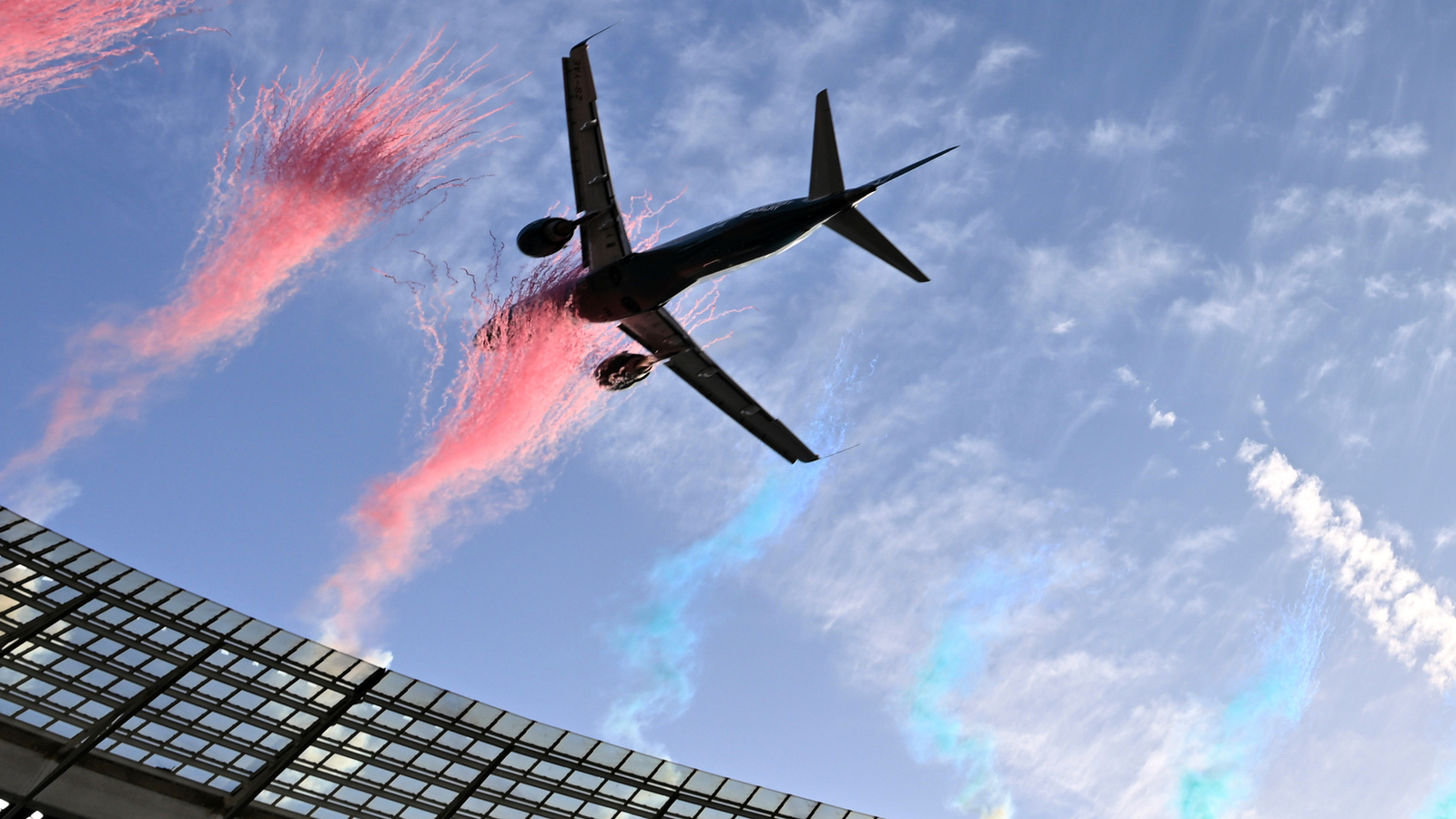
The stadium flyby safety debate has erupted across South Africa and the global aviation community after two passenger jets performed a breathtakingly low pregame flyover at a rugby match in Cape Town. The aerial stunt, which thrilled an estimated crowd of 56,000 spectators, has since divided opinion between those who celebrated the spectacle and aviation professionals who warn that the margin for error was dangerously slim. As videos of the dramatic moment continue to circulate worldwide, questions about the limits of civilian aircraft performance are taking center stage in conversations about entertainment, marketing, and aviation safety.
A Pre-Game Spectacle Like No Other
The atmosphere at Cape Town’s DHL Stadium was already electric ahead of the showdown between South Africa and New Zealand, two of the fiercest rivals in international rugby. But the energy inside the venue reached an entirely new level when two Embraer regional passenger jets, operated by local airline Airlink, roared over the stands just moments before kickoff.
Eyewitnesses described the moment as both awe-inspiring and unnerving. The lead aircraft skimmed the curved roof of the stadium at what appeared to be an impossibly close range, while the second jet followed behind, disappearing momentarily into a dramatic plume of pink dust that had been released as part of the pregame entertainment. The crowd roared, the broadcast cameras captured every angle, and the moment instantly became a global talking point.
The Aircraft and the Airline Behind the Flyby
Airlink, a regional carrier that sponsors the ongoing rugby series between the two nations, confirmed that both jets were Embraer aircraft , small to medium-sized passenger planes typically used for short-haul commercial routes. The airline emphasized that neither jet was carrying passengers during the stunt, which is a small comfort to those watching from the ground and around the world.
How Low Did the Jets Actually Fly?
According to flight tracking service Flightradar24, the lead aircraft passed just 41 to 46 feet (12 to 14 meters) above the stadium roof. That figure, calculated using publicly available flight data, is significantly lower than typical flyover altitudes, even for military demonstrations or air show performances.
A video posted on social media platform X by Airlink showed the first jet pulling up slightly as it passed precariously close to the outer edge of the curved stadium roof. The aircraft then dipped before climbing again on the other side, creating a wave-like trajectory over the structure. The second jet followed closely behind, flying through the pink dust cloud that had been triggered as part of the pregame show.
The stadium flyby safety debate has largely centered on these precise altitude figures. While the pilots executed the maneuver flawlessly, the question many aviation professionals are asking is: what if something had gone wrong?
Airlink’s Defense: Carefully Planned and Within Safety Limits
Airlink pushed back forcefully against the criticism, stating that the flyby was conducted according to all relevant safety regulations. The airline released a detailed statement explaining the precautions that were taken before the aircraft ever took to the skies over Cape Town.
According to the carrier, the entire maneuver was carefully planned and rehearsed in advance. The jets traveled at approximately 150 knots (roughly 278 kilometers per hour or 172 miles per hour) as they passed over the stadium. Each aircraft carried three senior captains onboard, with the crew split into the roles of commander, co-pilot, and safety officer , an unusually high crew configuration for a civilian regional jet.
Regulatory Oversight and Approval
The airline also acknowledged the involvement of regulatory authorities in the planning process. “The South African Civil Aviation Authority and Air Traffic Navigation Services provided valuable guidance, approval, and support to ensure a safe flyby,” Airlink said in its statement. This collaboration, the carrier argued, demonstrates that the stunt was not a reckless publicity stunt but a coordinated aviation event subject to oversight.
In a subsequent update, Airlink confirmed that the flight data recorded by both aircraft had been provided to the civil aviation authority for review. The data was intended to confirm that the aircraft operated within civil aviation safety limits for both speed and altitude throughout the entire maneuver.
Aviation Experts Raise Red Flags
Despite the airline’s reassurances, several prominent aviation specialists have voiced serious concerns. The stadium flyby safety debate has drawn commentary from pilots and consultants around the world, with many questioning whether civilian passenger aircraft should ever be used in such high-risk displays.
Chris Martinus, president of the Aircraft Owners and Pilots Association South Africa, told The Associated Press that the flight profile of the lead aircraft was particularly troubling. “Basically, that lead aircraft was kind of like dodging over the roof and climbing over the one side and dipping below and then climbing over the other side. That was a little bit uncomfortable,” Martinus said. He emphasized that at such low altitudes, pilots would have very limited options in the event of an emergency.
The Risk Factors Nobody Can Fully Control
Keith Tonkin, an Australian aviation consultant and former military and commercial pilot, went further in his assessment. Tonkin pointed out that Embraer passenger jets are simply not designed or intended for low-level operations of this kind. The aircraft are built for efficient regional travel, not for the precision flying demanded by aerial demonstrations near obstacles.
Tonkin warned about the precedent this flyby could set. “The bigger picture is that a benchmark has been established and others may expect to do something similar, and that’s not going to end well,” he said. He added that turbulence or a bird strike at such a low altitude could leave pilots with too little room to maneuver without striking the stadium itself.
A Tradition with Deep Roots in South African Rugby
To understand why the flyby happened in the first place, it helps to look at the long-standing tradition of military and civilian flyovers at major South African rugby fixtures. The most famous of these took place in 1995, when a Boeing 747 flew over Ellis Park in Johannesburg before the Rugby World Cup final between South Africa and New Zealand , a match that became iconic for reasons far beyond the pregame entertainment.
Since that historic moment, flyovers have become a regular feature at the biggest matches on the South African rugby calendar. Airlines, military units, and aerobatic teams have all participated, each trying to deliver a more spectacular performance than the last. The escalation of these events is precisely what concerns aviation experts like Tonkin, who see the latest Cape Town flyby as part of a trend toward increasingly daring displays.
The Broader Implications for Aviation Safety
While the immediate stadium flyby safety debate focuses on a single event, the underlying questions are far more sweeping. Should civilian passenger aircraft be used for entertainment flyovers at all? Who bears responsibility if something goes wrong? And how should civil aviation authorities balance the cultural and commercial value of such spectacles against the inherent risks?
The Embraer jets used in the Cape Town flyby were not carrying passengers, which reduces the immediate risk to the public. However, aviation experts stress that any accident involving such aircraft near a populated venue would have catastrophic consequences, regardless of whether the planes were full of travelers or operated by a small, elite crew.
Bird strikes, sudden wind gusts, mechanical failures, and even minor pilot miscalculations become exponentially more dangerous at extremely low altitudes. Recovery time and altitude are simply not available when an aircraft is operating just a few dozen feet above a structure filled with tens of thousands of people.
What’s Next? The Civil Aviation Authority Steps In
Following the controversy, the South African Civil Aviation Authority indicated that it planned to issue a formal statement after reviewing the black box data provided by Airlink. That review could shape future policy on civilian aircraft flyovers at sporting events and other public gatherings.
For now, the airline stands by its decision and emphasizes that all procedures were followed. The pilots involved, each with extensive experience and credentials, executed the maneuver without incident. But as the airport flyby safety debate continues, regulators face mounting pressure to clarify exactly what is and is not permissible in such displays.
Conclusion: Spectacle vs. Safety
The dramatic flyby over Cape Town Stadium delivered exactly what its organizers intended , an unforgettable moment that captivated a live audience and millions of viewers around the world. Yet the stadium flyby safety debate it has triggered is unlikely to fade anytime soon. Aviation professionals, regulators, and the general public are now grappling with a question that sits at the intersection of entertainment and risk: how low is too low when civilian aircraft perform for cheering crowds?
As the civil aviation authority completes its review, the outcome will likely influence not just future rugby flyovers but also the broader standards governing commercial aircraft in low-altitude demonstrations worldwide. One thing is certain , the images from Cape Town will remain in the public consciousness for years to come, serving as both a thrilling reminder of aviation’s spectacle and a cautionary tale about the boundaries that should never be crossed in the pursuit of showmanship.