
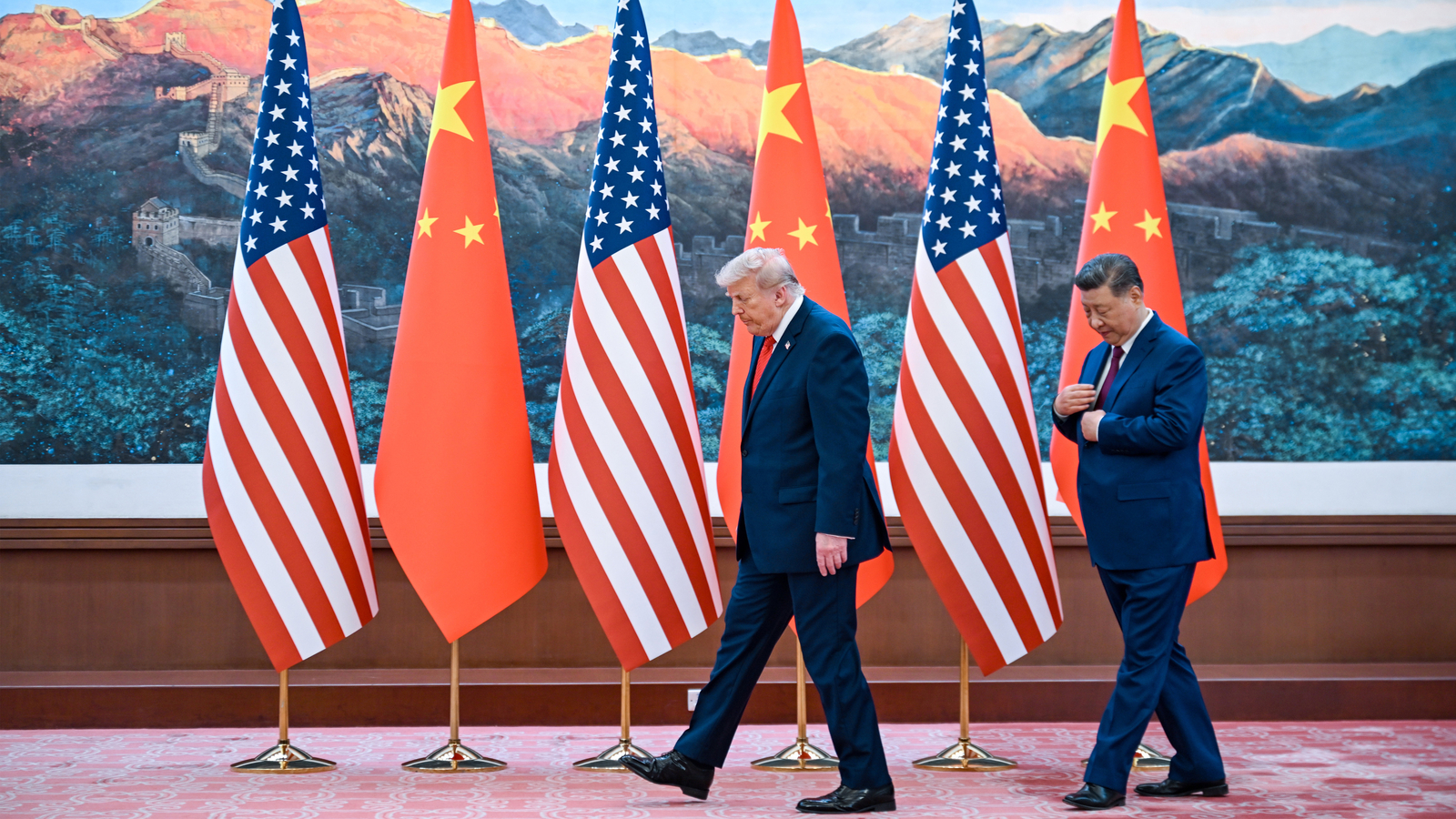
During a closely watched summit in Beijing, Chinese President Xi Jinping delivered an unmistakable Xi Taiwan warning to President Donald Trump, cautioning that the United States and China could spiral into outright conflict if disagreements over the self-governing island are not managed with care. The unusually blunt admonition came during a private meeting at the Great Hall of the People and underscored just how precarious the China-US relationship remains, even as both leaders projected optimism about the broader bilateral partnership.
The Xi Taiwan warning immediately dominated diplomatic headlines, signaling that while Trump and Xi can exchange warm platitudes in public, their governments remain far apart on one of the most sensitive geopolitical flashpoints of the twenty-first century. From an $11 billion arms package awaiting delivery to a deepening trade relationship still haunted by tariffs, the stakes of this meeting extended well beyond ceremonial handshakes.
Setting the Stage: Trump’s High-Stakes Beijing Visit
Trump’s three-day visit to the Chinese capital was loaded with symbolism. An elaborate welcome ceremony featured booming cannons, military bands performing “The Star-Spangled Banner” and China’s national anthem, and hundreds of schoolchildren waving dual flags. Yet behind the pageantry, the two leaders sat across from each other for roughly two hours, tackling some of the most consequential issues in global geopolitics.
Before cameras, Trump praised Xi as “a great leader” and declared it “an honor to be your friend,” predicting that “the relationship between China and the USA is going to be better than ever before.” Xi offered a more measured response, framing the moment through the lens of historical responsibility. He invoked the Thucydides Trap,a foreign policy concept describing how rising powers often clash with established ones,and asked whether the two nations could “forge a new model for relations between major powers.”
The contrast in tone was striking. Trump leaned into personal flattery, while Xi steered the conversation toward long-term strategic risk, foreshadowing the stern Taiwan message delivered behind closed doors.
Xi’s Stark Warning on Taiwan
Following the meeting, Chinese Foreign Ministry spokesperson Mao Ning posted on X that Xi had characterized Taiwan as “the most important issue in China-US relations.” Xi’s framing was unambiguous,if handled properly, the relationship would enjoy “overall stability.” Otherwise, he warned, “the two countries will have clashes and even conflicts, putting the entire relationship in great jeopardy.”
This Xi Taiwan warning was remarkable in its directness. Beijing rarely speaks so bluntly in diplomatic settings, and the language signaled that China’s patience with American policy toward Taipei may be wearing thin. Analysts immediately noted that the warning reflects Chinese displeasure with Washington’s continued military support for Taiwan.
The Trump administration has approved an $11 billion arms package for the island, intended to bolster its self-defense capabilities, but delivery has not yet commenced. Meanwhile, Trump has demonstrated greater ambivalence toward Taiwan than his predecessors, fueling speculation about whether he might be persuaded to scale back American commitments.
Taiwan’s Response and Regional Implications
Taiwan’s government welcomed the continued American backing. Michelle Lee, a spokesperson for Taiwan’s premier, told reporters that her government “views all actions that contribute to regional stability and the management of potential risks from authoritarian expansion positively.” She emphasized that the United States “has also repeatedly reiterated its firm and clear position of support for Taiwan.”
The careful diplomatic language underscores how precarious the situation remains. For Beijing, Taiwan represents a non-negotiable core interest. For Washington, long-standing policy supports Taiwan’s ability to defend itself while acknowledging the One China framework. The Xi Taiwan warning makes clear that any perceived drift toward formal Taiwanese independence,or any dramatic shift in US arms deliveries,could ignite a serious confrontation.
Beyond Taiwan: The Iran Factor and the Strait of Hormuz
While Taiwan stole the headlines, the Beijing summit also grappled with the ongoing war in Iran and its ripple effects across global energy markets. China remains the largest purchaser of Iranian oil, and the United States is eager for Beijing to leverage that economic relationship to pressure Tehran. Secretary of State Marco Rubio explained in a Fox News interview that Trump would stress how “economies are melting down because of this crisis,” which in turn hurts Chinese exporters.
A particular point of friction is the Strait of Hormuz, one of the world’s most vital maritime chokepoints for oil and natural gas. The waterway’s partial closure has stranded tankers and caused energy prices to spike. The White House noted that both leaders agreed the strait “must remain open,” though Xi reportedly opposed any implementation of tolls on vessels transiting it.
In a sign of flexibility, Xi also expressed openness to increasing Chinese imports of US oil,a significant step that could gradually reduce Beijing’s reliance on Gulf crude. This olive branch suggested that while the Xi Taiwan warning was uncompromising on sovereignty, there remains room for pragmatic cooperation on energy security.
The Trade Truce and Economic Diplomacy
Despite the Taiwan tension, the economic dimension of the summit generated cautious optimism. The United States and China reached a trade truce last year that paused the threat of steep reciprocal tariffs. Officials are now exploring ways to extend that arrangement, and the Trump White House is eyeing fresh announcements before the president departs Beijing.
Potential wins include Chinese commitments to purchase American soybeans, beef, and aircraft, alongside expanded market access for US businesses. Trump administration officials are also pushing for the creation of a formal Board of Trade to manage ongoing commercial disputes. Xi reinforced this cooperative tone by declaring that “China’s door of opportunity will open wider,” even meeting with a delegation of US business leaders accompanying Trump.
George Chen, a partner at The Asia Group consultancy, observed that Xi has made his “red line crystal clear” on Taiwan, while simultaneously signaling a welcoming posture on economic engagement. The dual message appears deliberate: China wants American capital and trade, but it will not tolerate moves that suggest a shift in the strategic balance across the Taiwan Strait.
Understanding the Thucydides Trap
Xi’s reference to the Thucydides Trap deserves special attention. The term, popularized by political scientist Graham Allison, draws on the ancient Greek historian’s account of the Peloponnesian War, arguing that a rising power’s challenge to a ruling power frequently leads to war. Allison identified sixteen historical cases in which a rising power threatened to displace an established one,and in twelve of those, war followed.
By invoking this concept directly to Trump, Xi framed the moment as historically pivotal. It was both a warning and an invitation: avoid the trap, and history can take a different course. For Beijing, Taiwan is the single issue most likely to convert theoretical rivalry into actual conflict, making the Xi Taiwan warning less a bluff and more a genuine diplomatic alarm.
What Comes After the Beijing Pageantry
The post-meeting itinerary,visits to the Temple of Heaven and a lavish state banquet,reinforced the ceremonial flavor of Trump’s trip. Yet beneath the pomp, the substance revealed a relationship simultaneously cooperative and combustible. On one hand, both leaders spoke of partnership rather than rivalry. On the other, Xi delivered one of the most pointed public messages about Taiwan in recent memory.
The Trump administration’s $11 billion arms package remains in limbo, neither formally activated nor abandoned. American officials appear to be balancing domestic political pressure, alliance credibility, and economic leverage. Trump himself has signaled openness to deal-making in ways previous presidents avoided, leaving allies and adversaries alike guessing about the true trajectory of Taiwan policy.
Conclusion: A Delicate Balance in Pacific Geopolitics
The Xi Taiwan warning delivered in the Great Hall of the People will reverberate well beyond the closing ceremony of Trump’s Beijing visit. It crystallized the central tension in twenty-first-century Pacific geopolitics: two superpowers whose economies are deeply intertwined but whose strategic interests increasingly diverge. Taiwan has become the bellwether of that competition,a small island whose fate could reshape the global order.
Whether the two nations can escape the Thucydides Trap may ultimately depend on how this single question is managed. For now, the message from Beijing is unmistakable: the United States should not mistake strategic ambiguity for indifference. Cooperation remains on the table, but so does confrontation. The coming months,whether through arms deliveries, trade negotiations, or moves in the Taiwan Strait,will determine which path the world’s two largest economies ultimately choose.