
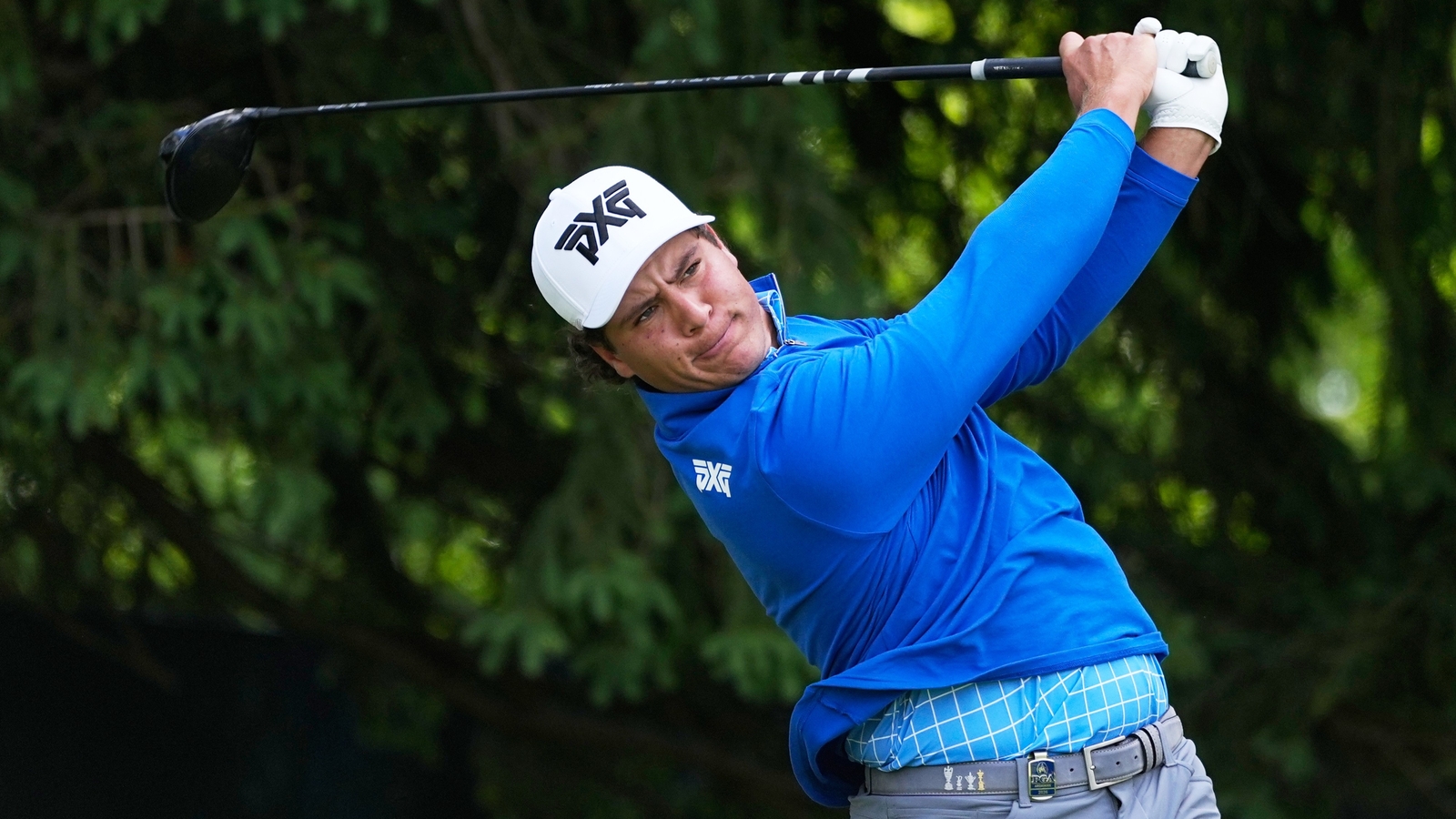
The PGA Championship returned to historic Aronimink Golf Club in Newtown Square, Pennsylvania, and the storied Donald Ross design immediately proved why major championship golf demands everything from the world’s best players. With chilly morning conditions, thick rough, demanding pin placements, and greens featuring massive undulations, the course delivered a brutally challenging test reminiscent of U.S. Open conditions rather than the softer setup players might expect in May.
Four players,Aldrich Potgieter, Stephan Jaeger, Min Woo Lee, and Ryo Hisatsune,managed to navigate the early-morning conditions and share the clubhouse lead at 3-under 67, establishing the benchmark for what would be required on this demanding layout.
Aronimink Bites Back from the First Tee
From the moment players teed off, Aronimink announced itself as a worthy major championship venue. The overnight rain did little to soften the layout, and the Donald Ross-designed greens lived up to every fear with their dramatic contours. Add gusting winds that arrived by mid-morning, and the test became even more punishing.
“Really, really thick rough and wind and really difficult greens and tucked pin locations is why you’re seeing what you may feel like are higher scores,” explained Xander Schauffele, who carded an opening-round 68. Schauffele knows something about PGA Championship scoring,he set the major championship scoring record at the 2024 PGA Championship at Valhalla with a staggering 21-under 263. His 68 on Thursday showed appreciation for the difficulty rather than disappointment.
The Early Leaders Find Their Footing
The four co-leaders each took slightly different paths to the same number, but all demonstrated the patience and precision required at Aronimink.
- Aldrich Potgieter, the big-hitting South African, played in the first group off the 10th tee and was the first to post 67, recording six birdies along the way. His strategy was clear: avoid the severe slopes on the greens whenever possible.
- Ryo Hisatsune produced the best ball-striking of the leaders, making seven birdies,including four that immediately followed bogeys, showcasing remarkable resilience.
- Stephan Jaeger caught fire on his front nine, running off three consecutive birdies to climb into the mix.
- Min Woo Lee acknowledged the difficulty of the pin placements, noting: “They did a really good job on putting them in tough positions. It’s a course where you don’t want to leave it in bad positions just because it can bite you in the butt pretty quick.”
Potgieter credited his strong positioning for the solid start: “I didn’t feel like I had to putt over some of these big slopes we had. So I definitely left myself in really good positions on the green.”
Major Champions Feel the Heat
Some of the game’s biggest names discovered that recent major championship success offers no protection from Aronimink’s challenges.
Rory McIlroy’s Rough Return
Masters champion Rory McIlroy produced one of the most disappointing rounds among elite players, closing his day with four consecutive bogeys and signing for a 4-over 74. The Northern Irishman struggled in every facet,from the damp, dense rough to the treacherous greens,and offered a colorful one-word assessment of his performance that translates loosely to “doo-doo.”
McIlroy wasn’t alone in his frustration. The combination of thick rough, firm greens, and unpredictable bounces made even routine shots feel hazardous. On the 15th hole, one of his approach shots shot forward an additional 20 feet on its second hop, perfectly illustrating the unpredictability that defined the morning.
Bryson DeChambeau’s Baffling Start
No one struggled quite like Bryson DeChambeau, who remarkably didn’t make a single birdie until his final hole of the day,the par-5 ninth. That late birdie prevented him from matching his highest score in a major championship, though his 76 still leaves him with significant work ahead. DeChambeau now faces the unwelcome possibility of a second consecutive missed cut in a major.
Stars Find Their Way to Red Numbers
Despite the difficulty, several notable names managed to post under-par rounds and position themselves well heading into Friday.
Jordan Spieth Keeps Grand Slam Hopes Alive
Jordan Spieth, who needs only the PGA Championship to complete the career Grand Slam, opened with a 2-under 69. This marks his tenth attempt at that elusive feat, and while he’s rarely been in the mix on weekends at this event, Thursday’s round provided genuine encouragement.
Spieth demonstrated excellent control off the tee and solid putting for most of the day. He was actually tied for the lead late in his round before a long three-putt on the seventh, a missed green on the par-3 eighth, and a failed birdie opportunity on the par-5 ninth left him wanting more.
“It was blowing really hard, and it was cold this morning,” Spieth said. “The course played very, very difficult. It was a good start. I’m going to need to improve on it, I think, each day.”
Jon Rahm’s Dramatic Rescue Act
Jon Rahm appeared headed for yet another disappointing start in a major before staging a remarkable back-nine comeback. The Spanish star holed out for eagle from the 11th fairway, chipped in for birdie on the treacherous par-3 eighth, and got up-and-down for birdie on his final hole to salvage a 69.
When informed that some observers expected better scoring in the morning wave, Rahm responded with genuine incredulity: “People thought it would be lower? Have you been out there? Have you seen this course?”
Rahm’s assessment captured the consensus among players. While the numbers on paper,width of fairways, for example,might suggest an easier test, the subtle slopes can send decent shots into the rough, making approach play extraordinarily difficult. Combined with tucked pin locations, attacking the flags became a risky proposition.
Notable Moments from Round One
A Penalty Before the First Swing
Garrick Higgo experienced perhaps the worst start imaginable. The South African was mere seconds late getting to the first tee when his group was announced, resulting in a two-shot penalty assessed before he even hit his opening drive. Despite the unfortunate circumstances, Higgo managed to post a respectable 69, demonstrating admirable mental fortitude.
“Unfortunately golf has these situations where we get penalized for things,” Higgo said afterward. “But it is a rule and I obviously broke the rule. I would love to have 3 under. Hopefully, I can make a good story out of it.”
A Historic Venue Returns to the Major Stage
Aronimink’s return to major championship golf carries significant historical weight. The club last hosted a major in 1962, when Gary Player won the PGA Championship. Since then, Aronimink has hosted PGA Tour events in 2010, 2011, and 2018, with the latter coming after a comprehensive restoration project that returned the layout to its Donald Ross roots.
That restoration has clearly paid dividends. The course now presents exactly the kind of firm, fair, and demanding test that defines major championship golf. Using the PGA of America’s old slogan,”This is major”,felt entirely appropriate as players battled the layout throughout the morning wave.
Looking Ahead: The Afternoon Wave
Defending champion Scottie Scheffler teed off in the afternoon alongside Cameron Young and Matt Fitzpatrick, with all eyes on whether the world number one could replicate the dominant form that delivered his previous major victory. Their scores would provide crucial context about how the course evolved throughout the day as conditions continued to change.
The early returns suggested that Aronimink would only grow more difficult as the week progresses. With thick rough penalizing wayward drives, severely undulating greens creating treacherous putts, and winds capable of transforming manageable approaches into survival tests, every player in the field would need their best golf just to keep pace with the leaders.
Conclusion
Round one of the PGA Championship at Aronimink delivered exactly what major championship golf demands: a thorough examination of every aspect of a player’s game. The four co-leaders at 67 demonstrated that birdies were available for those who could navigate the course’s demands, while the struggles of McIlroy and DeChambeau reminded everyone that no pedigree is safe on this layout. As the tournament continues, the players who combine strategic patience with execution under pressure will rise to the top. Aronimink has firmly established itself as a worthy major championship venue, and the battle for the Wanamaker Trophy is just beginning.