
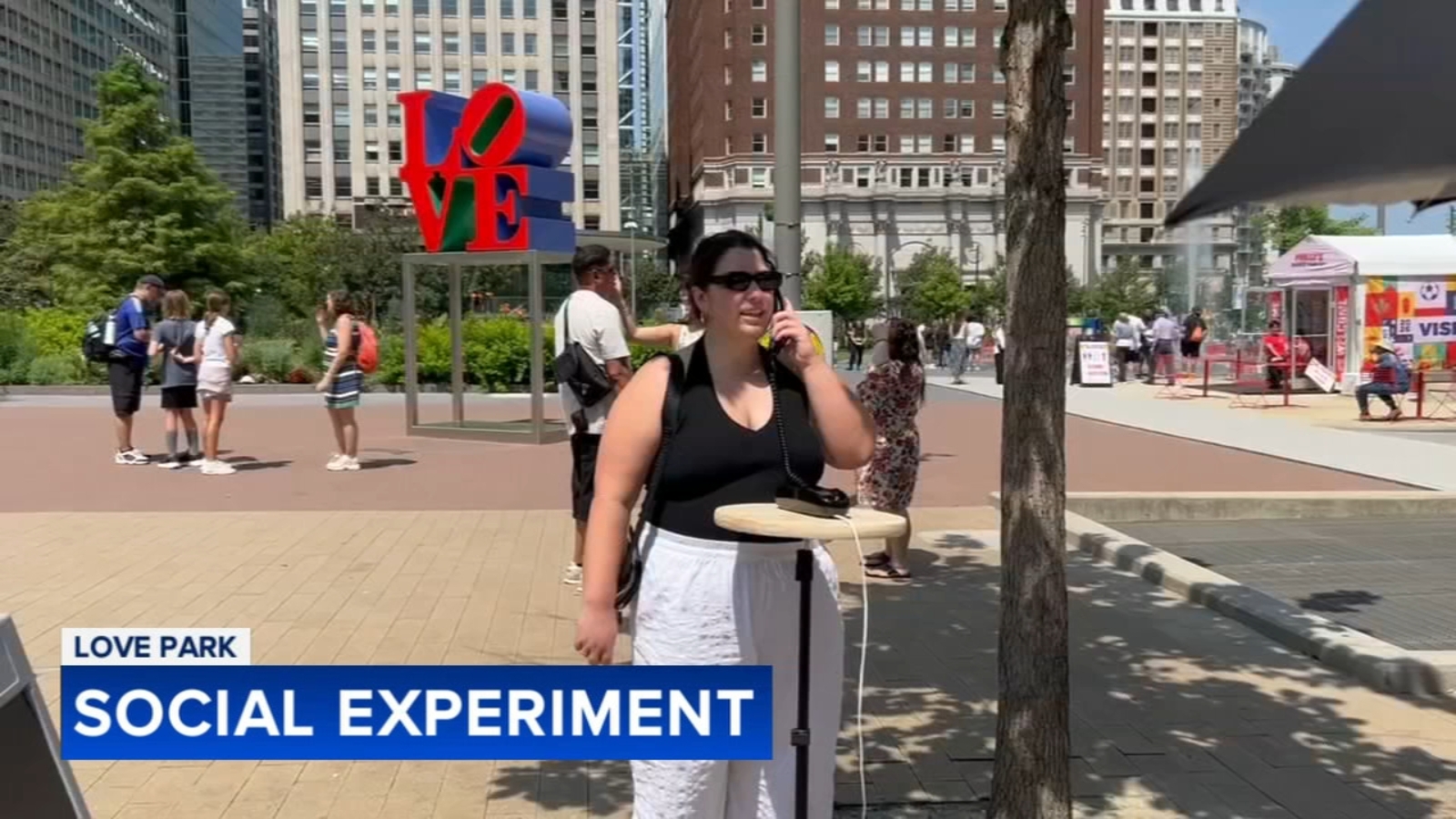
In the heart of Philadelphia, an unassuming rotary telephone at LOVE Park has become an unexpected sanctuary for heartfelt expression. Created by artist and social experimenter Dan Horan, this love park phone installation invites complete strangers to pick up a receiver, dial no number, and speak whatever is on their minds , to no one in particular, and yet, to everyone who happens to be listening.
What began as a quiet art project has turned into a viral phenomenon, drawing people from all walks of life who feel compelled to share their grief, joy, struggles, and hopes through a device that feels like a relic from a simpler era. The installation reminds us that sometimes, the most powerful conversations are the ones we have with ourselves , and with strangers who simply need to be heard.
The Story Behind the LOVE Park Phone Installation
Dan Horan is no stranger to interactive public art. For the past two years, he has been conducting social experiments throughout Philadelphia, placing unexpected objects in urban spaces and observing how people respond. The love park phone installation represents one of his most emotionally resonant projects to date.
The concept is disarmingly simple: a traditional dial-up telephone is set up in a public space, with no number to dial and no one on the other end. Visitors are invited to pick up the receiver and speak freely , to loved ones who have passed, to people they cannot reach, or simply to the universe itself. There is no agenda, no script, and no judgment.
Horan has explained that he chose to use a vintage rotary phone deliberately. The tactile experience of lifting a heavy receiver, holding it to your ear, and speaking into it creates a psychological shift that texting simply cannot replicate. The weight of the device, the familiar click of the dial, and the absence of a screen all conspire to make people slow down and speak from a deeper place.
Why a Phone? The Power of Analog Communication
In an age dominated by smartphones, social media, and instant messaging, the simple act of using a traditional telephone has become almost radical. Horan has spoken openly about why he believes the love park phone resonates so strongly with visitors.
“You used to be able to feel how excited or sad or mad somebody was when you picked up the phone and answered them,” Horan explained in an interview. “And now it’s all through text or message or, like, through status. And you can’t feel that energy unless it’s, like, some weird emoji, you know?”
This observation strikes at something profound about modern communication. Digital interactions, for all their convenience, often strip away the emotional texture that comes with hearing another person’s voice. The tremor in someone’s words, the catch of breath before a confession, the warmth of a laugh , these are elements that text-based communication struggles to convey.
Horan added that something almost magical happens when people lift the receiver: “For some reason, that phone , just picking it up , it brings out that energy that we all used to have when we would pick up the phone 20 years ago and talk to another.”
The Viral Moment That Sparked a Movement
Although the love park phone had been quietly collecting emotional confessions for days, it was a single recording that catapulted the project into the national spotlight. On the very first day Horan set up the phone, a young boy approached the installation and delivered a message that would move millions.
Through tears, the boy spoke into the receiver: “Hey, Mom, I know you’re up there in heaven, watching down on me. My brother Zy passed away.”
The raw honesty of this moment captured something universal about grief, love, and the human need to feel connected to those we have lost. The recording spread rapidly across social media, and suddenly, the love park phone was no longer just a local art experiment , it was a cultural touchstone.
Other Voices, Other Stories
Since that initial viral moment, dozens of visitors have stepped up to the phone and shared their own deeply personal reflections. The range of emotions expressed has been remarkable:
- Grief and loss: Many visitors have used the phone to speak to family members and friends who have passed away, finding a sense of closure or connection that traditional grief counseling sometimes cannot provide.
- Financial struggles: One woman, her voice breaking, shared: “Things are still hard; they’re expensive. It’s hard to make ends meet.” Her words echoed the quiet desperation felt by millions during economically uncertain times.
- Hope and gratitude: Not every message is tinged with sorrow. Some visitors have used the phone to express thankfulness, share good news, or simply say the things they wish they could tell someone in person.
- Unspoken confessions: Others have used the installation as a confessional of sorts, admitting truths they have never spoken aloud , apologies, regrets, or declarations of love.
What unites these diverse voices is the palpable relief that comes from finally giving words to feelings that have been bottled up inside. The love park phone installation has essentially become a public therapy session, accessible to anyone willing to pick up the receiver.
The Psychology of Speaking Into the Void
Why do people feel compelled to speak into a phone that connects to no one? The answer lies at the intersection of psychology, ritual, and human nature.
The Telephone as a Symbol
The telephone has long held a powerful place in our cultural imagination. From the dramatic phone calls in classic films to the lifeline calls in game shows, the act of picking up a phone and speaking carries an inherent sense of importance. When we hold a receiver to our ear, our brains engage in a kind of suspended disbelief , even when we know no one is listening, the physical ritual makes the act feel real.
Anonymous Expression and Catharsis
Public art installations like the love park phone offer something rare in modern life: a space for anonymous emotional expression. Unlike therapy, which requires vulnerability with a stranger, or journaling, which requires private discipline, speaking into a disconnected phone requires neither. There is no eye contact, no recorded transcript, no obligation , just the freedom to say whatever needs to be said.
This kind of catharsis can be remarkably healing. Research has consistently shown that verbalizing emotions , even to no one in particular , can reduce stress, improve mood, and help people process difficult experiences. The love park phone leverages this psychological principle in a way that feels accessible and unintimidating.
Community Witnessing
Another powerful element of the installation is the community it creates. Bystanders who witness someone speaking into the phone often find themselves unexpectedly moved. Some linger to listen, others offer supportive smiles, and many find themselves thinking about what they would say if they picked up the receiver themselves. The love park phone has, in this way, become a catalyst for collective empathy in a city that desperately needs it.
Looking Ahead: The Future of the Installation
Horan has expressed his intention to continue the love park phone project, weather permitting, at both its original location in LOVE Park and at a second site in Northeast Philadelphia, at the intersection of Frankford and Cottman. This expansion suggests that he believes the installation has the potential to reach even more people and touch even more lives.
For Philadelphia, the project represents something meaningful: a reminder that even in a city often characterized by its tough exterior, residents are hungry for moments of genuine connection. The love park phone installation proves that you do not need cutting-edge technology or a massive budget to create something transformative. Sometimes, all you need is a rotary phone and the courage to let people speak.
What Visitors Can Expect
For those interested in experiencing the installation firsthand, here is what you should know:
- No preparation is needed. Simply walk up, pick up the receiver, and speak. There is no wrong way to participate.
- Privacy is respected. While recordings sometimes circulate on social media, Horan has emphasized that the experience is fundamentally about personal expression, not performance.
- Emotions may surface unexpectedly. Many visitors report being surprised by the intensity of feelings that emerge once they begin speaking. This is a normal and welcomed part of the experience.
- The experience is free and open to all. There is no fee, no appointment, and no eligibility requirement.
A Mirror for Modern Loneliness
Perhaps the most striking thing about the love park phone phenomenon is what it reveals about the state of modern communication. We live in an era of unprecedented connectivity , we can text anyone, anywhere, at any time , and yet loneliness has reached epidemic proportions. Mental health professionals have identified a growing crisis of social isolation, particularly among young people who have never known a world without smartphones.
The love park phone installation speaks directly to this paradox. It suggests that what we have been missing is not more connections, but deeper ones. The kind of connection that comes from hearing a real voice, from being truly present in a moment, from saying something that matters out loud rather than typing it into a chat window.
Horan’s simple experiment has tapped into something that millions of people feel but struggle to articulate: a longing for authenticity in an increasingly curated world. By providing a space where people can be unguarded, unfiltered, and utterly themselves, the installation has become more than art , it has become a form of public healing.
Final Thoughts on the LOVE Park Phone
The love park phone is a testament to the enduring power of human vulnerability. In a city known for its history, its resilience, and its big hearts, a simple rotary phone has reminded us that the most meaningful conversations are often the ones we have with the people we miss, the parts of ourselves we hide, and the strangers who happen to be standing nearby.
Dan Horan’s installation deserves recognition not just as a clever art piece, but as a vital community resource. It has provided comfort to the grieving, voice to the struggling, and connection to the lonely. And perhaps most importantly, it has reminded an entire city , and now a broader audience , that sometimes, the most radical thing you can do is pick up a phone and simply speak from the heart.
If you find yourself in Philadelphia, consider stopping by LOVE Park. You do not have to pick up the receiver. But if you do, know that you are part of something larger , a quiet, ongoing conversation about what it means to be human in a world that sometimes forgets to listen.