
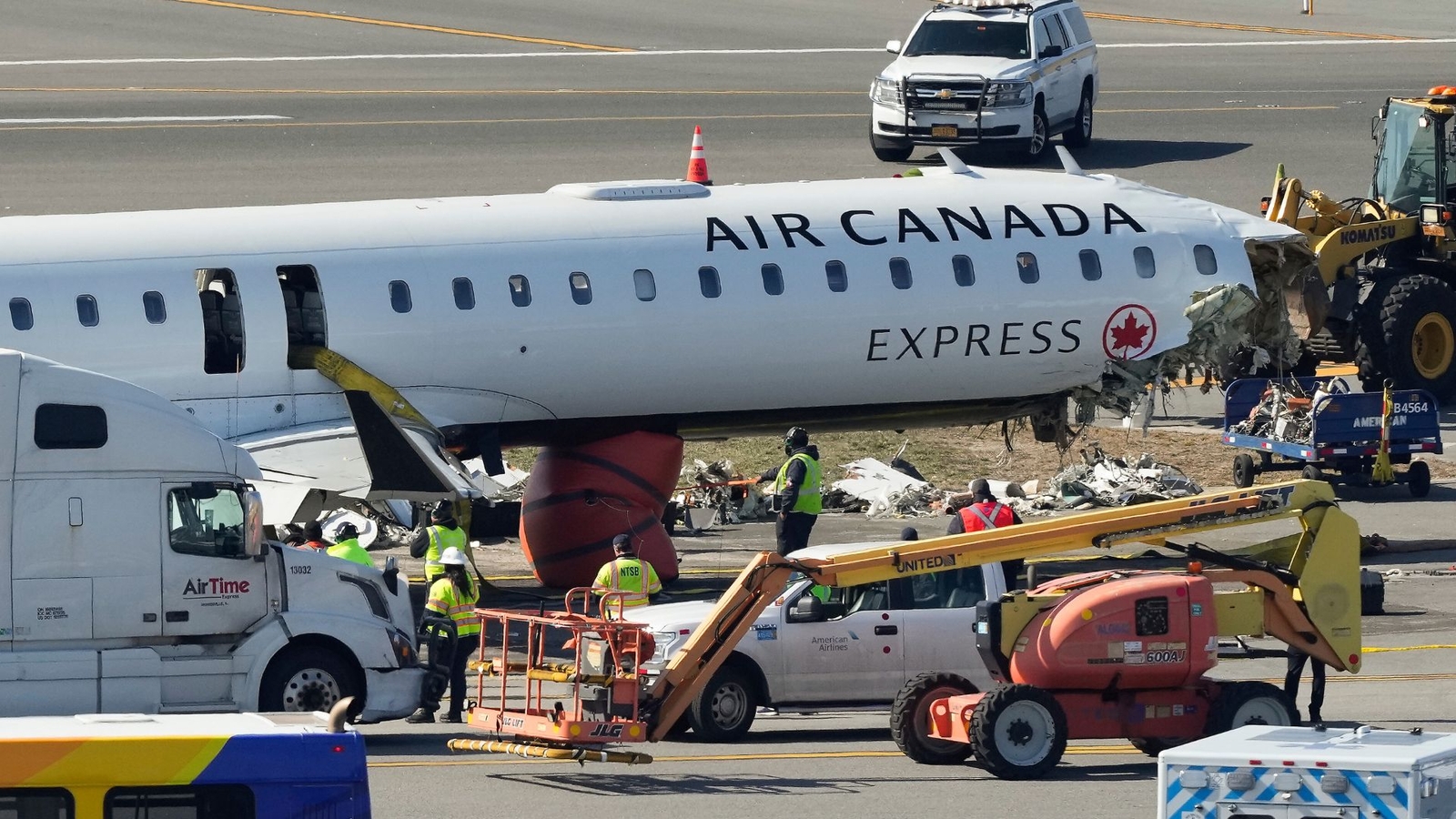
The LaGuardia Airport crash that occurred on March 22 has drawn national attention after the National Transportation Safety Board (NTSB) released its preliminary findings. The tragic collision between a regional jet and an airport firetruck on the runway claimed the lives of both pilots and injured dozens more, prompting a sweeping investigation into air traffic control procedures, runway safety systems, and ground vehicle operations at one of the nation’s busiest airports.
This preliminary report offers the most detailed account to date of the moments leading up to the disaster, though investigators caution that no final cause will be established for 12 to 24 months. Here’s everything we know so far about the LaGuardia Airport crash, what the NTSB report reveals, and why aviation safety experts are paying close attention.
Background: What Happened at LaGuardia Airport
On the evening of March 22, a regional jet operated by a commercial carrier was either taking off or landing at LaGuardia Airport when it collided with an airport firetruck that had entered the active runway. The impact occurred at significant speed, resulting in catastrophic consequences for those aboard the aircraft and serious injuries to the ground crew.
The crash instantly became one of the most significant aviation safety incidents at LaGuardia in recent memory. With approximately 40 passengers and crew members aboard the plane, and two firefighters inside the truck, the scope of injuries and loss has reverberated throughout the aviation community. Both pilots aboard the aircraft were killed in the collision, marking a sobering moment for an industry that has worked tirelessly to reduce fatal accidents over the past several decades.
What the NTSB Preliminary Report Reveals
The NTSB’s preliminary findings, released on Thursday, paint a complex picture of an incident involving multiple contributing factors rather than a single point of failure. Investigators emphasized that this document represents early observations and that a comprehensive final report is still months away.
The Final Seconds Before Impact
According to the report, both the driver of the firetruck and the pilot of the aircraft attempted evasive maneuvers in the moments before the collision. Each tried to swerve to avoid the other, suggesting neither operator had sufficient time or warning to prevent the crash entirely. Despite these desperate efforts, the closing speed between the two vehicles made avoidance impossible.
This detail is particularly significant for the ongoing NTSB investigation because it indicates that both individuals involved were actively trying to prevent the collision. It shifts the focus from operator error alone to a broader examination of the systems, communications, and procedures that allowed the encounter to occur in the first place.
Runway Warning Lights Were Functioning
One of the most striking findings in the preliminary report is that the runway lights designed to warn ground vehicles of aircraft landing and taking off were operational at the time of the crash. These lighting systems are specifically engineered as a critical safety barrier, illuminating when an aircraft is approaching or departing on an active runway.
However, the report notably does not explain why the firetruck did not stop in response to these activated warning lights. This gap in understanding has become a central focus of the investigation. Possible explanations under consideration include visual obstruction, driver inattention, miscommunication, or unfamiliarity with the specific runway configuration. Investigators will likely spend considerable time in the coming months examining this aspect of the runway incursion.
Air Traffic Control Conditions That Night
The NTSB report provides insight into the staffing situation inside the LaGuardia tower on the night of the crash. While two controllers were present, which meets the standard staffing requirement for that particular shift and time of day, the workload was not evenly distributed. One controller was actively managing the primary ground and tower responsibilities, while the other controller was simultaneously coordinating a separate emergency situation elsewhere in the system.
This division of attention may have contributed to communication breakdowns or delays in recognizing the developing hazard. The air traffic control environment during emergencies is inherently stressful, and the preliminary report suggests that the controller managing the immediate airspace may have been operating without full backup support during a critical window.
The Turret Operator’s Account
Perhaps the most revealing testimony included in the preliminary report comes from the turret operator, the individual positioned to oversee ground operations near the runway. In an interview with NTSB investigators, this person recalled hearing a controller transmit “stop stop stop” over the radio but admitted they did not initially know who the urgent message was directed toward.
Moments later, when the controller followed up with “Truck 1 stop stop stop,” the turret operator realized the warning was intended for their vehicle. As they attempted to turn left to exit the runway, they spotted the approaching aircraft’s lights. By that point, collision was unavoidable.
This sequence of events highlights several troubling questions for investigators. Why did the initial transmission not include the vehicle identifier? How much time elapsed between the first warning and the moment the firetruck actually stopped or turned? And critically, why had the firetruck entered the runway in the first place despite the active warning lights?
Casualties and Injuries From the LaGuardia Airport Crash
The human toll of this tragedy has been severe. Both pilots on the aircraft lost their lives in the collision, marking a devastating loss for their families, colleagues, and the broader aviation community. The two crew members inside the firetruck were transported to area hospitals with injuries, though specific details about their conditions have not been fully disclosed in the preliminary report.
Approximately 40 passengers and additional crew members aboard the aircraft also sustained injuries. The range and severity of those injuries have varied, with some individuals treated at the scene and others requiring hospitalization. The fact that all surviving occupants of the plane were able to be accounted for is a small consolation amid the tragedy, but it underscores the violent nature of the impact, given the aircraft’s last recorded speed of 104 miles per hour at the moment of collision.
The firetruck was reportedly traveling at approximately 30 miles per hour at the time of impact. While significantly slower than the aircraft, the combined closing speed and sheer mass difference between a commercial jet and a ground vehicle meant that survivability for those on the truck depended heavily on the structural integrity of the cab.
Understanding the Investigation Timeline
Aviation investigations of this magnitude rarely reach conclusions quickly. The NTSB has indicated that a final cause determination will not be available for 12 to 24 months, a timeline that reflects the meticulous and methodical nature of accident investigation work. During this period, investigators will conduct additional interviews, retrieve and analyze flight data, examine voice recordings, scrutinize airport surveillance footage, and review maintenance and training records for all parties involved.
The preliminary report serves as a factual snapshot of what investigators have confirmed so far. It is not intended to assign blame or determine causation, but rather to provide the public, industry stakeholders, and regulatory agencies with early information that could have immediate safety implications. In some cases, preliminary findings prompt the NTSB to issue urgent safety recommendations before the final report is even completed.
Broader Implications for Aviation Safety
The LaGuardia Airport crash has reopened important conversations about ground vehicle operations, runway safety protocols, and controller workload management. While commercial aviation remains extraordinarily safe by virtually every statistical measure, incidents like this one remind regulators and operators that vulnerabilities still exist, particularly at the intersection of ground and air operations.
Busy airports like LaGuardia, which operate with limited space and high traffic volumes, face unique challenges in maintaining separation between ground vehicles and active aircraft. The fact that warning lights were functioning yet did not prevent the crash suggests that redundant safety measures may need to be reevaluated. Possible improvements could include enhanced training for ground vehicle operators, additional audio or visual alerts, improved radio communication protocols, and better coordination tools between controllers.
For the traveling public, this incident may understandably raise concerns about the safety of flying. However, it’s worth noting that the systems and personnel involved in this crash are now subject to one of the most rigorous investigative processes in the world. The findings, when complete, will likely inform new safety standards designed to prevent similar tragedies from occurring in the future.
Conclusion
The preliminary NTSB report on the LaGuardia Airport crash provides critical early insight into a tragedy that has shaken the aviation industry and the New York City community. With both pilots lost, dozens injured, and many unanswered questions remaining, the investigation represents a vital step toward understanding how a functioning safety system could still result in such catastrophic outcomes. As investigators continue their work over the coming months, the families affected by this disaster deserve answers, and the flying public deserves assurance that every possible lesson will be learned from this heartbreaking event.