
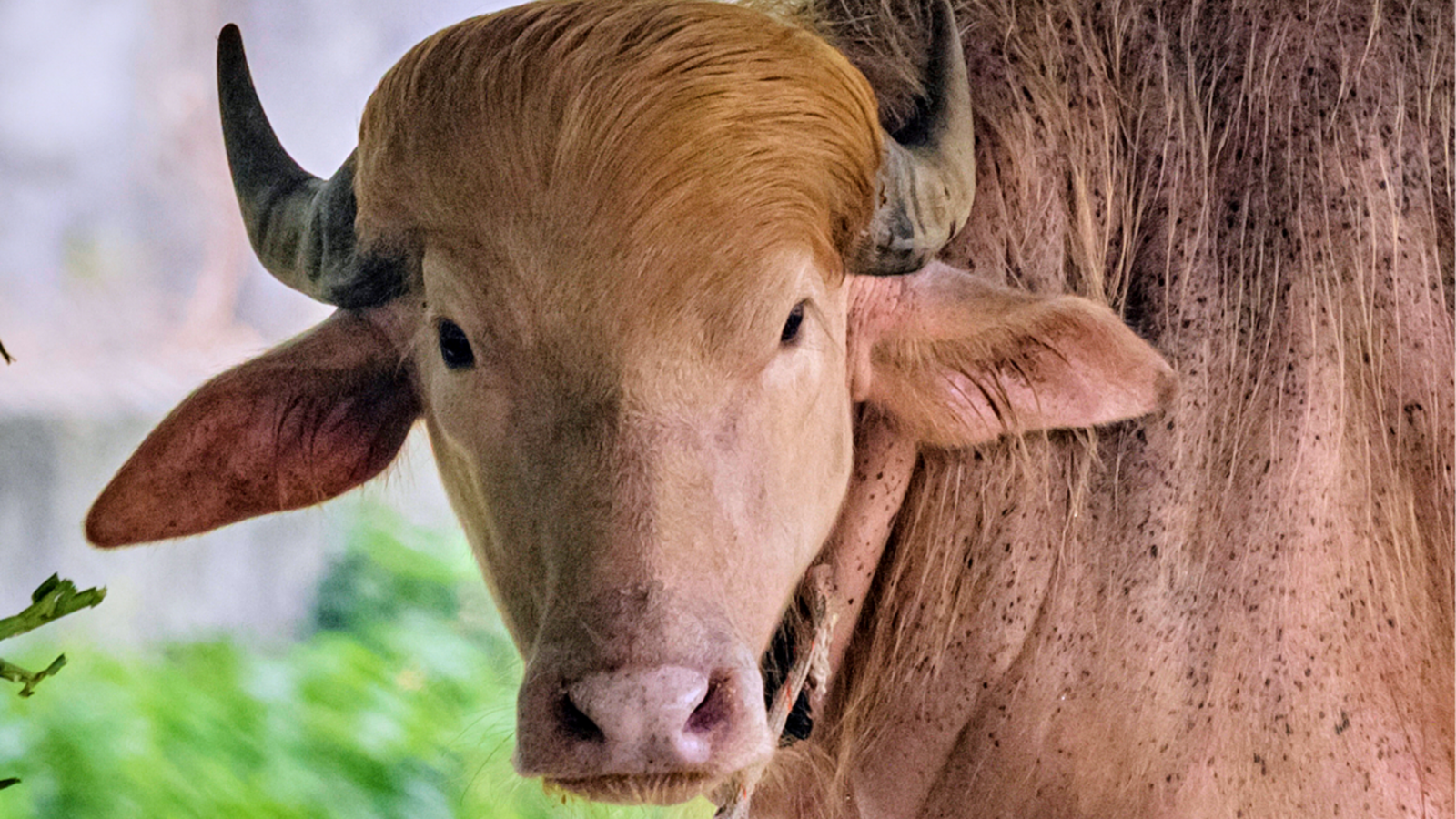
When you think of a famous American president, the last thing that probably comes to mind is a 700-kilogram albino buffalo wandering around an enclosure at the national zoo in Dhaka, Bangladesh. Yet that’s exactly the scene that has unfolded in recent weeks. An albino buffalo named Donald Trump has transformed from an ordinary farm animal into a viral sensation, drawing thousands of curious visitors to the Bangladesh National Zoo despite punishing summer heat. This unusual story captures the intersection of social media fame, cultural tradition, and the universal human fascination with the bizarre.
The story begins on a farm outside Dhaka, where a rare albino buffalo with a shock of golden hair caught the attention of a local farmer. The animal’s distinctive pale coloring and unusual blonde tuft on top of its head bore a striking resemblance to the hairstyle of the current American president. Once footage of this unusual creature hit social media platforms, it spread like wildfire across Bangladesh. The albino buffalo named Donald Trump quickly became a phenomenon, with people traveling from across the country to catch a glimpse of this uniquely colored horned mammal.
From Farm Animal to Celebrity: The Journey to the Zoo
Perhaps the most remarkable aspect of this entire saga is that the buffalo was originally destined for slaughter. In accordance with tradition, the animal was sold ahead of Eid al-Adha, the Islamic “Feast of Sacrifice,” one of the most important holidays in the Muslim calendar. Families across Bangladesh purchase livestock, including buffaloes, cattle, and goats, to sacrifice as part of religious observances during this festival.
However, once the animal’s social media fame reached critical mass, the Bangladeshi government stepped in. Citing security concerns,likely related to the enormous crowds gathering at the farm,Home Minister Salahuddin Ahmed ordered police to take custody of the buffalo. Authorities arranged a refund for the buyer who had purchased the animal for the religious sacrifice. The decision to relocate the rare albino buffalo named Donald Trump to the national zoo instead of allowing the traditional sacrifice was unprecedented and sparked its own conversation across the country.
This bold government intervention transformed what could have been a brief viral moment into an ongoing cultural event. The zoo setting provided a controlled environment where the public could safely view the animal while authorities maintained order among the growing crowds.
Spectacle at the National Zoo: Fans Brave the Heat
Since arriving at the Bangladesh National Zoo, the rare albino has drawn visitors from all corners of the country. On a recent Tuesday, families pressed against the fencing of the buffalo’s enclosure, smartphones held aloft to capture photos and videos of the famous animal. Fathers hoisted small children onto their shoulders to give them a better view of the golden-haired creature that had captured the nation’s imagination.
Despite sweltering summer temperatures in Dhaka, crowds have continued to flock to the zoo. The zoo staff have risen to the occasion, providing VIP treatment befitting the buffalo’s newfound celebrity status. Workers brush the animal’s distinctive golden tuft to one side, mimicking the carefully styled hairdo that earned the creature its famous name. Fans and cool water hoses help the buffalo stay comfortable in the tropical heat, a level of care rarely afforded to ordinary livestock.
“There is a resemblance to Donald Trump in its eyes, hairstyle, and skin color,” explained Mohammed Nasim, a student visiting from Dhaka. “And just as Donald Trump has a distinctive personality and lifestyle, this buffalo, after going viral, is now living a similar kind of life, enjoying a lot of attention and special treatment.” His observation captures exactly why this story has resonated with so many people,it represents a fairytale-like transformation for an animal that was heading toward slaughter.
Social Media Fame and Cultural Reaction
The viral nature of this phenomenon is a testament to the power of social media in modern Bangladesh. With one of the fastest-growing internet user bases in South Asia, Bangladeshi Facebook and other platforms have become significant drivers of cultural conversation. The footage that initially circulated showed the buffalo with its unusual coloring and golden tuft, and observers were quick to point out the resemblance to the American president.
For many visitors, seeing the albino buffalo named Donald Trump has become something of a pilgrimage. Mohammad Habibur Rahman traveled all the way from Jashore, a city in southwestern Bangladesh, specifically to see the animal in person. “Since before Eid, I had been seeing posts on Facebook saying that ‘Donald Trump’ would be sacrificed. Later, I heard that instead of being sacrificed, it had been placed in a zoo,” he explained. “So, I thought I would come to the zoo and see ‘Donald Trump’ for myself.” His journey illustrates how social media can transform a simple curiosity into a destination experience.
Locally produced media coverage has been extensive, with news outlets running daily updates about visitor numbers and the buffalo’s condition. The story has even spread beyond Bangladesh’s borders, attracting international attention to this unusual tale of an unlikely celebrity animal.
The Controversy: A Naming Debated
Not everyone has embraced the playful comparison between the buffalo and the American president. Some Bangladeshis found the naming disrespectful, particularly given the political tensions that sometimes exist between Muslim-majority nations and Western leadership figures. Local media reported that the exhibit originally featured a sign reading “Donald Trump,” though it has since been removed from public display.
The fallout included the dismissal of the zoo curator on Saturday, though officials did not publicly state the reason for the firing. Many observers believe the dismissal was directly connected to the controversy surrounding the animal’s name and the decision to display it so prominently.
“Giving a farm animal the name of one of the world’s most influential leaders was certainly the wrong thing to do,” said Mohammad Joynal Adedin, a Dhaka resident who visited the zoo despite his reservations about the naming. “It seems disrespectful. I think the farmer who did this made a poor decision.” His balanced view,coming to see the animal while disagreeing with its name,captures the complex feelings many Bangladeshis hold about this phenomenon.
The controversy touches on broader questions about cultural sensitivity, the power of social media to elevate ordinary events into significant news, and the boundaries of acceptable humor in international contexts. While many see the naming as harmless fun, others view it through a more serious lens.
An Unlikely Symbol of Wildlife in Bangladesh
Beyond the celebrity comparisons and political controversies, this story highlights something genuinely remarkable: the existence of albino buffaloes in the region. Albino animals are rare in any species, occurring due to a genetic condition that prevents the production of melanin, the pigment responsible for coloration in skin, hair, and eyes. In wild populations, albino animals often face significant survival challenges because their lack of camouflage makes them more visible to predators.
The fact that this particular specimen survived and thrived enough to reach adulthood is notable in itself. While buffaloes are common agricultural animals throughout South Asia, an albino individual with such striking features is genuinely uncommon. The Bangladesh National Zoo now has a unique specimen that draws visitors regardless of any celebrity comparisons,a genuine biological rarity that might otherwise have gone unnoticed.
Lessons from an Unusual Viral Story
This tale of the albino buffalo named Donald Trump offers several insights into modern culture. First, it demonstrates how social media can completely transform the trajectory of any story,turning a routine farm animal into an international sensation overnight. Second, it shows how the international reach of internet content can connect disparate cultures in unexpected ways, with Bangladeshi audiences drawing comparisons to an American political figure. Finally, it raises questions about how societies balance humor and respect, tradition and modernity, local culture and global celebrity.
The government intervention that saved the animal from ritual sacrifice also represents an interesting interplay between religious tradition and modern media-driven celebrity. Such interventions are rare, and this case may set a precedent,or at least a conversation,about how viral fame can alter traditional practices.
Conclusion: A Buffalo’s Golden Moment in the Spotlight
The story of the albino buffalo named Donald Trump continues to unfold at the Bangladesh National Zoo, where visitors from across the country and around the world gather to witness this unusual celebrity. Whether viewed as a humorous viral moment, an inappropriate political comparison, or simply an opportunity to see a rare albino animal up close, the phenomenon has clearly captured public imagination. As crowds continue to brave the Dhaka heat to see this distinctive golden-haired bovine, one thing remains certain: this buffalo’s journey from farm animal to government-protected zoo resident represents one of the most unusual celebrity stories in recent memory. Time will tell whether this golden moment in the spotlight will fade quickly or cement this unusual animal’s place in Bangladesh’s cultural conversation for years to come.