
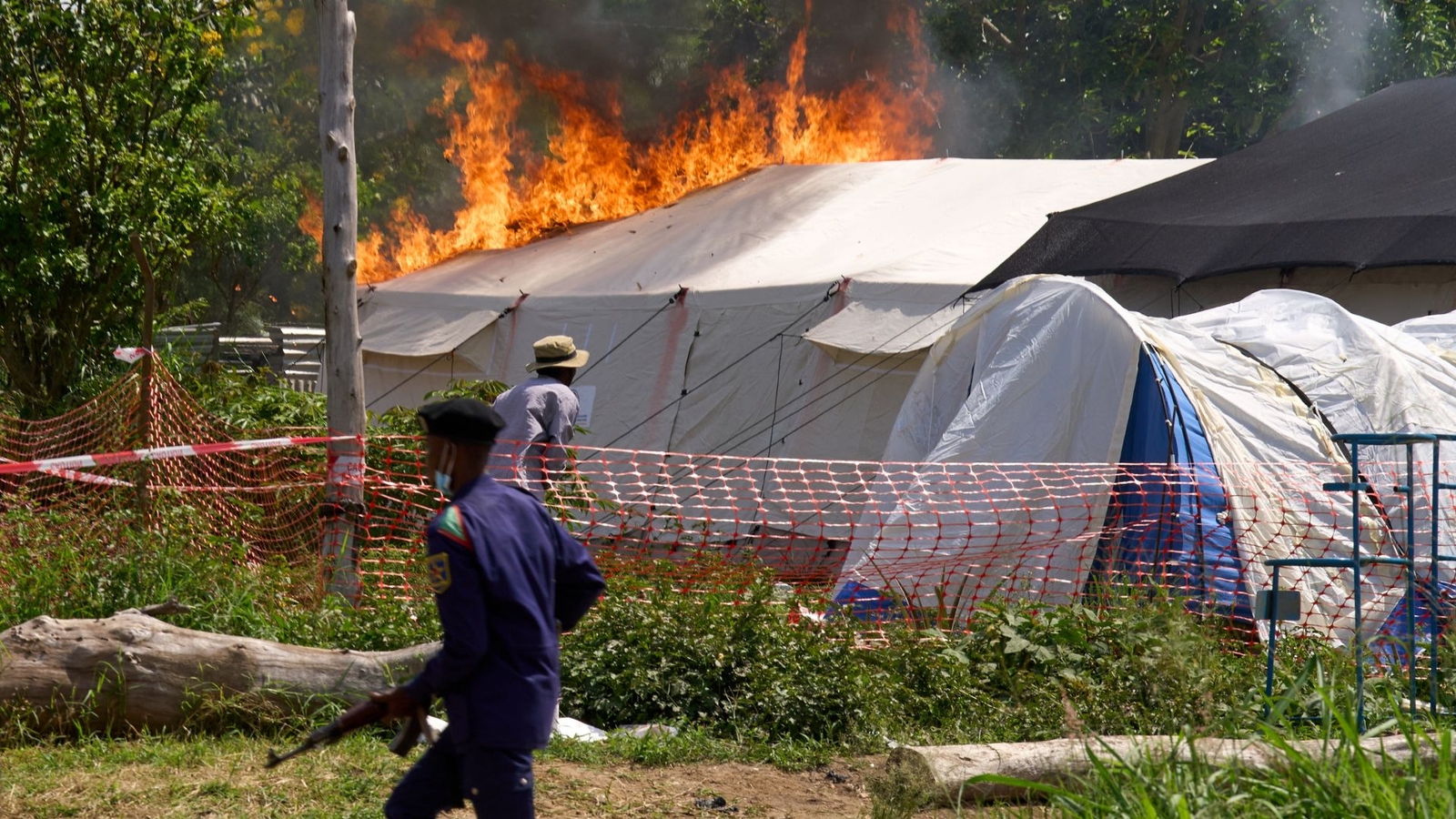
What happens when life-saving medical care collides with deep-rooted cultural traditions? That question has become tragically relevant as the Ebola outbreak Congo faces escalated into open conflict this week, with local youths torching an Ebola treatment center in Rwampara after being prevented from performing traditional burial rites for a community member. The incident offers a stark window into how fear, grief, and mistrust can fuel a public health crisis as much as the virus itself.
For weeks, health workers have been battling to contain one of the most challenging Ebola outbreaks in recent memory in the eastern provinces of the Democratic Republic of Congo. On Thursday, those efforts took a dramatic turn when an entire treatment facility went up in flames, underscoring the volatile mix of public panic, cultural sensitivity, and inadequate infrastructure that responders are navigating on the ground.
Anger Erupts in Rwampara Over Burial Protocols
The incident unfolded in Rwampara, a town at the epicenter of the current outbreak, when a group of young residents attempted to retrieve the body of a friend who had apparently succumbed to Ebola. Health protocols in place across the region prohibit traditional burial practices, requiring instead that bodies of suspected Ebola victims be handled by specially trained burial teams. The bodies of those who die from the disease remain highly contagious, and contact during funeral preparation has historically driven further transmission.
Witnesses described a chaotic scene. Local student Alexis Burata, who was nearby during the confrontation, told reporters that police attempted to calm the crowd but were overwhelmed. Frustrated youths broke into the treatment center and set fire to objects inside, including what appeared to be the body of at least one suspected Ebola victim being stored there. Aid workers were forced to evacuate by vehicle.
Jean Claude Mukendi, deputy senior commissioner and head of the public security department in Ituri Province, blamed the attack on a misunderstanding of burial guidelines. “His family, friends, and other young people wanted to take his body home for a funeral even though the instructions from the authorities during this Ebola virus outbreak are clear,” Mukendi explained. “All bodies must be buried according to the regulations.”
The Cultural Rift Behind the Violence
This isn’t just about one incident. The clash reflects a fundamental tension between Western-style biomedical containment and the deep cultural importance of honoring the dead in Congolese communities. When families are denied the chance to bury their loved ones according to tradition, the resulting grief can quickly morph into rage.
Field coordinator Hama Amadou of the humanitarian organization ALIMA confirmed that calm was eventually restored and aid teams resumed their work, but the damage to trust had already been done. The episode highlights how outbreaks are not purely medical events , they are social ones too.
The Outbreak’s Staggering Scope
According to figures from the United Nations, the Ebola outbreak Congo has produced approximately 148 suspected deaths and nearly 600 suspected cases, with two cases , including one death , already confirmed across the border in neighboring Uganda. Yet the World Health Organization has warned that the official numbers likely understate the true reach of the crisis.
WHO leadership has stated the outbreak is “almost certainly much larger” than recorded figures suggest, expressing alarm over the speed at which new cases are appearing. Jean Kaseya, Director-General of the Africa Centers for Disease Control and Prevention, noted that case counts are expected to rise as surveillance becomes more rigorous across the affected provinces.
- 148 suspected deaths recorded so far
- 600 suspected cases under investigation
- 2 cross-border cases identified in Uganda, including one death
- Ituri Province remains the epicenter, bordering Uganda and South Sudan
A New Strain With No Vaccine
One of the most troubling aspects of this outbreak is the specific virus behind it: the Bundibugyo virus. Three Ebola species are known to cause large outbreaks , Ebola virus, Sudan virus, and Bundibugyo virus , but this marks the largest known outbreak of the Bundibugyo strain ever recorded. The virus was first identified during a 2007-2008 outbreak in Uganda, and despite years of research, no approved vaccine or treatment exists for this particular species.
Experts have indicated it could take at least six to nine months before a viable vaccine becomes available. In the meantime, health workers are relying on supportive care, contact tracing, and strict infection control , interventions that depend heavily on community cooperation, which the Rwampara arson attack demonstrates is far from guaranteed.
The Virus Spreads to a New Province
In another alarming development, the outbreak has officially reached South Kivu Province, with cases confirmed near the city of Bukavu , roughly 500 kilometers south of the Ituri epicenter. The M23 rebel group, which controls portions of eastern Congo, reported the first death in the region on Thursday, and a second case was confirmed later in the day.
Until this point, the outbreak had been confined to Ituri and North Kivu provinces, plus the spillover cases in Uganda. The geographic expansion is raising concerns about containment, particularly because the virus appears to have circulated undetected for weeks following the first known death in late April. Health officials initially tested for a more common Ebola species, missing the Bundibugyo strain, and according to the WHO, “patient zero” has yet to be identified.
Anaïs Legand, a viral hemorrhagic fevers expert at the WHO, suggested the outbreak likely began “a couple of months ago,” based on its current scale. That timeline means the virus has had ample opportunity to spread along the region’s extensive movement networks.
International Ripples From the Crisis
The ripple effects are now being felt far beyond Central Africa. On Thursday, India and the African Union jointly announced the postponement of the India-Africa Forum Summit, originally scheduled for the following week in New Delhi, citing the “evolving health situation in parts of Africa.”
Closer to home, Congo’s national soccer team canceled a three-day World Cup preparation camp and a planned farewell event with fans in Kinshasa. While the U.S. government has placed restrictions on travelers who have visited Congo, Uganda, or South Sudan within the previous 21 days, foreign visitors are barred from entering the U.S., and American citizens or permanent residents are being diverted to Washington Dulles International Airport for screening.
Understanding Ebola: How It Spreads and What It Does
Ebola virus disease spreads through direct contact with the bodily fluids of infected individuals , including vomit, blood, feces, or semen. Symptoms typically begin with fever, vomiting, diarrhea, and muscle pain, and in severe cases can progress to both internal and external bleeding. The disease carries an extraordinarily high mortality rate, which is why even a single missed case can have devastating consequences for an entire community.
Health responders face the additional challenge of operating in a region marked by armed conflict and population displacement. Many residents are on the move, fleeing violence, which makes tracking contacts and isolating suspected cases exponentially more difficult. Combined with limited health infrastructure and shortages of supplies and trained personnel, the operational environment is exceptionally hostile.
Why Community Trust Matters More Than Ever
As Ariel Kestens, head of the International Federation of Red Cross and Red Crescent Societies delegation in Congo, put it, “The priority now is to act quickly and work closely with communities, as the coming days are critical.” That phrase , work closely with communities , captures the central lesson of the Rwampara fire. Without local buy-in, even the best-equipped response teams can be physically expelled from the very communities they are trying to save.
The coming weeks will likely determine whether the outbreak can be contained within its current footprint or whether it will spiral further. Success will depend not just on medical interventions, but on rebuilding trust with communities that have every reason to feel afraid, angry, and unheard.
Conclusion
The burning of an Ebola treatment center in Rwampara is a tragic illustration of what can happen when public health measures fail to account for the human realities of the people they aim to protect. The current Ebola outbreak Congo is shaping up to be the largest known outbreak of the Bundibugyo virus, with cases now spanning three Congolese provinces and crossing into Uganda. With no vaccine available for at least six more months, responders are in a race against time , and against fear. Bridging the gap between medical necessity and cultural respect may ultimately prove just as important as any vaccine or treatment in bringing this crisis under control.