
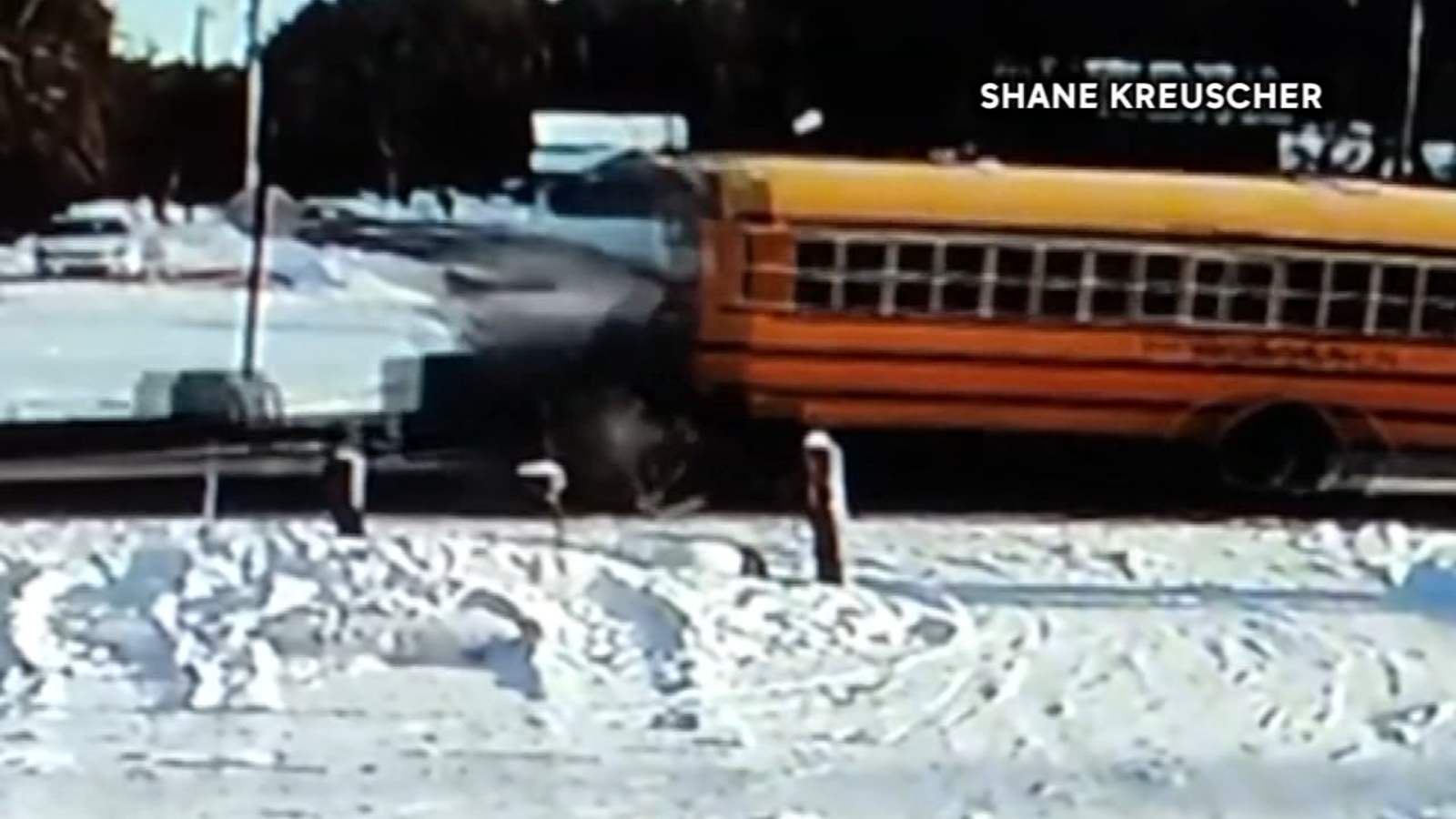
A shocking school bus crash in Waupaca County, Wisconsin, has left a family and an entire community grappling with fear, disbelief, and an urgent call for greater awareness about bus stop safety. On a quiet Tuesday afternoon along Highway 54 near the small community of Royalton, a truck pulling a trailer slammed into a school bus as young children were stepping off , and in the horrifying moments captured on camera, a 5-year-old girl was thrown from the bus onto the pavement.
What makes the incident even more astonishing is the outcome: despite the dramatic violence of the collision, no one suffered life-threatening injuries. But for the parents of the children involved, the emotional scars run deep, and they are now using their story to shine a spotlight on what they describe as a dangerous stretch of road where vehicles routinely travel at excessive speeds.
A Father’s Worst Nightmare
Shane Kreuscher had been waiting inside his home, expecting his three daughters to be dropped off by the school bus as they had been every other day. Instead, he heard something that would change his family’s sense of security forever.
“All of a sudden, I just heard and felt this huge boom,” Kreuscher recalled in an interview with WBAY. The sound was the unmistakable crash of a vehicle colliding with a school bus , right down the street from his home, right where his children were supposed to be arriving safely.
The Kreuscher children , 13-year-old Danee, her twin sister Amya, and 5-year-old Vera , were among only four students aboard the bus at the time. The relatively empty bus made the scene that followed even more surreal, as the children scrambled to understand what had just happened.
The Moment That Changed Everything
Vera Kreuscher, the youngest of the three sisters, was just stepping off the bus when the truck made impact. According to her older sister Amya, who witnessed the terrifying scene from inside the vehicle, Vera was on the last step of the bus when the collision occurred.
“When Vera was walking off the bus, she was on the last step. Then, the truck hit the bus. I could just see Vera fly out of the bus, and I just fell back,” Amya recounted, visibly shaken as she described watching her little sister being thrown from the bus and landing hard on the pavement.
Vera survived with scrapes and bruises, including a noticeable mark on her left arm from the impact with the road. But the close call has prompted her family to keep her , and her sisters , home from school the following day, both for physical recovery and emotional healing.
Eyewitness Footage and the Role of Video Evidence
The entire incident was captured on camera, and the resulting footage quickly circulated online, sparking outrage and concern from viewers across the country. The video shows the bus stopped along Highway 54 with its red lights flashing and stop arm extended , the universal signals that tell motorists they must stop and wait for children to board or disembark. Despite these clear warnings, the truck, which was pulling a trailer, failed to slow down in time and barreled into the side of the bus.
Bus-mounted cameras and stop-arm cameras have become increasingly important tools in documenting dangerous driving behavior around school buses. In many states, footage from these cameras is now admissible in court and can lead to significant fines or even criminal charges for drivers who illegally pass stopped school buses. This latest incident is likely to fuel further conversations about whether stronger enforcement mechanisms are needed in rural areas where bus stops may be less supervised.
The Driver’s Explanation and Ongoing Investigation
Following the crash, the truck driver took to social media to share his version of events, claiming that the afternoon sun had temporarily blinded him and contributed to the collision. The Waupaca County Sheriff’s Department confirmed that the crash remains under active investigation, and no charges had been announced at the time of the initial reports.
Whether sun glare will be accepted as a mitigating factor remains to be seen. While glare from low-angle sunlight is a legitimate driving hazard that affects thousands of accidents every year, legal experts note that drivers are still expected to take reasonable precautions , especially in school zones and around buses displaying flashing red lights. Driving at excessive speed, failing to wear appropriate sunglasses or use a sun visor, or not adjusting one’s route to account for known glare conditions can all be considered forms of negligence.
Parents Speak Out About Highway Safety Concerns
For Shane Kreuscher, the focus now is less on assigning blame and more on preventing future tragedies. He has been outspoken about ongoing school bus safety concerns on Highway 54, particularly the speeds at which vehicles travel through the area. The rural nature of the road, combined with limited visibility and the presence of multiple bus stops, creates what he considers a recipe for disaster.
“I have not been able to get rid of the adrenaline and the anxiety since last night. Even though I knew in my head what happened before I physically saw the video, after seeing the video, I think it made the anxiety so much so much worse as a parent because our kids have to get off this bus every day and get on this bus every day,” Kreuscher said.
His comments underscore a reality that countless families face: even after a traumatic event, life must go on, and children still need to board that same bus the next morning. For parents in rural school districts, there often is no alternative route, no other option, and the safety of their children depends largely on the vigilance and courtesy of strangers behind the wheel.
The Bigger Picture: School Bus Safety in America
The Waupaca County crash is not an isolated event. Across the United States, school buses are involved in tens of thousands of crashes every year. According to data from the National Highway Traffic Safety Administration (NHTSA), school buses remain one of the safest modes of transportation for children , far safer than being driven to school by a parent , but they are not immune to accidents, particularly those caused by other drivers.
In fact, the majority of fatalities in school bus-related crashes are not bus occupants. They are pedestrians, cyclists, or occupants of other vehicles. This statistic highlights a critical point: most school bus crashes are not caused by bus drivers, but by the motorists around them.
Common Causes of School Bus Crashes
Several factors consistently appear in crash analyses involving school buses:
- Drivers illegally passing stopped buses , Even with flashing red lights and extended stop arms, some drivers choose to ignore these warnings and speed past.
- Distracted driving , Texting, talking on the phone, adjusting the radio, or eating can delay a driver’s reaction time when approaching a stopped bus.
- Excessive speed , Especially in school zones or along rural routes with multiple bus stops, speed dramatically increases the severity of any collision.
- Sun glare and weather conditions , As alleged in the Waupaca County incident, low-angle sunlight can temporarily blind drivers and reduce visibility.
- Blind spots and turning accidents , Buses have large blind spots, and drivers of other vehicles sometimes misjudge the bus’s path.
What Can Be Done to Prevent Future Tragedies?
The conversation sparked by this Wisconsin crash touches on a range of potential solutions that communities, lawmakers, and parents have been advocating for years.
Strengthening Penalties
Many states have significantly increased fines and penalties for drivers who illegally pass stopped school buses. Some have even implemented automated camera enforcement that issues tickets based on stop-arm camera footage, similar to red-light camera systems. Expanding these programs to more school districts could deter reckless driving.
Improved Road Design and Visibility
Adding rumble strips, dedicated school bus pull-off areas, better signage, and flashing warning beacons at known bus stops can alert drivers well in advance that children may be present. In rural areas like Waupaca County, where budget constraints often limit such improvements, community advocacy becomes essential.
Education and Public Awareness Campaigns
Public service announcements, school-based education programs, and driver education curriculum updates can all help reinforce the importance of stopping for school buses. Some advocates have called for more visible reminders of the law, including painted “School Bus Stop Ahead” markings on roads and increased use of electronic message boards near bus stops.
Technology and Telematics
Modern school buses are increasingly equipped with GPS tracking, exterior cameras, and collision avoidance systems. These tools not only help document incidents like the one in Waupaca County but can also be used to identify dangerous drivers and hold them accountable.
A Family’s Plea for Change
For the Kreuscher family, the goal moving forward is clear. They want their experience to serve as a wake-up call , not just for drivers along Highway 54, but for communities across the country where similar risks exist. They hope that by sharing their story, they can draw attention to speed concerns, infrastructure needs, and the broader importance of treating school buses with the caution and respect they demand.
As Shane Kreuscher put it, the anxiety of knowing his children must board that same bus every day, traveling along the same road where a truck failed to stop, is something no parent should have to endure. His hope is that no other family has to experience what his went through , and that perhaps, in some small way, this frightening school bus crash becomes a turning point for safer roads in his community and beyond.
Conclusion: A Call for Vigilance
The Waupaca County school bus crash is a stark reminder of how quickly routine can turn into catastrophe. In a matter of seconds, a child’s daily bus ride home became a harrowing ordeal captured on video for the world to see. While the outcome , no serious injuries , is nothing short of miraculous, the emotional toll on the children, their parents, and the wider community is real and lasting.
School buses remain statistically among the safest ways for children to travel, but their safety depends on the cooperation of every driver who shares the road with them. By slowing down, staying alert, obeying stop arms, and speaking up about dangerous conditions in their own neighborhoods, communities can help ensure that no other family has to relive the terrifying moments that the Kreuscher family experienced on that October afternoon. The story of Vera, Amya, Danee, and their father is not just a local news item , it is a national conversation about responsibility, awareness, and the precious lives entrusted to us every school day.