
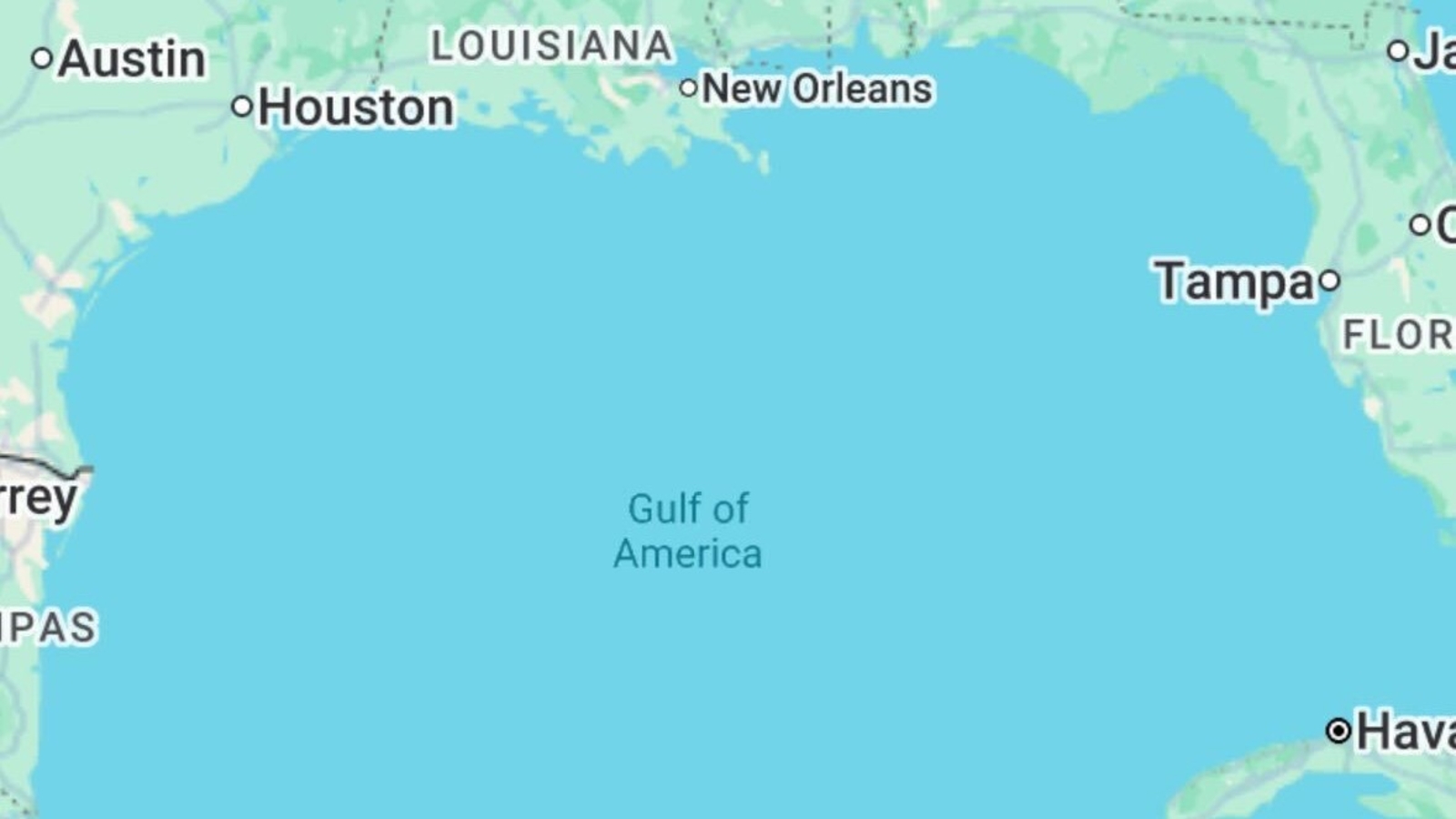
The gulf of america renaming controversy has escalated into a potential international legal battle, with Mexican President Claudia Sheinbaum threatening to take Google to court over how the tech giant displays the famous body of water on its mapping platform. The dispute centers on Google’s decision to label the entire Gulf of Mexico as the “Gulf of America” for users based in the United States, a move that Mexico argues oversteps the boundaries of any single nation’s authority.
What began as a symbolic gesture tied to a presidential executive order has now become a flashpoint in the ongoing debate over digital sovereignty, geographic naming conventions, and the power that technology companies wield in shaping how the world sees itself on a map.
The Roots of the Gulf of America Renaming Dispute
The controversy traces back to a presidential proclamation by Donald Trump that directed the official renaming of the Gulf of Mexico to the Gulf of America within the boundaries of the United States continental shelf. For Google, this meant updating Google Maps to reflect what the U.S. government considers an updated geographic designation under its own jurisdiction.
Google announced it would comply with the order, explaining that it follows a “longstanding practice of applying name changes when they have been updated in official government sources.” As a result, users in the United States now see the body of water labeled as the Gulf of America, while Mexican users continue to see “Gulf of Mexico.” Users in all other countries see both names displayed side by side.
On the surface, this compromise might seem reasonable. In practice, however, it has opened a diplomatic firestorm.
Mexico’s Core Objection
President Sheinbaum’s central argument is straightforward: the U.S. presidential order only changed the name within the area under American jurisdiction, specifically the U.S. continental shelf, which extends roughly 22 nautical miles from the coast. According to Sheinbaum, Google has gone far beyond that scope by labeling the entire waterway as the Gulf of America.
“What Google is doing here is changing the name of the continental shelf of Mexico and Cuba, which has nothing to do with Trump’s decree,” Sheinbaum told reporters during a Monday press conference. “We do not agree with this, and the Foreign Minister has sent a new letter addressing the issue.”
She emphasized that the renaming is “incorrect” and that Mexico has formally requested that Google confine any “Gulf of America” label strictly to the marine area under U.S. jurisdiction.
Why the Google Maps Decision Matters Beyond Geography
Maps are far more than navigational tools. They are powerful representations of sovereignty, identity, and history. When a major technology platform like Google decides to implement a name change controversy at scale, the ripple effects extend into education, business, tourism, and international relations.
For Mexico, the issue is not merely semantic. The Gulf of Mexico has been called by that name for centuries, and it forms a core part of Mexico’s geographic, cultural, and economic identity. Seeing it rebranded, even partially, on one of the world’s most widely used mapping platforms feels, to many Mexicans, like a quiet erosion of their sovereignty.
The country has also pointed out that the water body in question is shared with Cuba, which has similarly not consented to any name change. By labeling the entire gulf as the Gulf of America, critics argue, Google is effectively endorsing a unilateral interpretation of geographic boundaries that ignores neighboring nations.
The International Waters Question
A significant portion of the gulf lies outside any single country’s territorial waters. International maritime law and longstanding geographic convention generally treat such bodies of water as shared spaces. Mexico’s position is that no national government, and certainly no private company, has the authority to unilaterally rename a feature that straddles multiple jurisdictions.
In the formal letter Mexico sent to Google, the government made this position explicit: “Any reference to the ‘Gulf of America’ initiative on your Google Maps platform must be strictly limited to the marine area under U.S. jurisdiction.”
The letter continued with a clear warning: “Any extension beyond that zone exceeds the authority of any national government or private entity. Should that be the case, the Government of Mexico will take the appropriate legal actions as deemed necessary.”
The Bigger Battle: Tech Companies and Geographic Sovereignty
This dispute highlights a growing tension between private technology platforms and national governments over geographic naming authority. Google, Apple, and other major mapping services regularly face decisions about which names to display, often navigating between political pressure, user expectations, and historical accuracy.
Apple, for its part, also adjusted its maps to display “Gulf of America” for U.S. users following Trump’s executive order. The pattern suggests that tech companies are increasingly treating presidential directives as authoritative sources for cartographic decisions within the issuing country’s territory.
But Mexico’s challenge raises an important question: should private companies be the final arbiters of how international geographic features are labeled? Mexico clearly believes the answer is no. The country’s argument is that when tech giants implement name changes, they should carefully respect the limits of the legal authority behind those changes, rather than applying them across borders without consultation.
The Precedent-Setting Potential
If Mexico follows through on its threat to pursue legal action, the case could set a significant precedent for how digital platforms handle future naming disputes. A ruling in Mexico’s favor could force mapping companies to be more cautious about implementing geographic changes that cross international boundaries. Conversely, if the case is dismissed or settled quietly, it may embolden both governments and tech companies to take similar actions in the future.
What Google’s Response Reveals
During her press conference, Sheinbaum read aloud a response Google had sent to an earlier letter from Mexico. The company reiterated its position, stating that people in Mexico would continue to see “Gulf of Mexico,” people in the United States would see “Gulf of America,” and users elsewhere would see both names displayed.
While this sounds like a balanced approach, Mexico’s objection is that Google has effectively legitimized the U.S. renaming by displaying it at all. Even the dual-label approach for international users treats “Gulf of America” as an equally valid name for the entire body of water, which is precisely what Mexico disputes.
Sheinbaum indicated that Mexico is now waiting for Google’s response to its most recent letter before deciding whether to escalate the matter in court.
Looking Ahead: A Digital Diplomatic Standoff
The Mexico Google lawsuit threat represents a new kind of international dispute, one fought not over territory in the traditional sense but over the digital representation of territory. As mapping platforms become increasingly central to how people understand geography, the decisions these companies make carry real geopolitical weight.
Mexico’s stance reflects a broader concern among smaller and mid-sized nations: that the unilateral decisions of powerful technology companies, often made in response to the demands of even more powerful governments, can reshape global narratives without input from affected parties.
For now, the world is watching to see whether Google adjusts its approach or whether the dispute ends up in a courtroom. Either way, the Gulf of America renaming debate has already succeeded in drawing attention to a question that will only become more urgent in the years ahead: who actually controls the names we see on our screens?
Conclusion
The clash between Mexico and Google over the gulf of america renaming is far more than a cartographic squabble. It is a revealing moment in the evolving relationship between national sovereignty, international law, and the private technology companies that increasingly mediate our view of the world. As Sheinbaum and her government prepare their next move, the outcome could influence how digital platforms handle geographic disputes for years to come. Whether through diplomacy or litigation, Mexico has made clear that it will not allow a foreign executive order, however powerful its source, to dictate how the Gulf of Mexico is represented on the world’s most popular mapping service.