
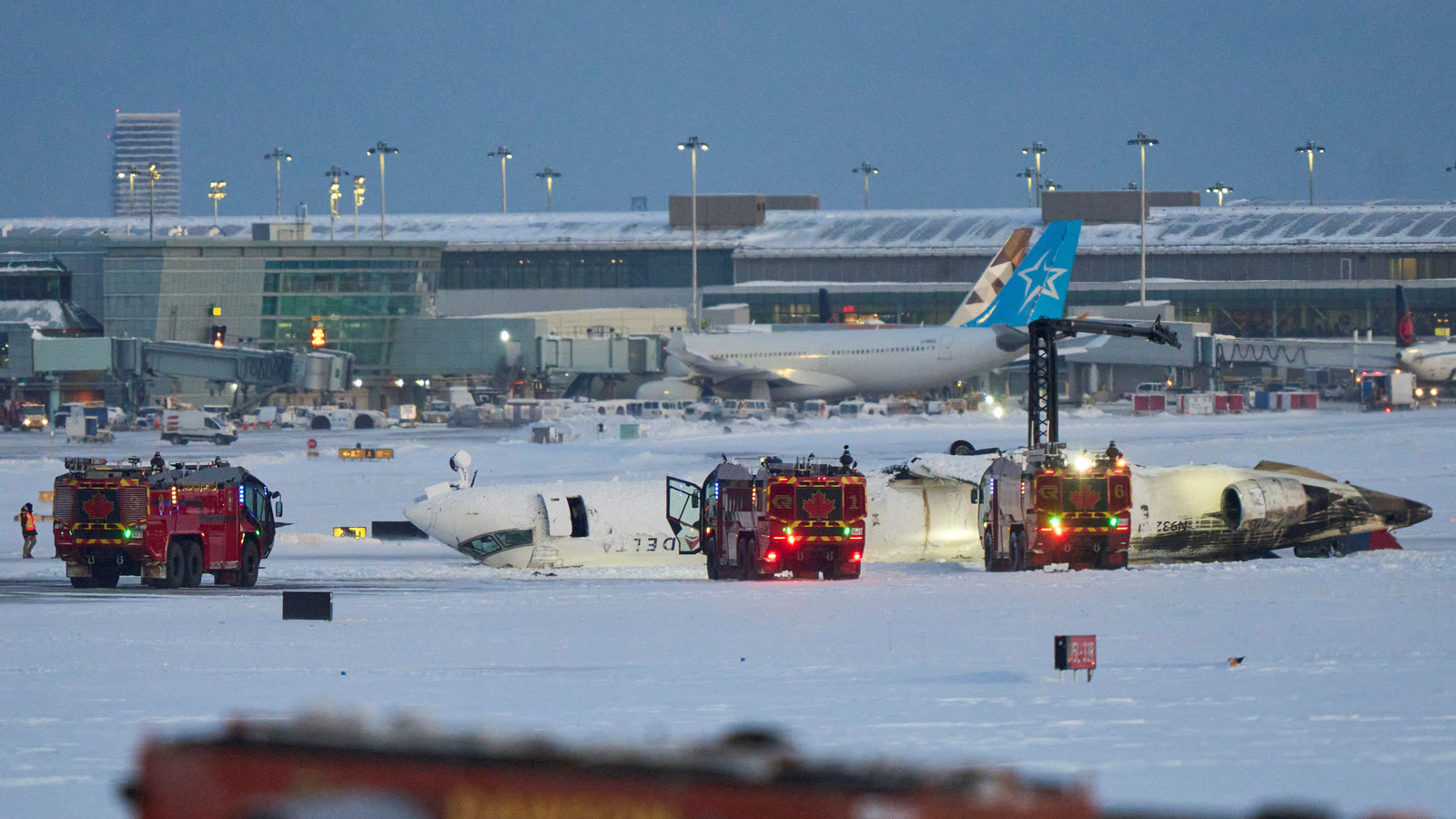
When news broke of a toronto plane crash at Toronto Pearson International Airport, the aviation world held its breath. A Delta regional jet, carrying 76 passengers and four crew members, flipped upside down upon landing, leaving survivors with harrowing accounts of hanging suspended by their seatbelts in an inverted cabin. The dramatic incident, captured on video, has raised questions about runway safety, weather conditions, and the emergency response that prevented what could have been a far worse tragedy.
What Happened During the Toronto Plane Crash
The incident involved Delta flight 4819, a CRJ 900 regional aircraft operated by Endeavor Air. The flight departed from Minneapolis on Monday afternoon and was scheduled to land at Toronto Pearson International Airport shortly after 2 p.m. local time. However, what should have been a routine landing turned into a terrifying ordeal for everyone aboard.
During the landing sequence, the aircraft flipped over on the runway, coming to rest upside down. New video footage obtained by ABC News shows the chaotic aftermath inside the cabin, with passengers dangling from their seats, held in place only by their seatbelts. The surreal scene resembles something from a movie, with rows of travelers inverted against the cabin ceiling, waiting for rescue.
Eyewitness Accounts and Survivor Stories
The personal accounts from those aboard the toronto plane crash paint a vivid picture of confusion, fear, and ultimately relief. Passenger Peter Koukov, who managed to capture video of the wreckage as he crawled toward an exit, described the surreal moment when everything went wrong.
“We hit the ground and we were sideways, and then we were hanging upside down like bats. It all happened pretty, pretty fast. The plane was upside down, obviously, some people were kind of hanging and needed some help being helped down.”
Another passenger, Pete Carlson, spoke about the disorienting experience of going from a routine landing to suddenly being inverted. “The one minute you’re landing and kind of waiting to see your friends and your people and the next minute you’re physically upside down and just really turned around. It sounded, I mean, it was just cement and metal, you know.”
Perhaps the most striking visual from the emerging footage is the sight of flight crew members standing on what had become the ceiling, working calmly to help passengers unbuckle and escape the overturned aircraft. Their composure during such an extraordinary situation drew praise from aviation experts and passengers alike.
The Scene at Toronto Pearson International Airport
Eyewitnesses near the airport described a sudden flurry of activity as emergency vehicles rushed toward the scene. Ron James, who was preparing to board his own flight at a nearby terminal, noticed the commotion before authorities made any announcements.
- Fire trucks and helicopters deployed rapidly to the crash site
- Nearby boarding operations were suspended
- Passengers in adjacent terminals watched in shock as smoke became visible
- Airport staff moved quickly to redirect travelers
“All of a sudden the fire trucks and helicopters, you know, pushed out on a trolley and thought there was something wrong. Then we were going to get on the plane and they said no you’re not going anywhere,” James recalled. The rapid deployment of emergency resources reflected the severity of what had occurred.
Casualties and Injuries
While the toronto plane crash could have resulted in catastrophic loss of life, the outcome was considerably less severe than initial fears suggested. According to airport officials, at least 18 passengers were transported to hospitals for evaluation and treatment.
Peel Regional Paramedic Services reported that none of the injuries were considered life-threatening. However, three individuals did suffer critical injuries and required special medical attention:
- A child who was transported to the Hospital for Sick Children and listed in good condition by Monday evening
- A man in his 60s requiring critical care
- A woman in her 40s also receiving treatment for serious injuries
Beyond these critical cases, an additional 12 people were treated for mild injuries. The fact that everyone survived such a dramatic crash has been attributed to the robust design of the aircraft, the quick response of emergency personnel, and what officials called a “textbook” execution of rescue protocols.
Weather Conditions and Ongoing Investigation
One of the most pressing questions following the toronto plane crash is what caused the aircraft to flip during landing. At the time of the incident, weather reports indicated winds gusting up to 40 mph in the area, raising immediate speculation about whether crosswinds or wind shear may have played a role.
However, airport authorities have been careful not to jump to conclusions. Todd Aitken, fire chief at Toronto Pearson International Airport, addressed the media with measured statements about the investigation.
“This is an active investigation. It’s very early on. It’s really important that we do not speculate. What we can say is the runway was dry and there was no crosswind conditions.”
This distinction is crucial for the toronto plane crash investigation. While winds were present, officials confirmed that crosswind conditions , which are often implicated in landing accidents , were not a factor according to their initial assessment. The dry runway condition also rules out one of the more common causes of aircraft incidents during landing.
Aviation Expert Analysis
Julianne Fox, a pilot and aviation expert, weighed in on the incident, offering professional perspective on what passengers experienced and the broader implications for aviation safety. Her insights helped contextualize the unusual nature of an aircraft flipping on landing, an event that remains statistically rare in commercial aviation.
Emergency Response Praised
One consistent theme emerging from coverage of the toronto plane crash is the exceptional performance of emergency responders. Deborah Flint, president and CEO of Toronto Pearson International Airport, did not hesitate to credit the teams who arrived at the scene within moments of the incident.
“Airport emergency workers mounted a textbook response, reaching the site within minutes. This outcome is in due part to their heroic work, and I thank them profusely,” Flint stated.
The rapid response proved critical in evacuating the inverted aircraft and triaging injured passengers. The fact that flight crew members were able to assist passengers in escaping an upside-down cabin, combined with the swift arrival of ground-based emergency teams, likely prevented the situation from becoming far more dire.
Looking Ahead: What the Investigation May Reveal
As authorities continue to investigate the toronto plane crash, several factors will likely be examined in detail. The CRJ 900 aircraft involved in the incident is a widely-used regional jet with a generally strong safety record, which makes the circumstances particularly puzzling to aviation experts.
Investigators will need to consider multiple possibilities, including:
- Mechanical failure or malfunction during landing
- Pilot decision-making and crew resource management
- Micro-weather conditions specific to the runway at the time of landing
- Potential wildlife encounters (bird strikes)
- Runway conditions and any debris present
Aviation safety agencies, including the Transportation Safety Board of Canada and the U.S. National Transportation Safety Board (given the flight originated in Minneapolis), will collaborate to reconstruct the sequence of events that led to the aircraft flipping over.
Conclusion
The toronto plane crash of Delta flight 4819 will be remembered as a dramatic incident with a remarkably fortunate outcome. The fact that all 80 people aboard survived, with most injuries classified as non-life-threatening, speaks to multiple factors working in the passengers’ favor: the structural integrity of the CRJ 900, the skill and composure of the flight crew, and the rapid deployment of emergency services.
For the survivors who described themselves as “hanging like bats” in an inverted cabin, the experience will undoubtedly leave lasting memories. Yet as investigations proceed and safety protocols are reviewed, the broader aviation community will study this incident carefully. Each accident, no matter how unusual, offers lessons that can shape future safety standards and emergency procedures. The passengers, crew, and responders who navigated this terrifying event have already contributed valuable knowledge that may one day prevent similar tragedies from occurring elsewhere.