
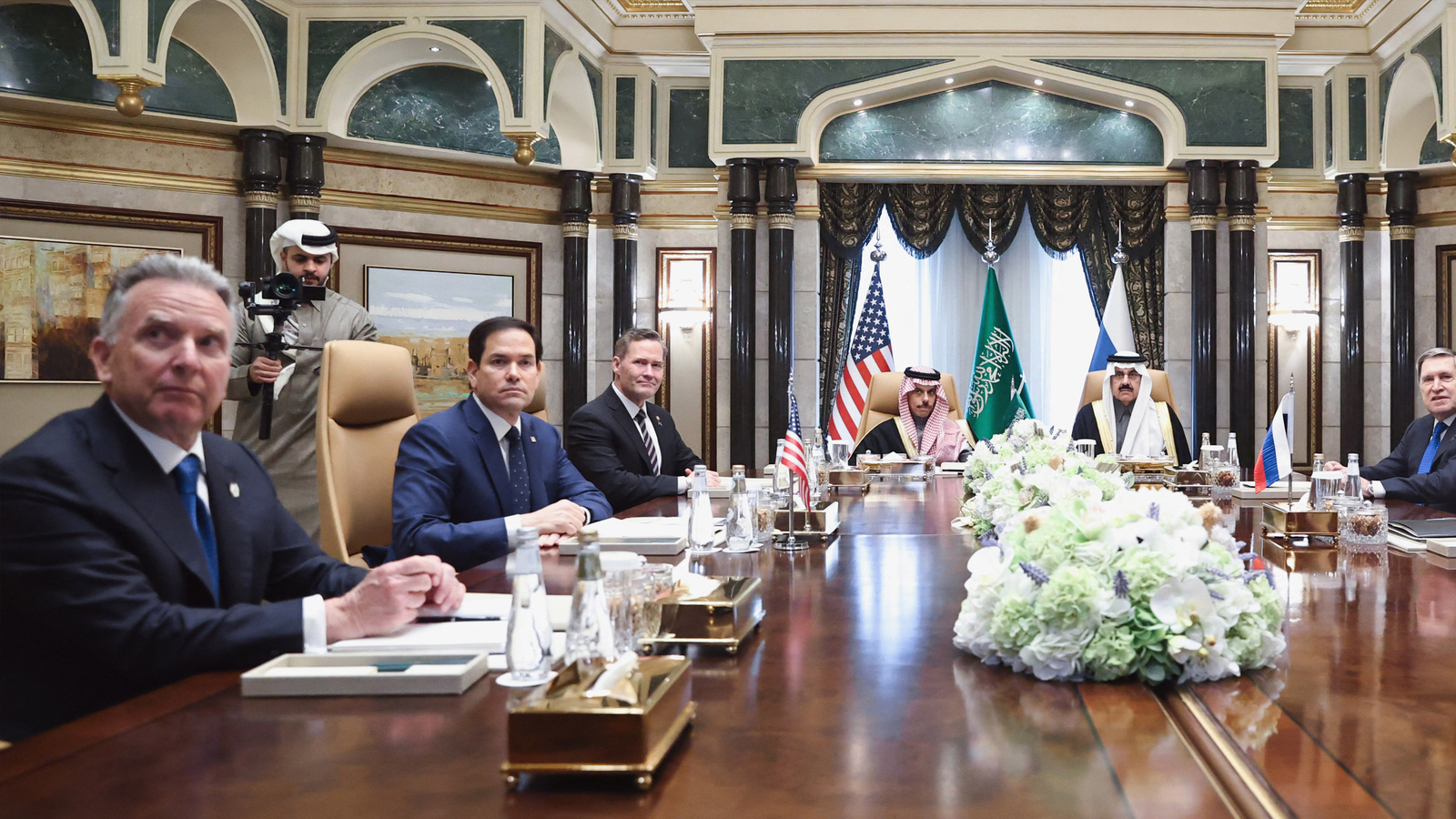
In a significant diplomatic development, high-level US-Russia Ukraine negotiations took place in Riyadh, Saudi Arabia, on Tuesday , and notably, Ukraine was not at the table. The approximately five-hour meeting between senior American and Russian officials marks the first major engagement between Washington and Moscow since President Joe Biden and Russian President Vladimir Putin met in Geneva before Russia’s full-scale invasion of Ukraine in 2022.
The exclusion of Kyiv from these critical discussions has sparked outrage from Ukrainian President Volodymyr Zelenskyy and prompted European leaders to convene emergency talks in Paris. As the diplomatic landscape shifts rapidly, questions about the future of Ukraine, European security, and the legitimacy of any potential peace deal loom large.
The Delegations: Who Was in the Room
The American team was led by Secretary of State Marco Rubio, Middle East envoy Steve Witkoff, and National Security Adviser Michael Waltz. The Russian delegation included Foreign Minister Sergei Lavrov, Kremlin foreign policy adviser Yuri Ushakov, and Kirill Dmitriev, the head of Russia’s sovereign wealth fund.
Notably absent from the Riyadh summit was any Ukrainian representation. The meeting took place at a time when Zelenskyy was traveling in the Middle East, having met with officials in the United Arab Emirates on Monday and scheduling additional meetings in Turkey and Saudi Arabia. The Ukrainian president said he planned to raise the US-Russia negotiations with Saudi Crown Prince Mohammed bin Salman during his visit.
Key Outcomes Announced by the State Department
- Consultation Mechanism: Both sides agreed to establish a structured channel for addressing irritants in the bilateral relationship.
- Embassy Staffing: The US and Russia agreed to restore diplomatic mission staffing as part of normalizing relations.
- Working Groups: High-level teams will be appointed to develop “a path to ending the conflict in Ukraine as soon as possible in a way that is enduring, sustainable and acceptable to all sides.”
- Future Cooperation: The two nations pledged to explore geopolitical cooperation and “historic economic and investment opportunities” emerging from a successful resolution.
State Department spokesperson Tammy Bruce described the discussions as “an important step forward” toward “enduring peace,” adding that both parties pledged “to remain engaged to make sure the process moves forward in a timely and productive manner.”
Zelenskyy’s Fierce Response: “About Ukraine Without Ukraine”
Reacting from the Ukrainian embassy in Ankara, Turkey, Zelenskyy did not mince words. He accused Russia of reviving the ultimatums it had issued during the early stages of its full-scale invasion.
“I have the impression that there are now some negotiations happening and they have the same mood, but between Russia and the United States,” Zelenskyy said. “Again, about Ukraine without Ukraine. It’s interesting, if Ukraine didn’t yield to ultimatums in the most difficult moment, where does the feeling come from that Ukraine will agree to this now?”
The Ukrainian president was unequivocal: “I never intended to yield to Russia’s ultimatums and I don’t intend to now.” He further declared that Ukraine “cannot acknowledge any agreements about us without us, and will not recognize such agreements,” adding that talking to an aggressor during wartime was once considered taboo.
The Question of Legitimacy
In a pointed display of diplomatic tension, Kremlin spokesperson Dmitry Peskov told journalists that Putin remains prepared to negotiate with Zelenskyy “if necessary” , while simultaneously questioning the Ukrainian president’s legitimacy. Russian officials have repeatedly framed Zelenskyy as illegitimate, citing martial law and the postponement of scheduled presidential elections.
European Allies Mobilize: The Paris Meeting
The US-Russia Ukraine negotiations in Saudi Arabia triggered swift action across the Atlantic. French President Emmanuel Macron convened a hastily organized meeting of European heads of government in Paris on Monday , just one day before the Riyadh talks.
Macron and President Donald Trump spoke via telephone for nearly 30 minutes before the European gathering. According to a White House official, the conversation was “friendly” and covered both the war in Ukraine and the upcoming bilateral meetings.
During the Paris meeting, UK Prime Minister Keir Starmer and Swedish Prime Minister Ulf Kristersson signaled openness to deploying armed forces on the ground in Ukraine as part of a potential peacekeeping mission after any deal is struck.
“If there is a peace deal [for Ukraine], and everybody wants a peace deal, then it’s got to be a lasting peace deal, not just a pause for Putin to come again,” Starmer said in Paris.
Starmer also emphasized the broader stakes: “There’s also a wider piece here which is the collective security and defense in Europe, and here, I think, we’ve got a generational challenge. We’ve all got to step up.”
Contours of a Potential Deal: What the US Has Signaled
The Riyadh meeting did not emerge in isolation. In the days leading up to the negotiations, Trump administration officials outlined potential terms for a settlement , most notably at the Munich Security Conference in Germany.
Defense Secretary Pete Hegseth made headlines when he characterized a return to Ukraine’s pre-2014 borders , before Russia’s annexation of Crimea , as “unrealistic.” He described that goal as an “illusionary” one that the United States would not champion. Hegseth similarly indicated that NATO membership for Ukraine would not be supported by Washington.
In response, Zelenskyy told Munich attendees that Ukraine must be guaranteed membership in “NATO, or a reliable alternative.” He also called for the construction of the “armed forces of Europe” as the Trump administration pushes for increased European defense spending.
Rubio on the Phone: The Road to Riyadh
Tuesday’s talks built on a series of preparatory communications. Lavrov and Rubio spoke by phone on Saturday, according to the State Department, following a conversation between Putin and President Trump the previous week. Bruce described the Riyadh meeting as the “second step to determine if the Russians perhaps are serious, and if they’re on the same page.”
Meanwhile, a spokesperson for Putin indicated that the meeting would be “devoted” primarily to “restoring the entire range of Russian-American relations” , a broader framing than the State Department’s narrower focus on Ukraine.
Pushback From the White House on Exclusion Concerns
Facing criticism over the absence of Ukrainian representation, National Security Adviser Mike Waltz defended the process on Sunday. “I will push back on any notion that [Ukrainians] aren’t being consulted,” Waltz said. “They absolutely are. And at the end of the day, though, this is going to be under President Trump’s leadership that we get this war to an end.”
Waltz conceded, however, that Kyiv “may not like some of the sequencing that is going on in these negotiations” , a candid acknowledgment that the diplomatic choreography has left Ukraine on the sidelines at a moment of profound consequence.
The Broader Implications
The US-Russia Ukraine negotiations in Saudi Arabia represent a fundamental shift in the diplomatic calculus surrounding the three-year war. By engaging Moscow directly , and at a high level , without Ukrainian participation, the Trump administration has signaled its willingness to pursue a settlement that may diverge from Kyiv’s stated red lines.
For Ukraine, the fear is clear: a deal brokered in its absence may impose terms it cannot accept. For European allies, the concern is equally stark , a settlement shaped largely by Washington and Moscow could leave the continent’s security architecture permanently weakened. And for Russia, the talks offer a chance to extract concessions at a moment when its military position on the ground remains contested but its leverage at the negotiating table appears to be growing.
What Comes Next
With both sides pledging continued engagement and high-level working groups yet to be formalized, the path from Riyadh to a durable peace remains deeply uncertain. Zelenskyy’s vow not to accept ultimatums, combined with European commitments to potential peacekeeping deployments, suggests that any agreement emerging from these bilateral discussions will face significant scrutiny , and potential resistance , from multiple quarters.
The war that began with Russia’s full-scale invasion in 2022, following sustained cross-border aggression since 2014, has already reshaped global geopolitics. The conversations now underway in Riyadh may ultimately determine whether that reshaping leads to a genuine, lasting peace , or simply to a pause before the next chapter of conflict begins.