
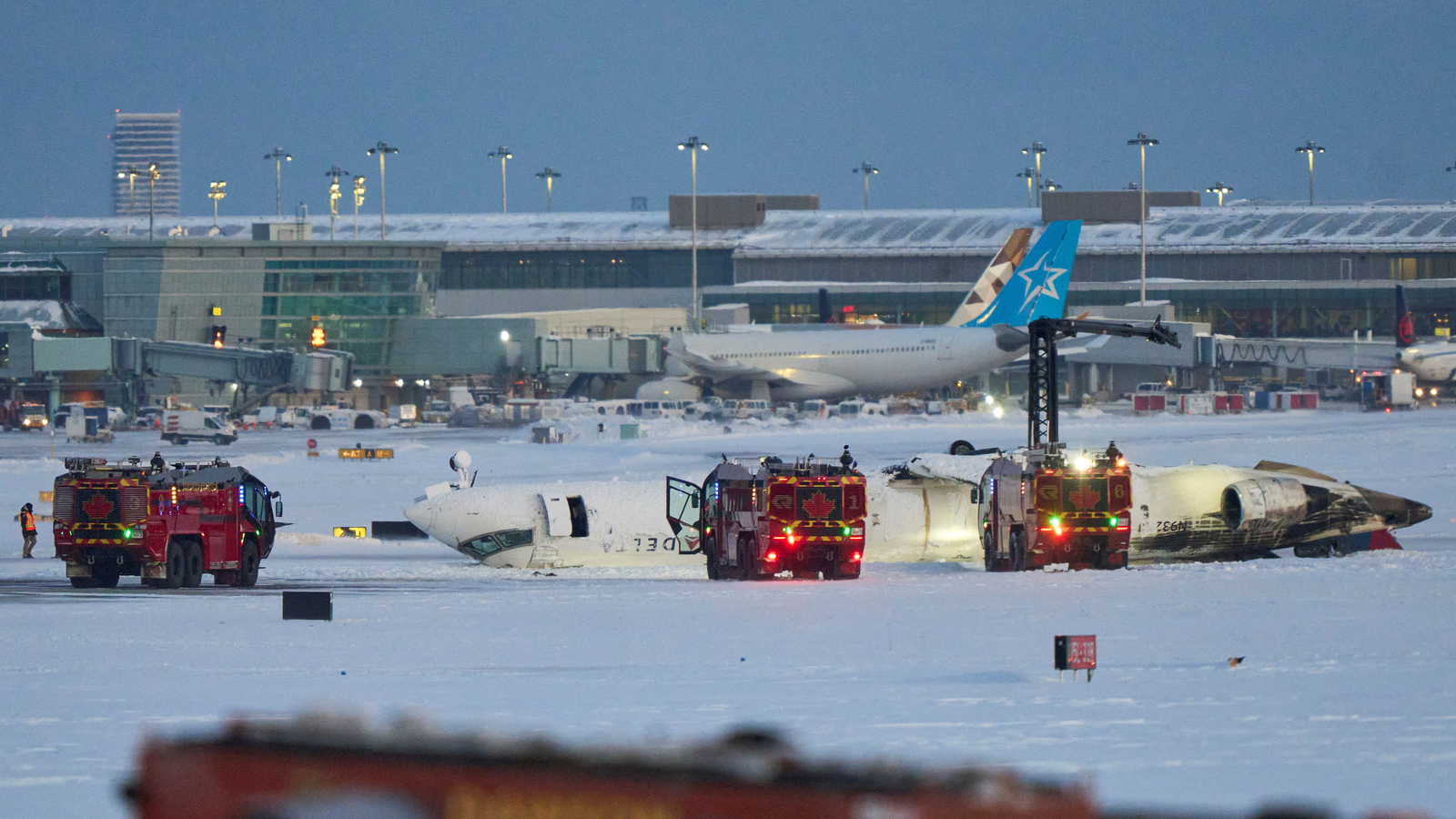
The shocking Delta Flight 4819 crash at Toronto Pearson International Airport has captured global attention after dramatic video footage surfaced showing the exact moment the regional jet burst into flames, bounced violently across the runway, and flipped upside down upon landing. The incident, which occurred on a Monday afternoon, has since become one of the most talked-about aviation accidents in recent memory,largely because of the extraordinary outcome: all 80 people on board survived.
What makes this crash particularly remarkable is not just the severity of the accident, but the fact that investigators now possess vivid, real-time video evidence showing precisely how the aircraft came to rest inverted on the snow-covered tarmac. This footage, which has been turned over to aviation safety authorities, offers an unprecedented look into the chaotic final seconds of the flight.
What Happened During the Landing
Delta Flight 4819, operated by regional carrier Endeavor Air, had departed from Minneapolis and was on approach to Toronto Pearson International Airport when it encountered serious trouble on touchdown. According to the dramatic video reviewed by investigators, the aircraft made contact with the runway before erupting in flames. The jet then bounced violently along the pavement before ultimately overturning and skidding to a halt in an inverted position.
The aircraft involved was a Bombardier CRJ 900, a twin-engine regional jet commonly used for short to medium-haul flights across North America. The plane came to rest upside-down on the snow-covered runway, a scene that could easily have resulted in mass casualties under different circumstances.
The Moment Everything Went Wrong
Eyewitness accounts combined with the video evidence paint a terrifying picture of the crash sequence. Witnesses near the airport reported seeing the plane touch down, immediately catch fire, and then begin a violent series of bounces before rolling over completely. The speed at which the situation deteriorated left little time for the flight crew to react.
Aviation experts reviewing the video footage have noted that the initial touchdown appeared normal before something went catastrophically wrong,possibly related to landing gear failure, crosswinds, or runway conditions. The Transportation Safety Board of Canada (TSB) is leading the investigative effort, with teams from the U.S. Federal Aviation Administration (FAA) and the National Transportation Safety Board (NTSB) assisting in the inquiry.
Survivors and Injuries
In what can only be described as a miraculous outcome, all 76 passengers and four crew members aboard the aircraft survived the crash. However, the physical and emotional toll was significant. At least 21 individuals were transported to area hospitals for treatment of various injuries, with the majority suffering non-life-threatening conditions. By Tuesday morning, Delta confirmed that 19 of those hospitalized had already been released.
One survivor described the terrifying scene inside the cabin after the plane flipped on the runway, comparing the experience to “hanging like bats.” Once the aircraft came to rest upside-down, passengers and crew found themselves suspended by their seatbelts in the inverted cabin, with smoke, debris, and confusion surrounding them. The orderly evacuation that followed is being credited to the training and composure of the flight crew, who managed to get everyone out safely despite the chaotic conditions.
A Community Response
First responders from across the Greater Toronto Area converged on Toronto Pearson International Airport within minutes of the crash. Firefighters, paramedics, and airport emergency personnel worked in challenging conditions,including snow-covered ground and sub-zero temperatures,to extract passengers from the overturned aircraft and provide immediate medical care.
The Aircraft and Its Operator
The CRJ 900 involved in this incident was operated by Endeavor Air, a wholly-owned subsidiary of Delta Air Lines that primarily flies regional routes throughout the United States and Canada. The CRJ 900 is one of the most widely used regional jets in North America, with hundreds of units operated by various carriers globally.
Delta Air Lines has grounded the specific aircraft involved in the crash as investigators work to determine the cause. The airline has also committed to cooperating fully with all regulatory bodies investigating the incident. Maintenance records, pilot histories, and flight data are all expected to play crucial roles in determining what caused this Delta Flight 4819 crash.
Investigation Details and Contributing Factors
Investigators from multiple agencies are now working together to piece together what went wrong. The TSB of Canada is the lead authority, given that the crash occurred on Canadian soil, but the involvement of both the FAA and NTSB reflects the cross-border nature of regional aviation.
Weather and Runway Conditions
One significant area of focus is the weather conditions at the time of the accident. Reports indicate that Toronto Pearson International Airport experienced “extreme conditions” in the days leading up to the crash, including significant snowfall and icy runways. Investigators will be looking closely at whether runway contamination, braking action, or crosswind components contributed to the accident sequence.
Winter operations present unique challenges for aviation, and even small miscalculations during landing can have catastrophic consequences. The CRJ 900, like all commercial aircraft, is designed to handle adverse weather conditions, but the combination of factors at play on the day of the crash will need to be carefully analyzed.
Video Evidence as a Key Investigative Tool
The dramatic video footage showing the crash sequence has already proven invaluable to investigators. Such clear documentation of an aircraft accident is relatively rare and may help answer crucial questions about the timing of the fire, the nature of the bounces, and the precise moment of inversion. Frame-by-frame analysis could reveal whether there was a mechanical failure, pilot input error, or environmental factor that triggered the chain of events.
Delta’s Response and Corporate Statement
Delta Air Lines CEO Ed Bastian addressed the incident publicly, expressing the airline’s commitment to supporting everyone affected by the crash. In a statement, Bastian emphasized that the company’s “most pressing priority remains taking care of all customers and Endeavor crew members who were involved.”
“We’ll do everything we can to support them and their families in the days ahead,” Bastian continued, “and I know the hearts, thoughts, and prayers of the entire Delta community are with them. We are grateful for all the first responders and medical teams who have been caring for them.”
Delta has also established dedicated support channels for passengers and their families, including crisis counseling services and assistance with travel arrangements, medical bills, and other needs arising from the crash.
Broader Implications for Aviation Safety
While the primary focus remains on the well-being of those involved in the Delta Flight 4819 crash, this incident is also likely to prompt broader discussions about regional aircraft safety, winter operations, and emergency response protocols. The Bombardier CRJ 900 fleet, in particular, may come under increased scrutiny in the weeks and months ahead.
Lessons That Could Emerge
Every aviation accident, no matter how survivable, contributes to the industry’s ongoing effort to improve safety. Investigators will be looking at several key questions:
- What caused the initial fire? Understanding whether the fire preceded or resulted from the runway impact is crucial.
- Why did the aircraft bounce? Multiple bounces during landing can indicate issues with pilot technique, aircraft configuration, or runway conditions.
- Were there any prior maintenance concerns? A thorough review of the aircraft’s maintenance history may reveal underlying issues.
- Did weather play a decisive role? The extreme conditions reported in the days before the crash will be carefully analyzed.
Findings from this investigation could lead to new safety recommendations affecting not just Delta and Endeavor Air, but potentially the entire regional aviation industry.
Conclusion
The Delta Flight 4819 crash at Toronto Pearson International Airport is a sobering reminder of both the risks inherent in aviation and the remarkable resilience of modern aircraft design and emergency response systems. The fact that all 80 people on board survived a crash severe enough to invert the aircraft on the runway is nothing short of extraordinary,and a testament to the safety protocols, crew training, and engineering standards that define modern commercial aviation.
As the investigation continues, with the TSB, FAA, and NTSB working in coordination, more details will emerge about what exactly caused this terrifying sequence of events. For now, the aviation community, the passengers involved, and their families can take some comfort in the knowledge that the worst-case scenario was avoided. The dramatic video that captured the crash will undoubtedly serve as an important tool in understanding exactly what happened,and, ultimately, in helping prevent similar incidents from occurring in the future.