
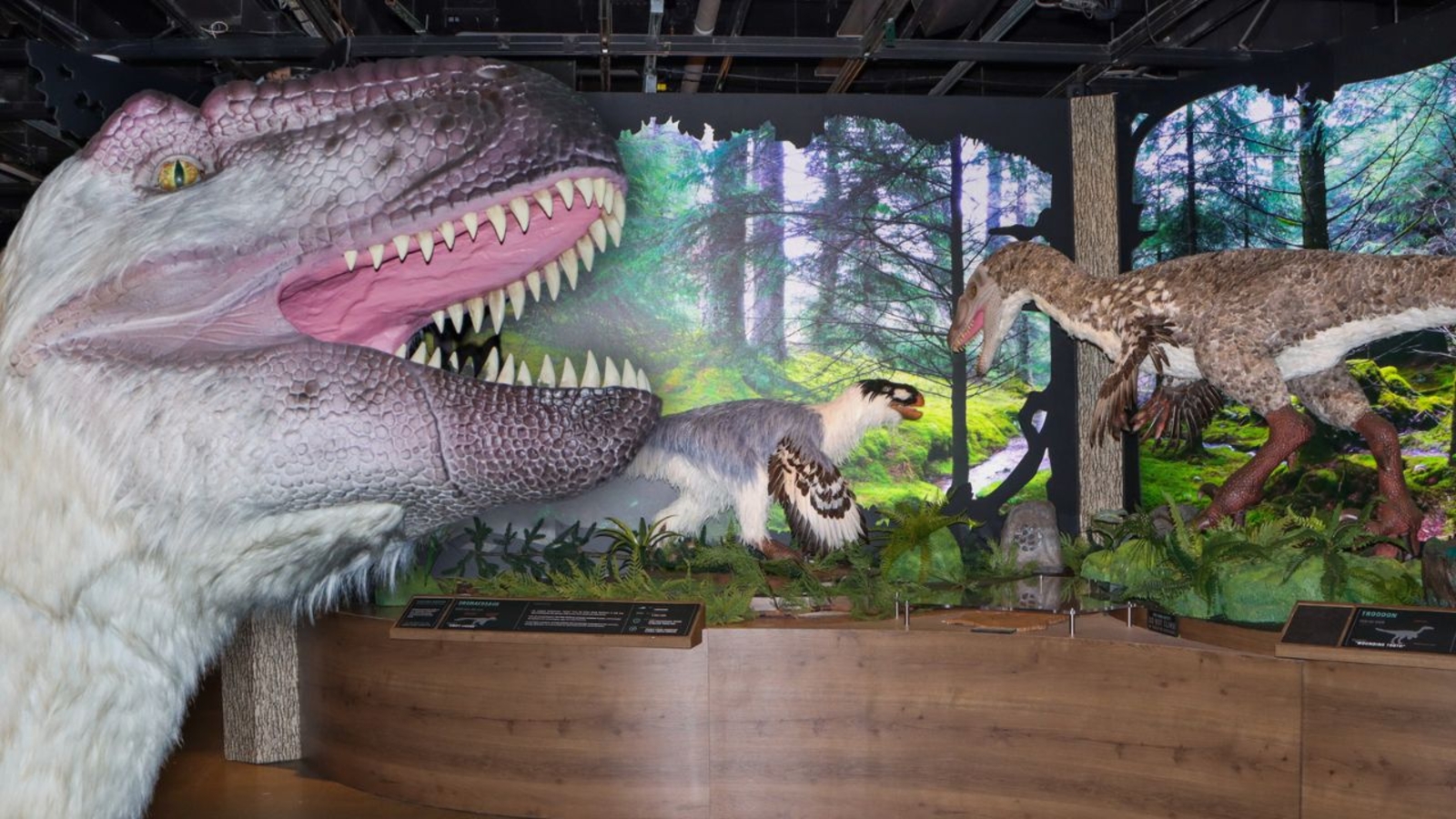
If you’re fascinated by the ancient creatures that once roamed our planet, the Ice Dinosaurs exhibit at The Academy of Natural Sciences of Drexel University in Philadelphia offers an unforgettable journey into a world most people never imagined. This groundbreaking attraction transports visitors millions of years back in time to prehistoric Alaska, recreating a frozen landscape teeming with life during the Mesozoic Era. Far from the icy, lifeless tundra we associate with Alaska today, this prehistoric wilderness was once a thriving ecosystem where remarkable dinosaurs adapted to seasonal extremes. The exhibit combines cutting-edge animatronic technology with scientific accuracy to deliver one of the most immersive dinosaur experiences available on the East Coast.
A Frozen World Reimagined: What the Ice Dinosaurs Exhibit Reveals
Most people picture dinosaurs roaming lush tropical jungles and steamy swamps, but groundbreaking paleontological research has revealed that many species thrived in environments far colder than anyone previously imagined. The Ice Dinosaurs exhibit challenges these long-held assumptions by showcasing dinosaurs that lived in ancient Alaska during the Late Cretaceous period, when the region experienced dramatic seasonal changes ranging from warm, sunlit summers to dark, freezing winters.
What makes this exhibition particularly compelling is its commitment to scientific authenticity. The recreations are based on actual fossil discoveries made in regions like the North Slope of Alaska, where paleontologists have uncovered evidence of hadrosaurs, ceratopsians, and even tyrannosaur relatives that endured months of near-darkness and snow. Visitors walk through carefully designed environments that reflect what scientists believe these landscapes looked like, complete with reconstructed vegetation, lighting effects that mimic seasonal shifts, and soundscapes featuring the calls and movements of the animals that once inhabited these lands.
The Science Behind Prehistoric Alaska
Paleontologists working in Alaska have made remarkable discoveries over the past few decades that fundamentally changed our understanding of dinosaur biology and adaptability. Excavations in the Prince Creek Formation and other remote sites have yielded a treasure trove of fossils, including:
- Duck-billed dinosaurs (hadrosaurs) that grew to impressive sizes despite the challenging climate
- Horned dinosaurs (ceratopsians) adapted to cold-weather foraging
- Small theropods that likely fed on prey populations during the brief Arctic summer
- Pachycephalosaurs and other unique species documented nowhere else on Earth
These finds suggest that some dinosaurs were warm-blooded or at least possessed metabolic adaptations that allowed them to survive in environments where temperatures plunged well below freezing for extended periods. The Ice Dinosaurs exhibit brings this fascinating research to life in ways that traditional museum displays simply cannot match.
Animatronic Dinosaurs Bring Prehistory to Life
At the heart of the Ice Dinosaurs exhibit lies a stunning collection of animatronic dinosaurs that push the boundaries of what museum-goers can experience. Unlike static skeletons or traditional mounted fossils, these mechanical marvels combine robotics, materials science, and paleontological artistry to create creatures that move, breathe, and behave with startling realism.
The animatronic dinosaurs featured in this exhibition incorporate sophisticated engineering that allows them to perform a range of natural movements. Watch their heads turn slowly to survey their surroundings, observe subtle breathing motions that suggest living animals, and listen as they produce scientifically informed vocalizations based on what researchers believe these creatures may have sounded like. The level of detail extends to skin texture, coloration patterns, and proportional accuracy, all informed by the latest research into dinosaur appearance and behavior.
Engineering Meets Paleontology
Creating a convincing animatronic dinosaur requires collaboration between paleontologists, engineers, artists, and computer programmers. Each creature in the Ice Dinosaurs exhibit represents hundreds of hours of careful design work, starting with skeletal reconstructions based on actual fossil evidence. From there, artists add layers of musculature and skin, while engineers program movement sequences that reflect current theories about dinosaur locomotion and behavior.
The result is a collection of prehistoric creatures that feel genuinely alive. Visitors often report moments of genuine surprise when a seemingly inanimate dinosaur suddenly turns its head or emits a low growl. This immersive quality makes the Ice Dinosaurs exhibit particularly valuable for educational purposes, helping visitors of all ages connect emotionally with creatures that lived millions of years before humans appeared on Earth.
An Immersive Journey Through the Seasons
One of the most innovative aspects of the Ice Dinosaurs exhibit is its treatment of seasonal change. Ancient Alaska was not a uniformly cold environment; rather, it experienced dramatic shifts between long summer days when the sun barely set and winter months of complete darkness. The exhibit recreates these conditions through carefully designed lighting, temperature variations in viewing areas, and seasonal soundscapes that immerse visitors in the experience of being in this ancient world.
As you move through the exhibit spaces, you’ll encounter environments that transform around you. Summer sections feature brighter lighting and the sounds of flowing water and active wildlife, while winter displays evoke the quiet stillness of snow-covered landscapes. This seasonal storytelling approach helps visitors understand how dinosaurs adapted to extreme conditions and what challenges they faced throughout the year.
The Sounds and Sights of a Lost World
The immersive quality of the Ice Dinosaurs exhibit extends well beyond what visitors can see. The exhibit incorporates carefully designed audio elements that bring the prehistoric environment to life. Visitors hear the calls of different dinosaur species, the rustle of vegetation in ancient forests, and ambient sounds that suggest a thriving ecosystem. These auditory elements complement the visual experience and help create a multi-sensory journey through deep time.
For families with children, this multi-sensory approach proves especially effective at capturing young imaginations. Kids who might quickly lose interest in traditional fossil displays find themselves completely captivated by dinosaurs that move and sound like living creatures. Many parents report that their children remember their visit to the Ice Dinosaurs exhibit long after other museum experiences have faded.
Why This Exhibit Matters for Science Education
The Ice Dinosaurs exhibit represents more than entertainment; it serves as a powerful educational tool that communicates complex scientific concepts to general audiences. By presenting dinosaurs as living animals within their environmental context, the exhibit helps visitors understand key principles of evolutionary biology, paleontology, and ecology.
Visitors leave with a deeper appreciation for several important scientific ideas:
- Dinosaur diversity and adaptation – How different species evolved to fill specific ecological niches
- Climate science and deep time – How Earth’s climate has changed dramatically over geological timescales
- The scientific method – How paleontologists gather evidence to reconstruct ancient ecosystems
- Conservation awareness – How understanding past climate change can inform our response to current environmental challenges
Accessibility for All Ages
The Academy of Natural Sciences has designed the Ice Dinosaurs exhibit to engage visitors across a wide range of ages and knowledge levels. Younger children experience the wonder of seeing giant creatures move and roar, while older students and dinosaur experts can appreciate the scientific accuracy embedded in every detail. Educational signage throughout the exhibit provides context and deeper information for those who want to learn more, while hands-on elements allow tactile engagement with concepts like fossil identification and dinosaur anatomy.
Planning Your Visit to the Ice Dinosaurs Exhibit
Located at The Academy of Natural Sciences of Drexel University in Philadelphia, the Ice Dinosaurs exhibit is accessible to visitors throughout the Mid-Atlantic region and beyond. The museum has a long history of presenting innovative natural history exhibits, and this particular installation continues that tradition of combining scientific rigor with public engagement.
When planning your visit, consider arriving early to avoid peak crowds, particularly on weekends and school holidays. The immersive nature of the exhibit means that visitors typically spend considerable time moving through the spaces, allowing the experience to unfold gradually. Many visitors find that returning to favorite sections reveals new details they missed on first viewing.
Beyond the Ice Dinosaurs: Other Academy Highlights
While the Ice Dinosaurs exhibit stands as a major attraction, The Academy of Natural Sciences offers numerous other permanent and rotating displays worth exploring during your visit. From the famous dinosaur hall featuring mounted fossil skeletons to live animal exhibits and interactive science demonstrations, the museum provides a full day of educational entertainment that complements the Ice Dinosaurs experience perfectly.
The Lasting Impact of Experiencing Prehistoric Life
Encountering the Ice Dinosaurs exhibit leaves a lasting impression on most visitors. There’s something fundamentally different about standing before a creature that moves and breathes compared to examining a skeleton behind glass. The experience creates emotional connections that transform abstract scientific knowledge into vivid memories.
For paleontology enthusiasts, the exhibit offers a chance to see scientific theories translated into tangible form. For families, it provides shared experiences that spark conversations about science, history, and our planet’s past. For casual visitors, it delivers the simple wonder of witnessing something remarkable. In all these cases, the Ice Dinosaurs exhibit succeeds because it treats visitors as curious minds eager to engage with genuine scientific discovery.
The combination of animatronic technology, immersive design, and rigorous scientific content makes this exhibit a standout destination for anyone interested in natural history. By revealing the surprising story of dinosaurs that thrived in ancient Alaska, the exhibition expands our understanding of what these remarkable animals were capable of and how they adapted to environments far more varied than we ever imagined. Whether you’re a lifelong dinosaur devotee or simply curious about prehistoric life, the Ice Dinosaurs exhibit promises an experience that educates, inspires, and stays with you long after you’ve returned to the present day.