
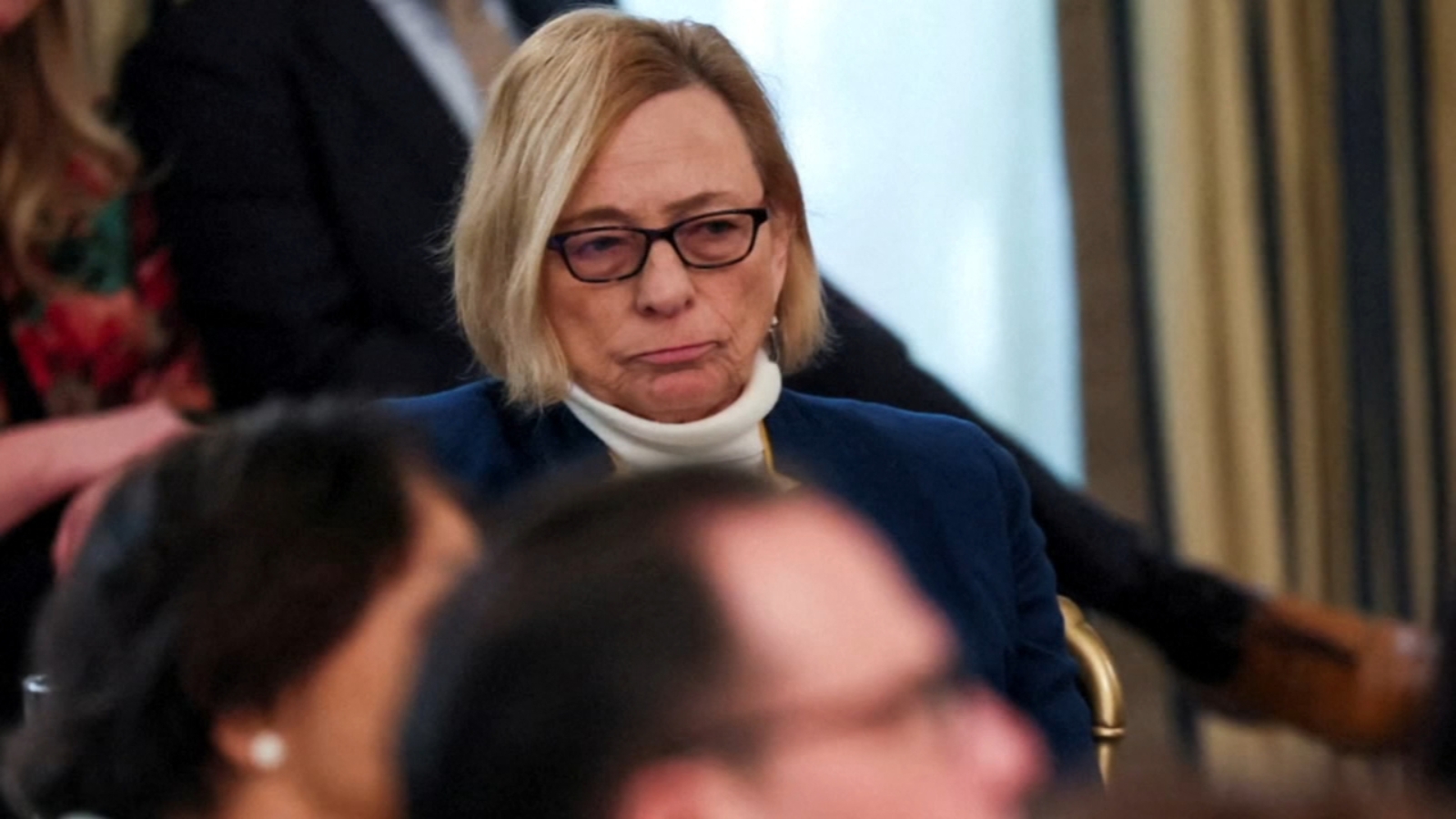
The transgender athletes funding battle between President Donald Trump and Maine Governor Janet Mills has become one of the most high-profile confrontations in the ongoing national debate over women’s sports, executive power, and state sovereignty. What unfolded at a recent White House gathering of bipartisan governors was more than a policy disagreement,it was a direct challenge that ended with both sides promising legal warfare.
The exchange, brief but pointed, crystallized the tension between federal enforcement of Title IX interpretations and a Democratic governor’s refusal to comply. It also set the stage for what could become a landmark legal confrontation over the limits of presidential authority to withhold federal money from states that resist federal mandates.
How the White House Clash Unfolded
During a meeting with governors from across the political spectrum, President Trump turned his attention directly to Governor Mills and questioned whether Maine would comply with his recently signed executive order restricting transgender athletes from competing in women’s sports.
“Are you not going to comply with that?” Trump asked, according to the exchange.
Mills replied that she intends to follow both state and federal laws. Trump then asserted federal supremacy, stating, “We are the federal law,” before delivering an unmistakable warning: Maine would receive no federal funding unless it fell in line with the order.
The governor’s response was immediate and unflinching. “See you in court,” she told the President.
Trump welcomed the challenge, predicting a swift legal victory and even suggesting Mills’s political career might not survive the confrontation. The exchange, captured in front of dozens of state leaders, immediately drew national attention and highlighted just how combustible the issue of transgender athletes funding has become.
The Executive Order at the Center of the Controversy
The flashpoint traces back to the “Keeping Men Out of Women’s Sports” executive order Trump signed earlier this year. The directive instructs federal agencies to interpret Title IX,the federal civil rights law prohibiting sex-based discrimination in education,as a prohibition against transgender girls and women participating in female sports categories.
Supporters argue the order is necessary to preserve competitive fairness and opportunities for female athletes who have trained and competed within established categories for decades. Critics counter that the policy excludes transgender students without addressing underlying discrimination and that the executive branch is overstepping its authority into areas traditionally managed by state and local school boards.
For the federal government, the funding threat is the primary enforcement mechanism. By tying compliance to federal dollars, the administration is leveraging its budgetary power to push states toward alignment with its interpretation of Title IX.
Maine’s Response and the Legal Stakes
Following the White House confrontation, Governor Mills released a formal statement doubling down on her position. She warned that if the President moves to strip federal funding from Maine schools, her administration and the state Attorney General would pursue “all appropriate and necessary legal action” to restore those resources.
“The State of Maine will not be intimidated by the President’s threats,” Mills declared.
The legal question at the heart of this dispute centers on the conditions under which the federal government can attach funding requirements to state compliance. Federal funding conditions must generally meet several constitutional tests, including being related to the federal interest in the spending program and not being unduly coercive. Maine’s potential lawsuit would likely argue that the Trump administration’s funding cutoff violates these principles.
Legal scholars note that the Supreme Court has historically given Congress,and by extension, the executive branch,wide latitude to set conditions on federal grants, particularly when those conditions are tied to the purpose of the funding itself. However, courts have also struck down conditions deemed coercive or unrelated to federal objectives.
The Department of Education’s Directed Investigation
On the same day as the White House exchange, the Department of Education escalated the situation further by sending a formal letter to a Maine education official. The letter announced a “directed investigation” of the Maine Department of Education, citing allegations that the state continues to permit male athletes to compete in girls’ interscholastic athletics.
The department specifically referenced a Maine high school that allegedly is still allowing at least one male student to compete in girls’ categories. This investigation represents a separate but parallel front in the federal-state conflict, potentially leading to enforcement actions beyond just funding restrictions.
Such investigations can result in findings of Title IX violations, which may carry their own consequences, including potential loss of federal education funding or mandated policy changes.
Broader Context: NCAA Policy Shift and Related Legal Battles
The confrontation comes amid a broader recalibration of policies governing transgender participation in sports. The NCAA recently revised its transgender policy, limiting women’s competition to athletes assigned female at birth. This shift aligns with the federal direction but has drawn criticism from advocates who argue it excludes transgender women without sufficient scientific or ethical justification.
Meanwhile, the Trump administration has pursued other transgender-related executive actions that have faced judicial pushback. A federal judge recently paused a separate executive order restricting gender-affirming care for transgender youth, signaling that courts remain willing to scrutinize administration policies in this space.
These parallel developments illustrate that the transgender athletes funding dispute is not isolated,it is part of a sweeping federal agenda that is encountering resistance at multiple levels of government and the judiciary.
Why This Fight Matters Beyond Maine
While Maine is the immediate target, the outcome of this confrontation will have implications far beyond a single New England state. Governors across the country are watching closely, as are state education officials, athletic directors, and families of transgender athletes.
If the federal government successfully pressures Maine into compliance through funding restrictions, it could establish a powerful precedent for shaping policy in other states. Conversely, if Maine succeeds in court, it could reinforce the principle that states retain meaningful authority over education and athletic policy even when federal money is involved.
The dispute also raises practical questions about how schools and athletic programs will navigate conflicting guidance from federal agencies, state governments, and courts. Many institutions find themselves caught between compliance with one set of rules and potential violations of another.
The Political Dimensions
Beyond the legal and policy questions, the exchange carries significant political weight. Trump’s pointed remark about Mills’s future in elected politics suggested that the administration views this fight as not just a constitutional matter but a political battle. For Democratic governors, the issue tests their willingness to publicly resist federal mandates. For Republican leaders, it demonstrates the administration’s willingness to use executive power aggressively.
The issue also energizes both bases of the political spectrum. Supporters of the executive order see it as a long-overdue stand for women’s sports. Opponents view it as discriminatory federal overreach that targets a vulnerable minority population.
As legal proceedings unfold, expect both sides to frame the fight in the most compelling terms possible,fairness versus inclusion, federal authority versus state rights, and constitutional limits versus executive power.
Conclusion: A Defining Moment for Federal-State Relations
The confrontation between President Trump and Governor Janet Mills represents more than a policy disagreement over transgender athletes funding. It is a defining test of how far the executive branch can go in using federal dollars to compel state compliance with contested interpretations of civil rights law.
With Maine prepared to take the matter to court and the Department of Education opening formal investigations, the legal battle lines are firmly drawn. Schools, athletes, and families across the country will be watching as this case progresses through the courts, knowing that the eventual ruling could reshape the balance between federal authority and state independence for years to come.
Regardless of where one stands on the underlying issue, the case underscores a fundamental reality of American federalism: when federal and state governments disagree, the courts,not the Oval Office,ultimately decide who wins. Governor Mills has made clear she intends to let the judiciary make that call.